
 admin
admin 
ZetaChain (ZETA) is the first Universal Blockchain that provides native access to all blockchain ecosystems. It brings programmability to non-smart contract chains such as Bitcoin and Dogecoin, enabling developers to create truly interoperable applications without compromising security or user experience. Built with Cosmos SDK and CometBFT, ZetaChain operates with 5-second finality, Core and Observer-Signer validators, and incentive mechanisms that prioritize security across all connected chains. With Universal EVM, Universal Smart Contract, and the ZRC-20 token standard, it offers cross-chain asset management, liquidity access, and a unified user experience. Funded with $27 million by investors such as GSR, CMT Digital, Blockchain.com, Jane Street Capital, LongHash Ventures, Sky9 Capital, Foundation Capital, TPC, LIF, Vy Capital, Human Capital, Krust, Vista Lab, and Kudasai, ZetaChain aims to make blockchains as accessible, diverse, and connected as the internet. In this article, we will examine in detail what ZetaChain is, how it works, its use cases, advantages, risks, tokenomics, team, and investors.
What is ZetaChain (ZETA)?
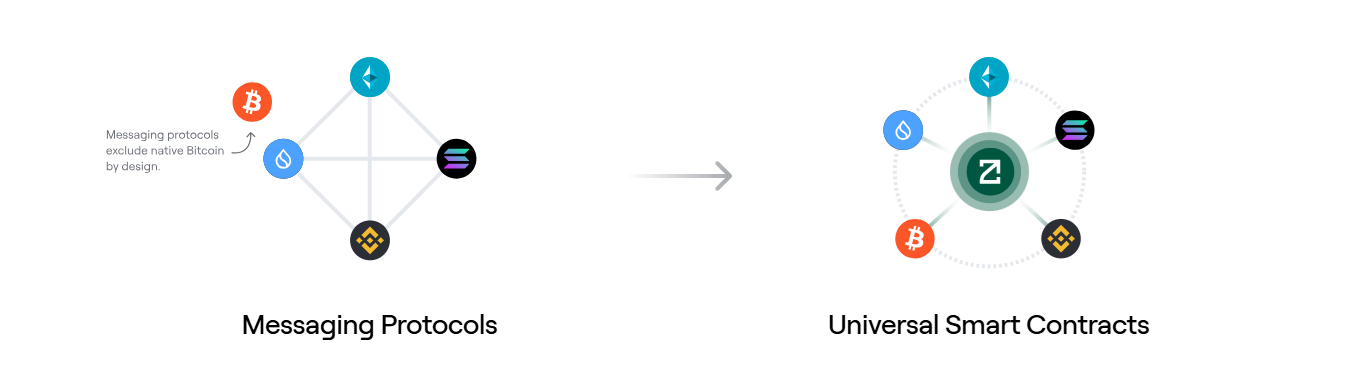
ZetaChain is designed as a Universal Blockchain that provides native access to every blockchain. It unifies Bitcoin, Ethereum, Solana, BNB Chain, TON, and more on a single platform, allowing developers to perform transactions across multiple chains with a single smart contract. ZetaChain supports calling EVM-compatible smart contracts from any chain with Universal EVM, reading/writing to all chains with Universal Smart Contract, and native asset transfers with the ZRC-20 token standard.
With its Hub-and-Spoke architecture, all cross-chain messages pass through ZetaChain, facilitating the integration of new chains and enforcing security rules from a single point. ZetaChain is built with Cosmos SDK, CometBFT, and Cosmos EVM, offering a modular structure, fast finality, and full EVM compatibility. It operates with ~4-second block times, hundreds of TPS capacity, and infrastructure specifically designed for secure cross-chain interactions.
Purpose of ZetaChain
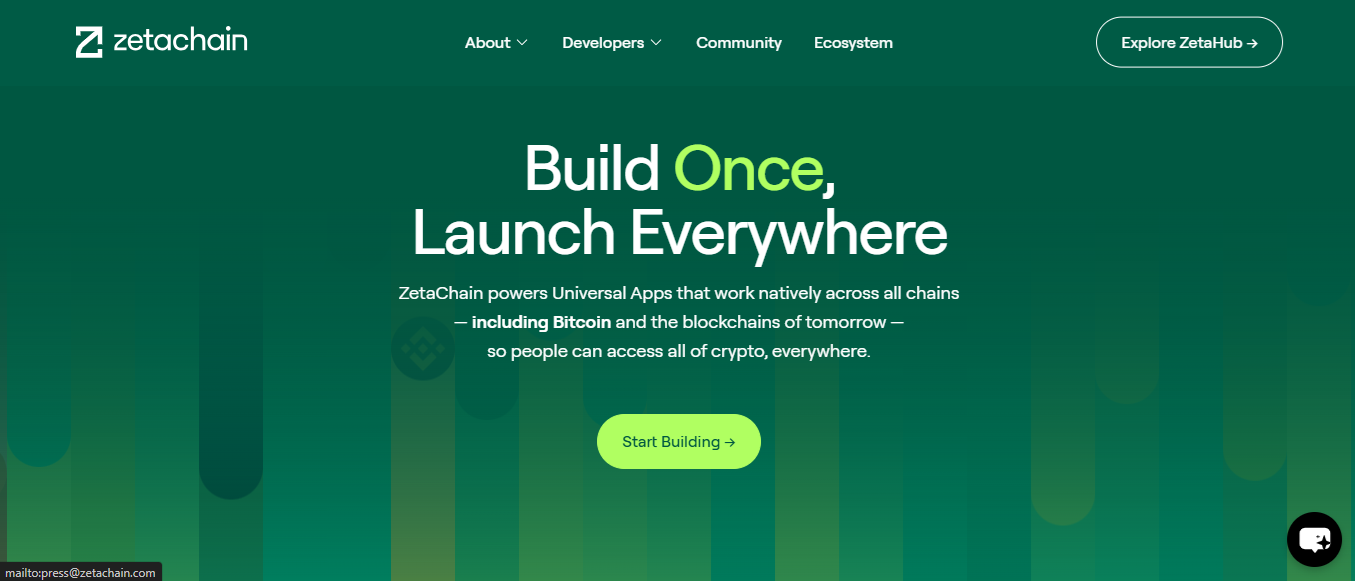
The blockchain revolution promised an open, borderless digital world controlled by its users. However, today, innovation is constrained by isolated ecosystems and technical boundaries, and users are trapped in digital silos. This fragmentation threatens the core promise of decentralization. ZetaChain aims to fulfill blockchain technology’s promise of openness and borderless innovation. As a Universal Blockchain, it seeks to become the Universal Entry Point to the decentralized world, providing true connectivity and freedom across all chains. It brings programmability to Bitcoin, unified liquidity to DeFi, and universal digital ownership to social applications. ZetaChain removes barriers between chains, making cryptocurrency as accessible and connected as the internet.
How Does ZetaChain Work?
ZetaChain operates with a Hub-and-Spoke architecture:
-
Hub: ZetaChain, the main layer coordinating all cross-chain activities.
-
Spokes: External chains such as Ethereum, Solana, Sui, TON, and Bitcoin, connected via standardized protocols.
All cross-chain messages and transactions pass through ZetaChain, ensuring consistent processing, easy chain integration, and single-point security enforcement.
Validators:
-
Core Validators: Run ZetaChain nodes, participate in CometBFT consensus, and produce blocks. Open to anyone staking the required ZETA. Incentivized with transaction fees and rewards; subject to slashing for malicious behavior.
-
Observer-Signer Validators: Run both ZetaChain nodes and ZetaClient. Monitor cross-chain events on connected chains, vote on validity, and coordinate outbound transactions upon majority approval. Sign using Threshold Signature Scheme (TSS); no single validator controls the private key.
Modules:
-
CrossChain Module: Manages the state and lifecycle of cross-chain transactions (CCTX). Creates new CCTX records upon validation of inbound events, updates statuses, and stores inbound/outbound parameters.
-
Observer Module: Manages the observer set, voting mechanisms, and consensus policies. Maintains a list of authorized observers, creates ballots for each event, and defines thresholds and supported chain parameters.
-
Fungible Module: Deploys ZRC-20 tokens representing assets from connected chains, manages liquidity pools, and enables calls to omnichain smart contracts from ZetaChain.
-
Emissions Module: Distributes rewards to observers, validators, and TSS signers based on participation metrics from a pre-funded pool.
-
Authority Module: Handles administrative functions and permission checks. Maintains admin groups and permissions, ensuring only authorized entities perform sensitive actions.

Protocol Contracts:
-
On ZetaChain:
-
GatewayZEVM: Primary entry point for outbound transactions. Handles asset withdrawals, external contract calls, and ZRC-20 mint/burn logic.
-
ZRC-20: ERC-20-compliant tokens representing assets from connected chains.
-
ContractRegistry: Stores metadata for deployed protocol contracts.
-
-
On Connected EVM Chains:
-
GatewayEVM: Entry point for inbound transactions. Handles deposits, calls to ZetaChain, and emits events for observers.
-
ERC20Custody: Stores ERC-20 assets deposited for cross-chain transfers.
-
ContractRegistry: Provides metadata for protocol contracts on the connected chain.
-
Cross-Chain Transaction Flow:
-
Inbound (Connected Chain → ZetaChain): User interacts with gateway contract → Observers detect event → Voting on ZetaChain → Majority approval updates CCTX, mints assets, calls target contract.
-
Outbound (ZetaChain → Connected Chain): GatewayZEVM is called → Validators process request → TSS signing → Transaction broadcast to destination → Success completes; failure triggers revert.
Use Cases
Project is used in the following areas:
-
Bitcoin: Native DeFi interactions, new yield opportunities without intermediaries, securely integrating Bitcoin into the broader crypto economy.
-
DeFi: Unified liquidity and execution hub; DEXs, yield aggregators, stablecoins, money markets.
-
Social, Gaming, NFT: Minting, trading, and managing digital assets across any blockchain; simple interoperability for creators, collectors, and players.
-
Infrastructure: Decentralized, secure foundation; institutional-grade reliability with leading validators.
Usage Steps:
-
Connect to ZetaChain with MetaMask.
-
Bridge assets or transact directly with ZETA.
-
Develop Universal Smart Contracts with Solidity.
-
Call from any chain and access liquidity.
-
Transfer native assets with ZRC-20.
Advantages of ZetaChain
-
Chain Orchestration: Multi-chain operations with a single contract.
-
Forward Compatibility: Automatic compatibility when new chains are added.
-
Native Token Transfer: No wrapped assets, unified liquidity pools.
-
Familiar Developer Experience: Solidity, Foundry, Hardhat, Ethers.js support.
-
Gasless EVM: Gas only on the calling chain, free execution on ZetaChain.
-
Security: TSS, slashing, bonded stake for economic security.
ZetaChain Tokenomics
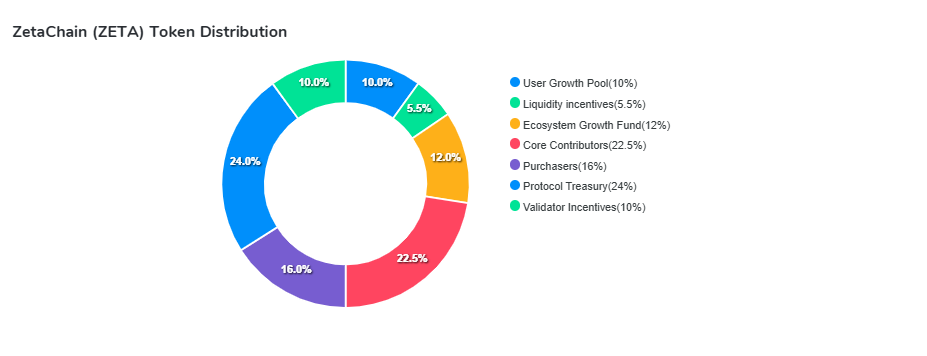
ZETA Token Information:
-
Token Name: ZETA
-
Total Supply: 2,100,000,000
-
Distribution:
-
User Growth Pool: 10% (210M) – User growth, airdrops, wallet campaigns.
-
Ecosystem Growth Fund: 12% (252M) – Developer grants, partnerships.
-
Validator Incentives: 10% (210M) – 4-year block rewards.
-
Liquidity Incentives: 5.5% (115.5M) – Liquidity incentives.
-
Protocol Treasury: 24% (504M) – Insurance, bug bounties, development.
-
Core Contributors: 22.5% (472.5M) – Team.
-
Purchasers and Advisors: 16% (336M) – Investors, advisors.
-
-
Inflation: ~2.5% annual target after 4 years.
-
Token Anchoring (October 23, 2024): 1.5B ZETA permanently anchored to ZetaChain; maximum 600M transferable to Ethereum.
ZETA Use Cases:
-
Gas for ZetaChain EVM.
-
Intermediary asset in cross-chain messaging (burn/mint).
-
Exchange in core pools for outbound gas payments.
-
Validator staking and delegation.
-
Governance voting.
ZetaChain Investors
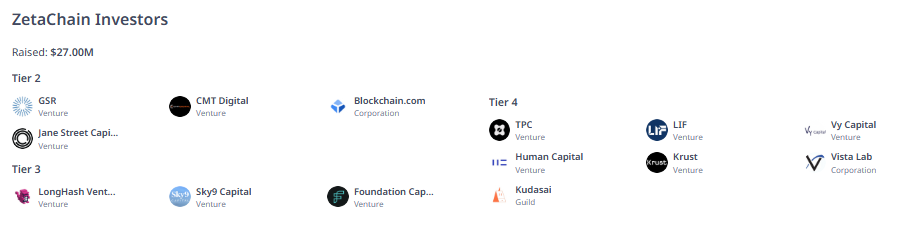
Raised $27 million:
-
Tier 2: GSR, CMT Digital, Blockchain.com, Jane Street Capital.
-
Tier 3: LongHash Ventures, Sky9 Capital, Foundation Capital.
-
Tier 4: TPC, LIF, Vy Capital, Human Capital, Krust, Vista Lab, Kudasai.
Technical Infrastructure
-
Universal EVM: Callable from any chain, built-in interoperability.
-
Universal Smart Contract: Natively deployed on ZetaChain, reads/writes to all chains.
-
Universal NFT/Token Standard: ERC-721/ERC-20 assets minted on any chain, transferred across. Burned on source, minted on destination. Persistent ID, revert support.
-
TSS Addresses: Decentralized management by validators, asset custody.
-
Core Liquidity Pools: ZETA and other assets for cross-chain gas payments.
Future of ZetaChain
With mainnet, project will become a universal platform uniting all chains. It will bring smart contracts to Bitcoin, unlimited liquidity to DeFi, and universal ownership to NFTs. Developers will work across all chains with a single contract; users will transfer assets without intermediaries. ZetaChain will make blockchains as connected, accessible, and diverse as the internet.
ZetaChain Team
-
Ankur Nandwani (Co-Founder): Vision and strategy.
-
Charlie Pyle (Co-Founder): Technical leadership.
-
Charlie McCowan (Head of Cyber Security and DevOps): Security infrastructure.
-
Jonathan Covey (Head of Community): Community growth.
-
Denis Fadeev (Head of Developer Experience): Developer tools.
-
Michelle Kang (Marketing Advisor): Brand and communication.

Official Links
You can also freely share your thoughts and comments about the topic in the comment section. Additionally, don’t forget to follow us on our Telegram, YouTube, and Twitter channels for the latest news and updates.