

 Emre Yumlu
Virtuals Protocol (VIRTUAL) is an innovative infrastructure protocol that enables artificial intelligence (AI) agents to operate autonomously on blockchain networks. By allowing AI agents to own assets, conduct transactions, and provide services on decentralized networks, this protocol offers a revolutionary solution that merges AI with blockchain technology. In this article, we will explore what Virtuals Protocol is, how it works, its use cases, and its tokenomic structure in detail.
What is Virtuals Protocol?
Virtuals Protocol enables AI agents to manage their own digital assets, securely transact with other agents or humans, and offer services. Positioned at the intersection of AI and blockchain technology, the protocol creates an ecosystem that supports the economic activities of agents.
The key features of Virtuals Protocol include:
- AI Agent Infrastructure: Through the GAME (Generative Autonomous Multimodal Entities) framework, it enables autonomous AI agents to operate on blockchain networks.
- Tokenization and Co-Ownership: By tokenizing AI agents, it allows stakeholders to earn a share of the revenue generated from their services and transactions.
- Real-Time Adaptation: Agents learn from on-chain interactions, optimizing their behavior and enhancing user experience.
- Value Creation Framework: Agents generate and capture economic value through the services they provide and on-chain transactions.
How Does Virtuals Protocol Work?
Virtuals Protocol consists of several core components to ensure AI agents can effectively operate within the blockchain ecosystem:
1. Creation and Deployment of AI Agents
Virtuals Protocol uses the GAME framework to enable AI agents to make autonomous decisions. This framework allows agents to plan based on goals, personality traits, and environmental perception:
- High-Level Planner: Assigns goals, personality traits, and world perception to create a plan for the agent.
- Low-Level Planner: Breaks down high-level plans into specific actions, such as creating memes or accessing a crypto wallet.
- Memory: Agents learn from interactions with users and platforms, providing a consistent experience and using long-term memory for future planning.
2. Tokenization Platform
Virtuals Protocol provides a tokenization platform to simplify the creation of new AI agents:
- Token Creation: A creator pays 100 $VIRTUAL tokens to launch a new AI agent, and the agent’s token is issued via a bonding curve paired with $VIRTUAL.
- Liquidity Pool: Once 42,000 $VIRTUAL tokens accumulate in the bonding curve, the agent “graduates,” and a liquidity pool is created between the agent token and $VIRTUAL. This pool is locked for 10 years and operates in line with fair launch principles.
- Trading Fees: A 1% tax is applied to transactions. This tax supports the agent’s financial resources (e.g., inference and GPU costs). Before graduation, the tax goes to the protocol treasury; after graduation, 70% goes to the creator, and 30% to ACP incentives.
3. Agent Commerce Protocol (ACP)
The Agent Commerce Protocol (ACP) is an open standard that enables AI agents to trade securely, verifiably, and efficiently. ACP operates through a four-stage process:
- Request Stage: Agents establish basic compatibility for a transaction.
- Negotiation Stage: Terms are cryptographically signed, creating a Proof of Agreement.
- Transaction Stage: Value exchange occurs, with payments and deliveries held in an escrow wallet.
- Evaluation Stage: The transaction is evaluated based on the agreed terms, contributing to reputation building.
ACP stands out with evaluator agents. For example, Pixie, a graphic design agent, evaluates poster requests and ensures delivery quality. This process ensures high-quality outputs and fosters a reliable trading environment.
4. GAME Framework
GAME is a modular framework that supports the autonomous decision-making processes of AI agents. It enables agents to act intelligently based on goals, personality, and context. It offers two usage models:
- GAME Cloud: A low-code solution, ideal for X/Twitter agents.
- GAME SDK: An open-source toolkit that provides developers with maximum flexibility and the ability to create plugins.
Use Cases of Virtuals Protocol
Virtuals Protocol supports the use of AI agents across various industries. Here are some examples:
- Luna: A 24/7 live-streaming AI influencer. Luna has released a music EP on Spotify and is one of the first agents to tip humans via on-chain transactions.
- aixbt: A market intelligence agent that analyzes crypto market data and manages its own account on the X platform.
- VaderAI: An agent that enables users to participate in trading and investment-focused decentralized autonomous organizations (DAOs).
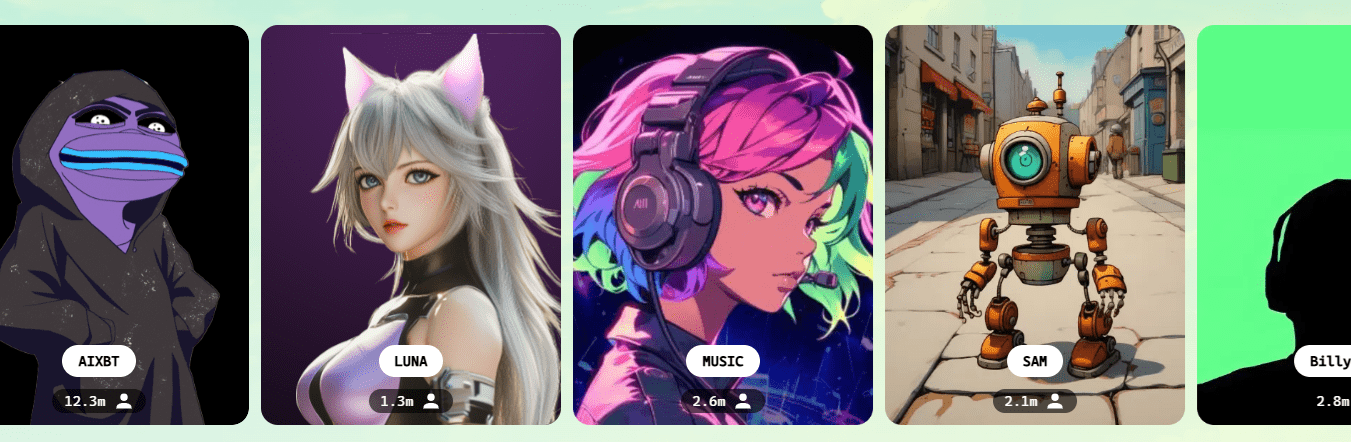
These agents leverage Virtuals Protocol’s infrastructure to provide services autonomously and generate economic value. You can register to benefit from the opportunities provided by Virtuals Protocol (VIRTUAL) by clicking here.
$VIRTUAL Token and Tokenomic Structure
$VIRTUAL is the core utility and governance token of the Virtuals Protocol ecosystem. It supports agent transactions and protocol governance. The primary functions of the $VIRTUAL token include:
- Liquidity Pairs: Each agent token is paired with $VIRTUAL in a liquidity pool. Creating a new agent requires $VIRTUAL tokens, increasing demand for $VIRTUAL and creating deflationary pressure.
- Payment Medium: Users purchasing agent tokens or paying for agent services must first convert USDC or other currencies into $VIRTUAL.
- Governance: $VIRTUAL holders can participate in protocol governance through veVIRTUAL (vote-escrowed $VIRTUAL) and gain access to Genesis airdrops.
Token Distribution
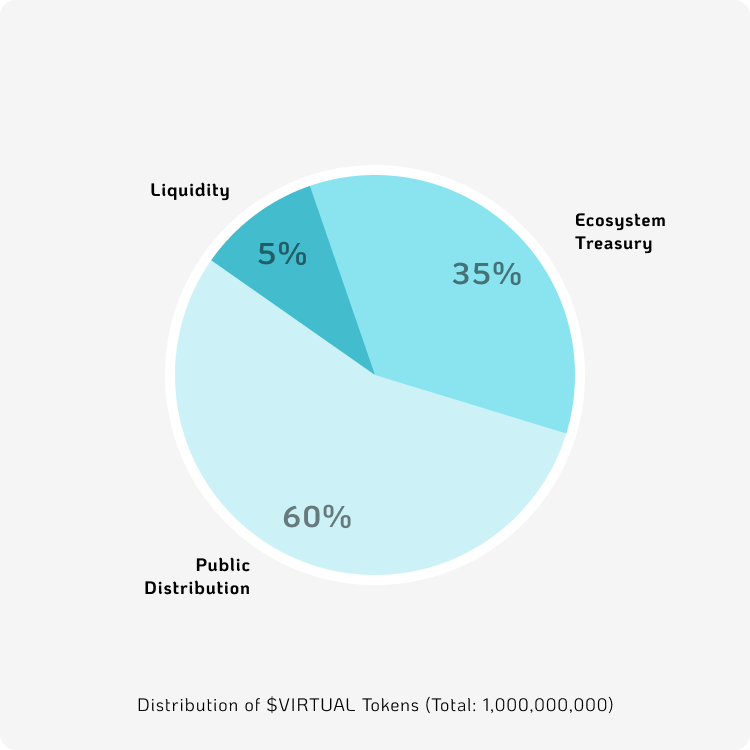
A total of 1 billion $VIRTUAL tokens have been distributed with a fixed supply and no inflation:
- Public Distribution: 60% (600 million tokens) is available to the public.
- Liquidity Pool: 5% (50 million tokens) is allocated for liquidity pools.
- Ecosystem Treasury: 35% (350 million tokens) is used for community incentives and ecosystem growth. This treasury is held in a DAO-controlled multi-signature wallet, with no more than 10% annual emission for the first three years.
veVIRTUAL and Staking
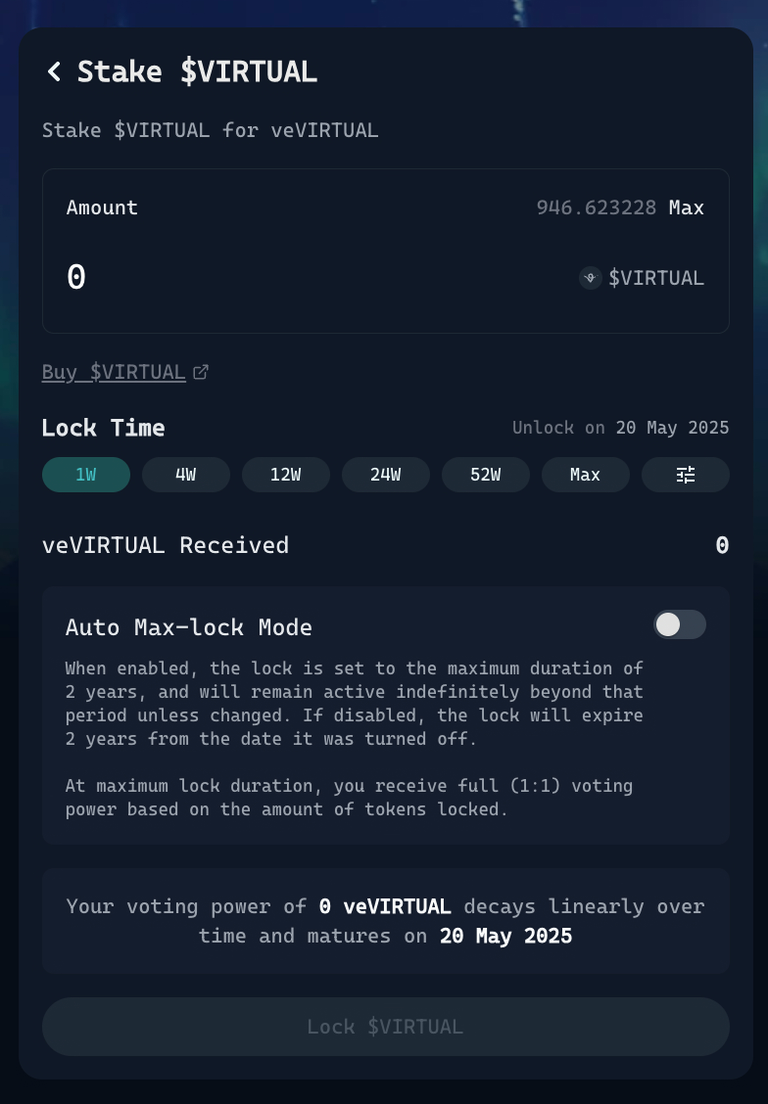
veVIRTUAL is obtained by locking $VIRTUAL tokens and supports long-term incentives. veVIRTUAL holders:
- Earn daily Virgen Points.
- Gain access to Genesis airdrops.
- Will soon receive governance power.

Users can lock $VIRTUAL tokens for up to 2 years to earn veVIRTUAL. The Auto Max Lock mode offers the highest voting power and multiplier.
Genesis Launches
Virtuals Protocol aims to launch AI agent tokens fairly and transparently through Genesis Launches. These launches provide early access through a structured, contribution-based model:
- Points System: Participants earn Virgen Points through contributions to the ecosystem. These points are used for token allocation in Genesis Launches.
- Allocation Mechanism: Users commit points to receive a share of the 37.5% pre-sale pool. The maximum user allocation is 0.5% of the total token supply.
- Refund Policy: Full refunds are provided for failed launches or unused $VIRTUAL and points.
The Future of Virtuals Protocol
Virtuals Protocol offers a robust infrastructure for scaling the economic activities of AI agents. Two main clusters currently under development highlight the protocol’s potential:
- Autonomous Media House (AMH): An autonomous creative agency composed of AI agents performing various media production tasks. For example, Luna coordinates content requests, while AlphaKek produces memes.
- Autonomous Hedge Fund (AHF): An asset management system that autonomously performs data analysis, strategy development, and trade execution.
The protocol continues to develop ACP to make agent-to-agent trading safer and more efficient. Additionally, new features like agent registries aim to simplify agent creation and ecosystem participation for developers.
Virtuals Protocol Investors and Supporters
Virtuals Protocol’s investors include prominent names across various tiers. DeFiance Capital and Merit Circle are lead investors in the seed round. LongHash Ventures and MV Global are Tier 3 investors, with MV Global supporting the seed round.
Stakez Capital and AITECH Labs are Tier 4 investors, with Stakez Capital participating in the seed round, while AITECH Labs’ investment stage is unspecified. NewTribe Capital, a Tier 5 investor, also participated in the seed round. These investors are key players in supporting Virtuals Protocol’s growth.
Virtuals Protocol (VIRTUAL) Founding Team
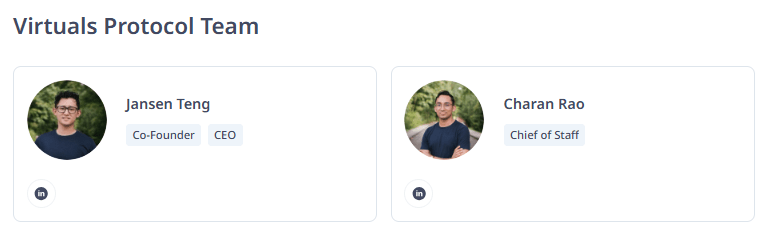
Jansen Teng, CEO and Co-Founder: Leads Virtuals Protocol, a decentralized platform enabling co-ownership and management of AI agents across various applications.
Charan Rao, President: A scale architect driving innovation in AI, blockchain, and gaming, building billion-dollar ecosystems by integrating operations, finance, and compliance.
Official Links
- Virtuals Protocol (VIRTUAL) Website
- Virtuals Protocol (VIRTUAL) X (Twitter)
- Virtuals Protocol (VIRTUAL) Whitepaper
You can freely share your thoughts and comments about the topic in the comment section. Additionally, don’t forget to follow us on our Telegram, YouTube and Twitter channels for the latest news and updates.