

 Emre Yumlu
In the world of cryptocurrency and blockchain, the integration of artificial intelligence (AI) with decentralized infrastructure is gaining increasing importance. Unibase (UB) stands out as the first high-performance decentralized AI memory layer. This platform empowers AI agents with long-term memory storage, cross-platform interoperability, and autonomous learning capabilities, forming the foundation for the Open Agent Internet. So, what exactly is Unibase, how does it work, and why is it attracting attention? Let’s explore.
What is Unibase (UB)?
Unibase is a platform that provides a high-performance, decentralized AI memory layer for AI agents. It supports AI agents’ long-term memory storage, cross-platform communication, and autonomous learning and development capabilities. Unibase aims to bring the Open Agent Internet vision to life by creating a modular, verifiable, and composable AI agent ecosystem. The platform is active on the BNB Chain testnet and is integrated with leading protocols like MCP, ElizaOS, Virtuals, and Swarms. The $UB token plays a central role in the platform’s operations, used for protocol fees, governance, and knowledge contributions.
Unibase addresses the challenges of traditional AI systems, such as the lack of long-term memory, cross-platform interoperability, and data sovereignty issues, enabling AI agents to operate securely, transparently, and scalably. With ecosystem projects like BitAgent, TwinX, TradingFlow, and Beeper, Unibase sets a new standard for Web3-based AI applications.
Key Features of Unibase (UB)
Unibase offers a revolutionary infrastructure for AI agents. Here are the platform’s core features:
1. Decentralized Memory (Membase)
Membase provides a secure and scalable long-term memory layer for AI agents. It stores conversation history, interaction records, and knowledge bases, enabling agents to ensure continuity, personalization, and traceability.
2. AIP Protocol
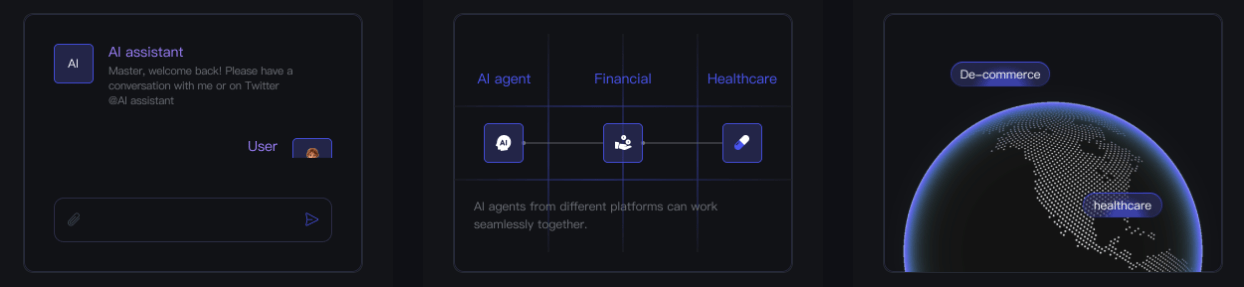
The Agent Interoperability Protocol (AIP) is a Web3-native communication standard. It enables agents to communicate, share knowledge, and interact securely across platforms. It is compatible with MCP and gRPC.
3. Unibase DA
The high-performance data availability layer offers real-time data storage and access with 100 GB/s throughput and low latency. It verifies data integrity using zero-knowledge proofs (ZKPs).
4. Secure Identity Management
Each agent is assigned a verifiable identity on the blockchain, forming the basis for secure interactions and data management.
5. Knowledge Mining
Users can earn $UB tokens by contributing to the knowledge base, enriching the open memory layer.
6. Autonomous Agents
Unibase enables agents to learn, adapt, and evolve autonomously, enhancing their intelligence with each interaction.
7. Scalable Infrastructure
Its horizontally scalable architecture supports exabyte-scale storage and millions of nodes, handling intensive data workloads.
How Unibase (UB) Works
Unibase operates with a layered architecture, ensuring efficient functionality for AI agents:
-
Application Layer: Includes AI agents like Trader Agent, Personal Agent, and Chess Agent, which users directly interact with.
-
Middleware Layer: Connects the application and core layers with Config Hub (customizing agent behavior), Memory Hub (persistent memory management), and Knowledge Base (shared knowledge repository).
-
Core Layer: Manages agent behavior and data exchange with AIP (communication standards), Membase (memory and identity management), and DA (data availability).
-
Infrastructure Layer: Supports the system with blockchain, distributed storage, and LLM APIs, providing a secure and scalable foundation.
Membase Workflow:
-
Agents register their identities on the blockchain.
-
Agent Hub synchronizes identity and permission data.
-
Agents interact with external services via Link Hub.
-
Config Hub manages agent configurations.
-
Memory Hub stores data and interaction history.
-
Unibase DA ensures decentralized and secure data storage.
Benefits of Unibase (UB) to Stakeholders
-
Developers: Build decentralized AI agents using AIP and Unibase SDKs.
-
Users: Benefit from autonomous, personalized, and secure AI services.
-
Token Holders: Stake $UB to participate in governance and earn rewards for knowledge contributions.
-
Community: Contributes to an open, transparent, and interoperable AI ecosystem.
Unibase (UB) Tokenomics
The $UB token plays a central role in the platform’s operations:
-
Token Name: UB
-
Total Supply: 10,000,000,000 UB
-
Use Cases:
-
Protocol Fees: Used for agent deployment, memory storage (Membase), and AIP usage.
-
Governance (veUB): Locking $UB enables participation in protocol governance and reward allocation.
-
Agent Staking: Staking $UB activates and promotes agents, with rewards based on agent activity.
-
Knowledge Mining: Contributing to the open memory layer earns $UB.
-
-
Model: Unibase adopts a ve(3,3) model to align long-term governance with active agent usage and knowledge contribution.

Unibase Roadmap
Unibase is advancing toward building the Open Agent Internet:
-
August 2025: Mainnet launch on BNB Chain (immortal agent creation and on-chain trading).
-
September 2025: TGE, veToken staking, bribe pool, and agent governance launch.
-
Q4 2025: On-chain memory verification (ZK-backed Membase layer).
-
Q1 2026: “One Million Memory Nodes” initiative to scale storage and retrieval.
-
Q2 2026: AIP 2.0 for cross-platform memory synchronization.
Unibase (UB) Partners
Unibase is integrated with leading agent ecosystem protocols like MCP, ElizaOS, Virtuals, and Swarms. Projects such as BitAgent, TwinX, TradingFlow, and Beeper enrich its ecosystem. Collaboration with CARV combines behavioral data with Unibase’s decentralized memory layer, accelerating AI agent development.
Unibase (UB) Team
Unibase is led by a globally distributed team with deep expertise in AI, cryptography, distributed systems, and token economics. Governance will transition to a decentralized DAO with on-chain voting powered by veUB.
Official Links
You can also freely share your thoughts and comments about the topic in the comment section. Additionally, don’t forget to follow us on our Telegram, YouTube, and Twitter channels for the latest news and updates.