

 Haciyev Reşit
As gold surges to record highs in 2025, investors are turning away from the U.S. dollar and seeking refuge in safe-haven assets. However, this rally may serve as a critical warning for both Bitcoin and the global economy.
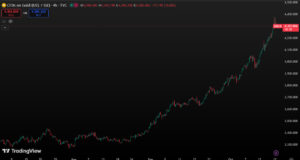
Global gold prices have reached all-time highs this year, signaling that investors are once again prioritizing stability amid growing uncertainty. The spot price of gold surpassed $4,300 per ounce for the first time, a move that highlights waning interest in U.S. dollars and Treasuries, while positioning gold as the clear winner amid economic turbulence.
Why Is Gold Surging in 2025?
Throughout history, gold has been a classic safe-haven asset during times of economic uncertainty. However, the rally of 2025 is driven not only by geopolitical risks but also by eroding confidence in monetary policy. Investors are increasingly questioning the long-term stability of the U.S. dollar. Mounting political pressure on the Federal Reserve, a soaring national debt, and rising inflation expectations have all pushed gold back into the spotlight.
Global Markets Analyst James Porter notes:
“This isn’t just a rally it’s a systematic return of trust. Investors are questioning their faith in fiat currency.”
Since early 2024, the price of gold has nearly doubled, while equities, bonds, and cryptocurrencies have struggled to keep pace.
Is the Dollar Losing Its Safe-Haven Status?
For decades, the U.S. dollar has been the preferred refuge during crises. Yet in the first half of 2025, the dollar recorded its biggest six-month decline in 50 years. Analysts describe this shift as the rise of the so-called “Debase Trade” — a growing move away from fiat currencies toward value-preserving assets, especially gold.
Central banks and China have played a decisive role in this surge in demand. Since Russia’s 2022 invasion of Ukraine, many nations have been diversifying their reserves away from the dollar. Today, central banks are collectively buying around 1,000 tons of gold per year — the highest level in half a century.
The People’s Bank of China has been reducing its holdings of U.S. Treasuries while increasing gold reserves as part of its broader de-dollarization strategy. As both the world’s largest gold producer and consumer, China’s actions have a direct and powerful influence on global prices.
Bitcoin Struggles to Keep Up
In contrast to gold’s meteoric rise, Bitcoin (BTC) appears to be losing momentum. With gold’s total market capitalization surpassing $30 trillion, Bitcoin would need to rise by over 1,500% to reach a similar valuation a disparity that has led many to question the “digital gold” narrative.
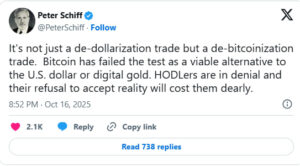
Economist Peter Schiff commented:
“This isn’t just about de-dollarization — it’s a test of Bitcoin’s claim as a safe-haven asset.”
Still, some investors — such as Mexican billionaire Ricardo Salinas — maintain that Bitcoin could eventually catch up to gold in the long run. Yet for now, market sentiment clearly shows a shift in confidence toward gold, as it continues to dominate in times of macroeconomic uncertainty.
How Long Can Gold’s Rally Last?
Analysts predict that gold’s upward momentum is unlikely to slow down in the near term. Goldman Sachs and Deutsche Bank both forecast that, driven by central bank purchases, ETF inflows, and geopolitical tensions, gold prices could reach $4,900 per ounce by the end of the year. However, a de-escalation in trade wars or easing of political tensions could trigger a short-term correction. For now, the market’s safe-haven preference remains firmly anchored in gold.
The renewed rise of gold signals a paradigm shift in the global economy. Investors are increasingly turning away from dollars and bonds in favor of physical assets and tangible value. While Bitcoin and the broader crypto market watch this transition unfold, gold has once again become the symbol of trust and stability.
You can also freely share your thoughts and comments about the topic in the comment section. Additionally, don’t forget to follow us on our Telegram, YouTube, and Twitter channels for the latest news and updates.