

 Emre Yumlu
Analysts suggest that if the Fed continues to lower interest rates and global macroeconomic conditions remain favorable, Bitcoin (BTC) could reach a new all-time high by early 2026. However, recent market developments have painted a very different short-term picture, leaving many investors puzzled.
Market Decline Despite Positive Developments
Earlier this week, several major announcements were expected to boost investor sentiment. The Federal Reserve officially declared the end of quantitative tightening (QT), while the U.S. and China reached a long-awaited trade truce. On top of that, two consecutive rate cuts and the approval of an altcoin staking ETF appeared to set the stage for a strong market rebound.
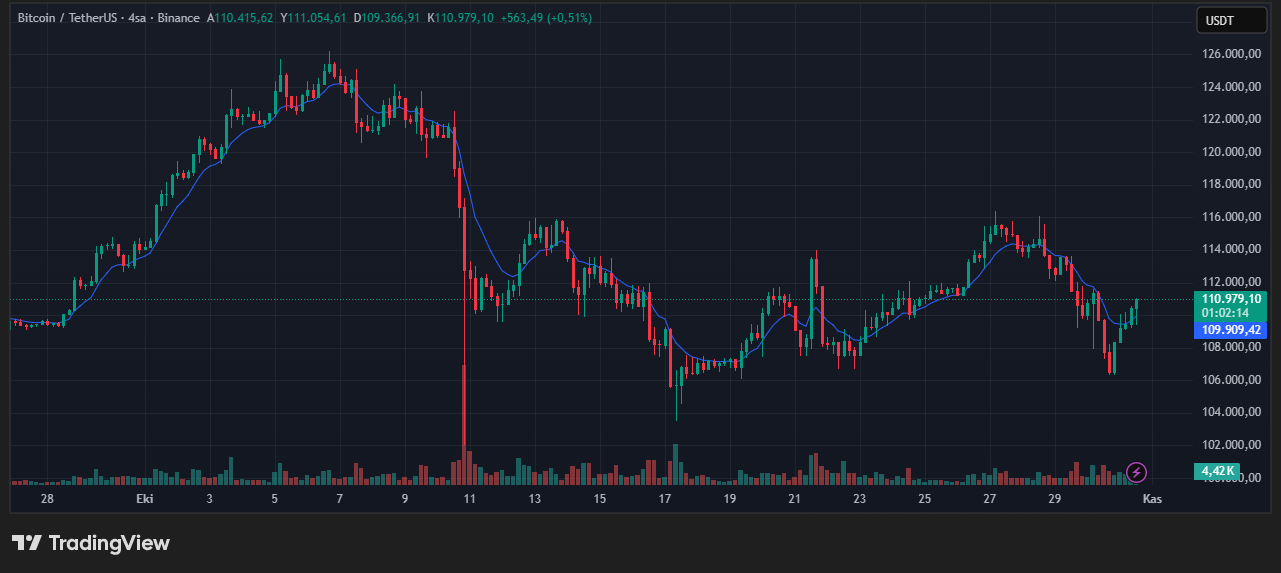
Yet, contrary to expectations, both Bitcoin and U.S. equities suffered a sharp decline. On-chain data signaled weakening institutional demand, while Fed Chair Jerome Powell’s cautious comments undermined confidence.
By the end of the week, Bitcoin was trading around $110,000, reflecting continued market fragility.
On-Chain Data Signaled Weak Institutional Demand
One of the key indicators pointing to Bitcoin’s decline was the Coinbase Premium Gap, which turned negative after a brief recovery. This metric measures the price difference between Coinbase—a preferred exchange among U.S. institutions—and global exchanges. Historically, it has served as a proxy for American institutional buying activity.
A negative reading indicates that U.S.-based investors are selling or avoiding accumulation, suggesting that Bitcoin’s recent price movements lacked strong institutional conviction. Retail investors, meanwhile, may have misinterpreted the wave of macroeconomic “good news” as a direct sign of sustained demand, overestimating its real impact.
Fed’s Cautious Outlook Shakes Confidence
According to CryptoQuant, the downturn was amplified by Powell’s statement that a December rate cut is “not guaranteed.” Although QT will officially conclude on December 1, Powell’s cautious tone raised fresh doubts about how quickly the Fed will ease monetary policy.
Additionally, the fragile nature of the U.S.-China trade truce and renewed reports of U.S. nuclear testing activities further weighed on investor sentiment, adding a layer of geopolitical uncertainty to an already unstable market environment.
Long-Term Outlook: A Healthy Correction Before a New High?
CryptoQuant’s analysis suggests that this recent correction represents a cooling-off period after months of speculative excess. Institutional hesitation, temporary liquidity concerns, and geopolitical risks have collectively worked to stabilize an overheated market.
Analysts believe that once QT fully ends and liquidity conditions improve, risk appetite could gradually recover, paving the way for Bitcoin’s next leg up.
The TeraHash analytics team noted that Bitcoin’s long-term bullish trend remains intact, though its momentum has clearly slowed. They identified $98,000 as a critical support level—if broken, BTC could slide toward the $70,000 zone amid deeper selling pressure.
Still, Bitcoin’s growing acceptance among major global funds and its strengthening institutional legitimacy suggest that any correction is likely to be measured rather than abrupt. Experts maintain that if the Fed maintains its rate-cutting trajectory and global economic stability persists, Bitcoin could set a new all-time high by late 2025 or early 2026.
You can also freely share your thoughts and comments about the topic in the comment section. Additionally, don’t forget to follow us on our Telegram, YouTube, and Twitter channels for the latest news and updates.