

 Emre Yumlu
In the crypto world, key management and private computation require a delicate balance between security and user experience. Lit Protocol (LITKEY) solves this issue as a decentralized key management and private compute network. It offers Web3 developers three core tools: decentralized signing and wallet management (with ECDSA and EdDSA support) via MPC TSS + TEEs, identity-based BLS encryption for decentralized encryption/decryption, and private compute executed over the Lit MPC TSS network and protected by sealed TEEs.
What is Lit Protocol (LITKEY)?
Lit enables managing secrets without handing them to centralized servers or burdening users with complex key handling. Its distributed architecture encrypts secrets at the hardware level, fragments them, and eliminates single points of failure. With threshold signature schemes (MPC TSS), universal accounts become programmable without relying on centralized custodians.
Using the Lit SDK, developers can easily: encrypt and decrypt private data, create and manage Web3 wallets and signers, sign transactions on virtually any blockchain, perform automated signing or decryption based on programmable conditions, and integrate with off-chain data. This allows building immutable, interoperable, and user-controlled applications, AI agents, and protocols.
Lit is a decentralized, programmable key management network for signing and encryption. It consists of independent nodes running inside sealed Trusted Execution Environments (TEEs). Each node holds unique key shares and a JavaScript execution environment. Key shares correspond to threshold signing or encryption keys managed collectively by all network nodes.
Developers define key usage with immutable JS functions called Lit Actions: transaction automations, spending policies, access rules. These functions run inside TEEs, inheriting the network’s threshold and hardware-based security.
Each node generates keys via Distributed Key Generation (DKG); no single party holds the full key. Operations require participation from more than two-thirds of the network. The private key is never exposed to any single node or client. Multiple cryptographic curves and schemes are supported.
Lit Actions can process on-chain/off-chain data, create automations like dollar-cost averaging, and define access or spending rules.
Security Model
Lit manages secrets, performs signing/decryption, and executes Lit Actions using MPC TSS and TEEs. Operations run in parallel and require over two-thirds participation.
MPC TSS removes single points of failure. TEEs provide hardware-enforced isolation, preventing key share extraction or output manipulation.
Node Architecture
Each node starts with a sealed TEE on an independently operated server. Sensitive data remains inaccessible to node operators or users. Connections verify authenticity using AMD SEV-SNP certificates.
Inside the TEE, nodes include a Deno JS environment and key shares. Key pairs are generated collectively via DKG.
Distributed Key Generation
DKG collectively generates keys; the full key never exists. Over two-thirds of nodes must collaborate for operations.
Root keys serve as the basis for hierarchical derivation and are periodically refreshed. Refresh (Proactive Secret Sharing) rotates shares without changing the key. Resharing enables node addition/removal.
On-Chain Coordination
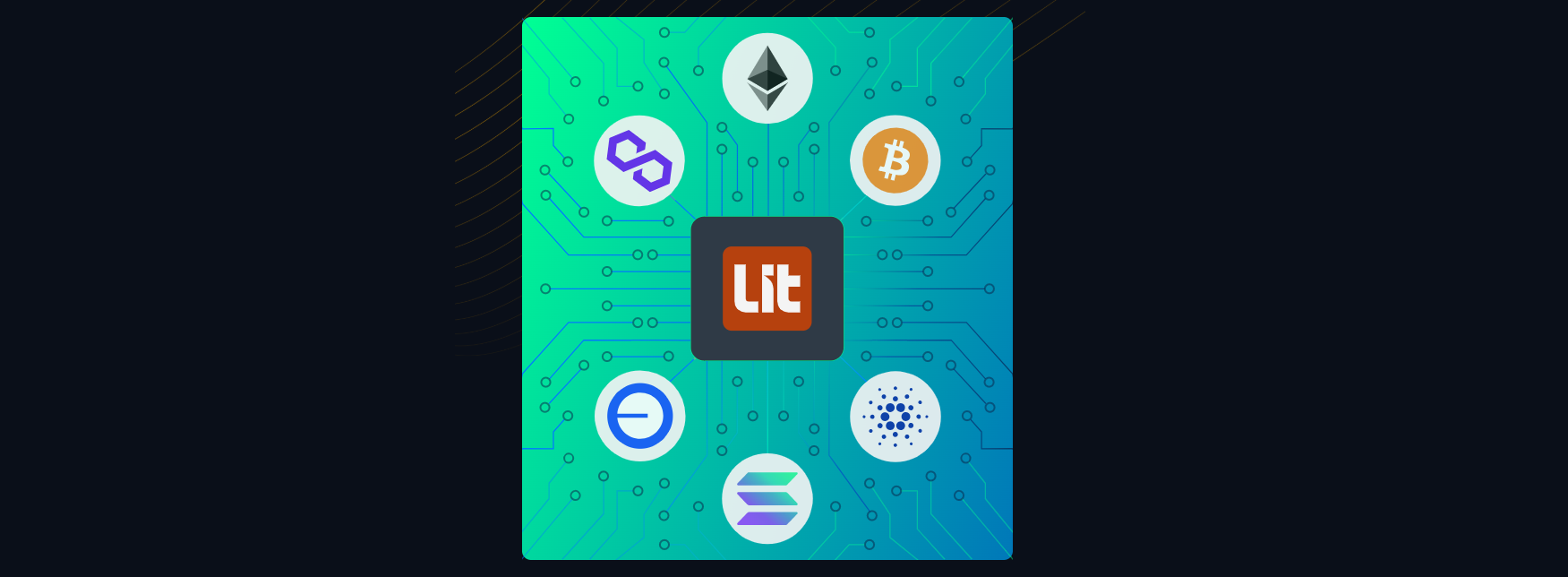
Chronicle, an Arbitrum Orbit chain, manages shared state. Programmable Key Pairs (PKPs) are minted as ERC-721s, with permissions handled via on-chain smart contracts. Node staking/rewards and service payments occur on Chronicle. Nodes run Orbit replicas inside TEEs.
Communicating with Lit Nodes
All communication is encrypted with SSL/TLS. Data decrypts only inside the TEE. Node-to-node interactions verify staking, attestation, and membership.
Requests are not publicly visible: encrypted transmission, TEE processing, and secure sharing protect them. Sensitive jsParams data (including API keys) remains hidden.
Request lifecycle: Users send authenticated requests to over two-thirds of nodes. Nodes verify and execute independently. Interactive operations require matching pending requests.
The Naga operator set is selected post-TGE via staking contest; the top 10 by stake weight form the initial set.
Cryptoeconomic Security
$LITKEY (not yet live) ensures liveness. Nodes stake to participate; slashing enforces uptime. Correctness relies on TEEs and threshold consensus. Token holders can delegate.
Backup and Recovery
Root key shares are verifiably encrypted for backup. Recovery requires two-thirds participation from both the recovery party and node operators using Blinders. Only joint cooperation decrypts backups.
Use Cases
- Web3 Wallets: Non-custodial keys with oAuth/Passkeys and automated transactions. Ex: Collab.Land, Genius Protocol.
- Digital Identity: Conditional access/encryption. Ex: Lens Protocol, Cheqd.
- Chain Abstraction/DeFi: Cross-chain signing. Ex: Tria, Eco.
- Oracles: Off-chain data signing (Oracle Kit, V7; V8 coming soon).
- AI Agents: Autonomous, verifiable agents (Vincent kit).
- Infrastructure: Payments, grants, streaming. Ex: Gitcoin, Livepeer.

Lit Protocol (LITKEY) Tokenomics
$LITKEY (ERC-20, 1 billion total supply, 22% initial circulating) serves as work, payment, and governance token.
- Work Token: Staking secures the network; rewards incentivize participation.
- Payment Token: Gas for Lit Chain; fees for operations.
- Governance Token: Operator selection, upgrades, grants.
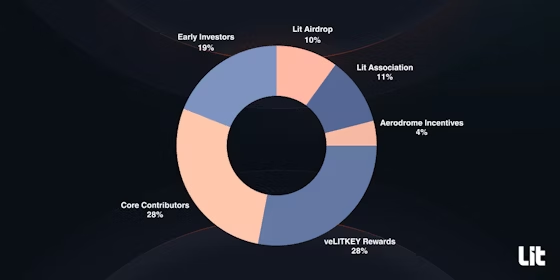
Allocation:
- Airdrop: 10%
- Lit Association: 11%
- Aerodrome Incentives: 4%
- veLITKEY Builder Rewards: 28%
- Founding Contributors: 28% (1-year lock, 24-month linear vesting)
- Early Investors: 19%
Community sale: 0.17% liquid, 0.14% 12-month vesting, 0.51% 1-year lock.
Staking and Delegation
Lock $LITKEY to secure the network and earn rewards. Stake weight = amount x lock duration (2 weeks–4 years). Longer locks yield higher multipliers. Rewards go to active operators.
Post-contest 10% bonus. Post-v1 transition to veLITKEY: revenue-based emissions, voting power.
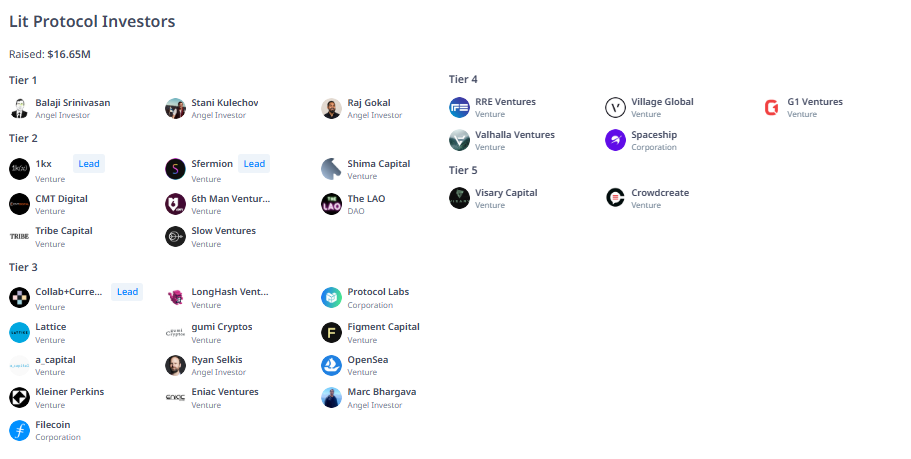
Lit Protocol Investors
Raised: $16.65M
- Tier 1: Balaji Srinivasan, Stani Kulechov, Raj Gokal
- Tier 2: 1kx, Sfermion, Shima Capital, CMT Digital, 6th Man Ventures, The LAO, Tribe Capital, Slow Ventures
- Tier 3: Collab+Currency, LongHash, Protocol Labs, Lattice, gumi Cryptos, Figment, a_capital, Ryan Selkis, OpenSea, Kleiner Perkins, Eniac, Marc Bhargava, Filecoin
- Tier 4: RRE, Village Global, G1, Valhalla, Spaceship
- Tier 5: Visary, Crowdcreate
Lit Protocol is a powerful infrastructure solving Web3’s trust and accessibility challenges. Backed by $LITKEY, the network delivers full control to developers and users.
Lit Protocol Team
Lit Protocol is an innovative project led by an experienced team focused on resolving Web3’s security and accessibility issues. The founders’ vision centers on providing developers complete freedom through decentralized key management. The team continuously advances the network and expands the ecosystem with deep expertise in crypto and technology.
- David Sneider – Co-Founder: The project’s visionary leader who designed Lit’s core architecture and prioritized decentralized security.
- Chris Cassano – CTO: Architect of the technical foundation; ensures network security and scalability through TEE and MPC integrations.

Official Links
You can also freely share your thoughts and comments about the topic in the comment section. Additionally, don’t forget to follow us on our Telegram, YouTube, and Twitter channels for the latest news and updates.