

 Emre Yumlu
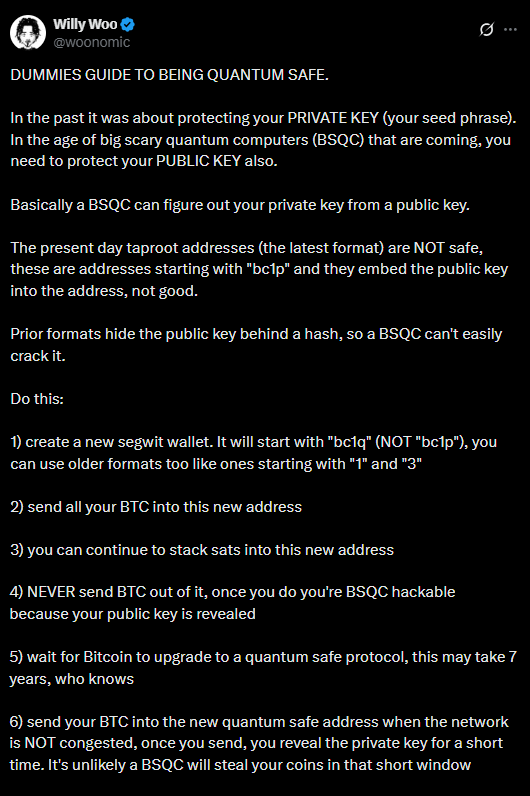
Debates surrounding the potential impact of quantum computing on Bitcoin have resurfaced once again, and on-chain analyst Willy Woo has introduced a temporary defensive strategy for long-term holders. According to Woo, users concerned about future quantum attacks may want to move their Bitcoin to SegWit-based wallets and leave the funds untouched until quantum-resistant protocols become available.
Renewed Concern Over Quantum Computing
Quantum machines have long been viewed as a possible threat to modern cryptography. Their theoretical ability to derive private keys from public keys has fueled discussions across the crypto space, with some warning that this could expose sensitive user data and digital assets. Woo suggests a stopgap measure: transferring BTC to a SegWit address and waiting until the Bitcoin network adopts a security upgrade capable of withstanding quantum-level attacks.
SegWit, implemented on August 23, 2017, represented a major upgrade to the Bitcoin protocol and remains widely used today.
Why SegWit Could Offer Temporary Protection
Woo argues that contemporary address formats could be more susceptible to quantum computers. For example, Taproot addresses embed public keys directly into the address structure, which—if quantum computing advances—could allow adversaries to infer private keys more easily. SegWit addresses, on the other hand, reveal the public key only when a transaction is made, providing an additional layer of obscurity.
As Woo explains, security concerns have shifted: “In the past, securing your private key was enough. With quantum computers on the horizon, protecting your public key matters as well.” Earlier address formats effectively concealed the public key behind a hash, making it harder for even advanced computational systems to crack.
However, Woo notes a key limitation: once BTC is moved into a SegWit address, it should ideally remain there until a quantum-resilient upgrade is deployed.
Woo also emphasizes that Bitcoin held by ETFs, corporate treasuries or cold-storage custodians could be made quantum-resistant earlier, provided those institutions take necessary precautions. The dominant view among researchers is that quantum computing will not pose a real threat until sometime after 2030, and work on quantum-safe standards is already in progress.
Critics Push Back: “SegWit Isn’t a Real Solution”
Not everyone is convinced by Woo’s approach. Charles Edwards, founder of Capriole, argues that SegWit alone will not protect the network, stating that Bitcoin urgently needs a protocol-level upgrade to prepare for quantum advances. Otherwise, he warns, the network could face serious vulnerabilities.
Meanwhile, other critics believe quantum fears are exaggerated, highlighting the current technological limitations of quantum systems. Michael Saylor has dismissed the panic altogether, calling quantum alarmism a marketing strategy aimed at promoting quantum-themed tokens. Additional researchers point out persistent challenges in quantum memory, thermodynamics and computation stability, suggesting true quantum threats remain distant.
You can also freely share your thoughts and comments about the topic in the comment section. Additionally, please follow us on our Telegram, YouTube, and Twitter channels for the latest news and updates.