

 Emre Yumlu
In DeFi, collateral is often siloed: Assets deposited in a lending pool can’t simultaneously back order book positions or serve as futures margin. Liquidity is fragmented, pricing is static, and risk management relies on delayed oracles. Flying Tulip (FT) tackles these issues head-on: an on-chain financial system offering spot trading (AMM + CLOB), lending, perpetual futures, insurance, and a settlement rail (ftUSD) with a single collateral base. The same deposit earns base yield while securing lending, CLOB orders, or futures margin. Pricing and risk derive from real executable liquidity—no static tables or lagging oracles. Protocol revenues flow transparently and programmatically into token buybacks.
In this article, we’ll dive into Flying Tulip’s architecture, products, tokenomics, and roadmap. Ready to explore the new benchmark for capital efficiency?
What is Flying Tulip (FT)?
Flying Tulip is an on-chain financial ecosystem that standardizes pricing, credit, and risk. It includes Spot (AMM + CLOB), lending, perpetual futures, insurance, and ftUSD settlement rail. Core principle: One collateral serves multiple roles. Revenues drive FT token buybacks and burns—a “token-first” model.
Better Yield: Collateral earns base yield while backing lending, CLOB orders, or futures margin. Revenues fuel buybacks. Better UX: Mechanics are contract-encoded; the same depth-aware prices power trading, LTVs, funding, and liquidations.

Problems and Solutions
Capital Isolation: Traditional DeFi silos collateral per product. Flying Tulip’s permissioned credit layer enables cross-collateral—one deposit secures multiple activities while continuing to earn yield.
Fragmented Liquidity & Static Pricing: x·y=k AMMs are reliable but produce wide spreads and volatility losses. Flying Tulip Spot uses a hybrid curve: constant-sum in calm markets (tight spreads), constant-product in stress (LP protection). Pricing comes from real executable liquidity.
USD-Centric Debt Assumptions: Lending risks are often USD-denominated. Flying Tulip supports asset-consistent borrowing and portfolio cross-margining—permissionless markets stay pair-scoped.
Centralized Dependencies: Perpetuals depend on external oracles. FT Futures uses internal trading (AMM + CLOB) for sub-second updates and depth-aware limits—eliminating oracle lag/manipulation risks.
System Design
Trading Engine: Spot (AMM + CLOB) – Pricing Backbone
- AMM: Transitions between constant-sum ↔ constant-product via volatility signals (EMAs). Pre-trade simulation, bounded impact, minimum reserves.
- CLOB: Price-time-priority limit orders.
- Router: Sweeps CLOB liquidity first, crosses remainder on AMM.
- Windows: TWAP (time-weighted), RWAP (reserve-weighted)—executable price and depth source for downstream systems (LTV, funding, liquidation).

Lending: Permissionless + Permissioned Cross-Collateral
- Permissionless: Every Spot pair auto-creates a lending market. Borrowing power is depth-aware from Spot windows. Snapshot LTV (locked at position open). Soft liquidation (time-sliced, depth-aware, CLOB-aware).
- Permissioned: Curated assets in one pool with cross-collateral. Debt-netting for delta-neutral structures (ftUSD)—near-zero liquidation paths within configured bounds. Single deposit earns yield while backing orders and futures margin.

Perpetual Futures: Oracleless, Depth-Aware
Internal trading serves as oracle. Leverage limits, liquidation sizing, slippage guards from TWAR windows (“How much X for Y clears in this interval without breaching reserves?”). Funding tied to Lend borrowing costs. Settlement in ftUSD; opt-in settlement LPs earn fees.

Settlement Rail: ftUSD / sftUSD
- ftUSD: Non-yielding (default), $1 peg. Protocol revenues from unstaked ftUSD.
- sftUSD: Staked ftUSD—earns yield (variable, not guaranteed).
- Structure: Delta-neutral, conservative sizing—balanced long/short.

Risk & Operations
- Policy: Conservative allocation (no leverage/bridge for treasury), per-asset/venue caps, circuit breakers, staged parameter changes.
- Execution: Pre-trade simulation, bounded fees (low in calm, high in stress), soft liquidation (time-sliced on Spot).
- Transparency: Addresses, parameters, windows (TWAP/RWAP/TWAR), utilization, fee schedules published. Audits and incident processes documented.
Programmatic Value Flow
All revenues (trading, lending, futures, insurance, settlement) feed FT buyback pipeline. FT distributed or burned per policy. Revenue-funded burns govern unlocks (Foundation/Team/Ecosystem/Incentives 40:20:20:20, 1:1). Interest-only burns directly reduce supply.
Insurance: Pay-as-You-Go Protection
- Model: Lending-like—premium paid only while active.
- LP: Supplies pool → earns premiums.
- Buyer: “Borrows” protection capacity, scales up/down.

Flying Tulip Roadmap
Development Cycle: Internal → Freeze → 3+ audits → GTM → Release.
Milestones (Dependency waterfall):
- PCA: On-chain raise + Perpetual PUT.
- Core Permissioned Stack: Lend, ftUSD, Leveraged Spot, Spot, Perpetual Futures.
- Core Permissionless Stack: Adaptive AMM, Dynamic Lend, Permissionless Futures/Options.
- Oracles & Apps: Witnessnet, Binary Prediction Markets, Launchpad, Insurance.
Estimated Timeline: 36-54 months (2-3 months per phase).
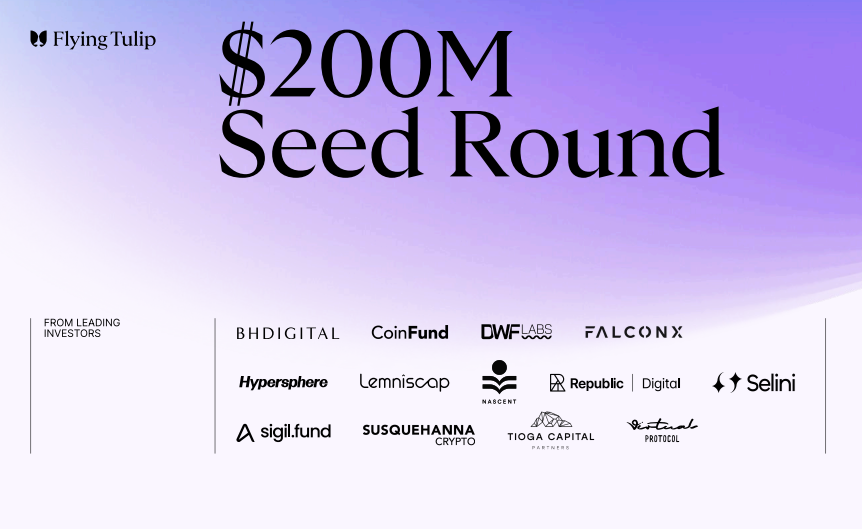
Flying Tulip Investors: $200M Raised, $1B Valuation
Flying Tulip, with its focus on capital preservation and sustainable value via yield-funded buybacks, raised $200 million at a $1 billion valuation. Backing spans leading VCs like CoinFund and Hypersphere to institutional players like DWF Labs and Brevan Howard Digital.
- Tier 2
- CoinFund
- Hypersphere Ventures
- DWF Labs
- Republic
- Nascent
- Tier 3
- Lemniscap
- Selini Capital
- Brevan Howard Digital
- FalconX
- Tier 4
- Tioga Capital Partners
- Sigil Fund
- Others
- Susquehanna International Group
- Virtuals Protocol
Flying Tulip Team
Flying Tulip was founded by Andre Cronje. The architect of Yearn Finance and Fantom, Cronje leads in DeFi capital efficiency and risk management. The team builds Flying Tulip from scratch with adaptive curves, oracleless futures, and token-first models—ending collateral isolation.

Official Links
You can also freely share your thoughts and comments about the topic in the comment section. Additionally, don’t forget to follow us on our Telegram, YouTube, and Twitter channels for the latest news and updates.