

 Emre Yumlu
Interest in new crypto-based financial products continues to grow, and Pi Network has recently entered the conversation—despite the absence of any official filing or regulatory move. As of today, a Pi Coin ETF does not exist in any form. There are no public documents, no institutional plans, and no confirmed announcements. Still, the key question remains: Could a Pi ETF become feasible in the future?
Key Requirements for a Potential Pi Network ETF
Market analysts emphasize that Pi Network must meet several critical conditions before traditional institutions can consider structuring an ETF around it.
1. Clear and Recognized Market Price
For a spot ETF to be viable, the underlying asset must have an established, widely accepted market price. While Pi currently displays pricing across various platforms, the market still lacks uniformity and consistency. Greater price stability and transparency will be essential before institutional investors regard it as ETF-eligible.
2. Adequate Liquidity
ETF providers must be able to buy and sell large quantities of the asset without significantly disrupting the market. At present, Pi’s trading volume remains far below that of major cryptocurrencies. Without deeper liquidity, the creation and management of an ETF would pose operational challenges.
3. Regulatory Maturity
Regulators require assets that can be tracked, audited, and protected against manipulation. Although Pi Network is gradually improving transparency and compliance, it has more progress to make before it can meet institutional regulatory expectations. Demonstrating a robust, verifiable framework will be essential.
4. Custodial Infrastructure
Every ETF relies on a regulated custodian capable of securely holding the underlying asset. Currently, no traditional financial institution can legally custody Pi under a regulated structure. For an ETF to materialize, a compliant custodian must be approved and full network accessibility must be established.
How a Future Pi ETF Could Function
If Pi Network eventually reaches full listing, gains strong liquidity, and achieves stable price formation, the groundwork for an ETF could emerge. In such a scenario, the ETF issuer would hold real Pi tokens through a regulated custodian while providing ongoing transparency and reporting. The ETF’s price would track Pi’s market value, allowing retail and institutional investors to gain exposure through standard brokerage platforms.
Such a development could boost liquidity, increase investor participation, and enhance Pi’s market visibility—though it would also place the asset under stricter regulatory monitoring and heighten market sensitivity to news and policy changes.
Pi Coin Price Outlook
Pi Coin continues to exhibit notable volatility. In the short term, the asset has recorded an approximate 4.96% daily decline, reflecting broader market uncertainties and fluctuations in liquidity.
On a weekly basis, however, Pi shows a more constructive trend, posting a 10.47% increase. This suggests that investor interest remains present and that confidence in the ecosystem has not completely diminished.
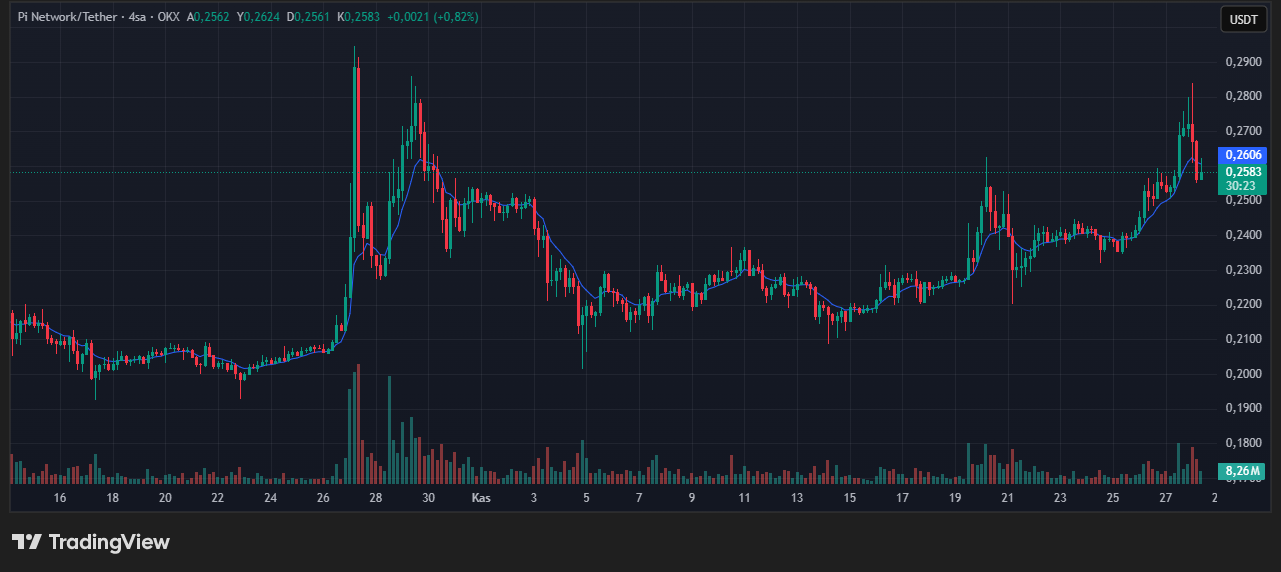
At the moment, Pi Coin is trading around 0.26 USD. The current price behavior indicates that Pi is still navigating an early price-discovery phase with limited liquidity and rapidly shifting market dynamics.
This article is for informational purposes only and does not constitute financial advice.
You can also freely share your thoughts and comments about the topic in the comment section. Additionally, don’t forget to follow us on our Telegram, YouTube, and Twitter channels for the latest news and updates.