

 Emre Yumlu
In recent years, as artificial intelligence technologies grow rapidly, while efficiency increases on one side, a critical problem has emerged on the other: the need for AI models to be trained with truly reliable, diverse, and human-verified data. Today, as more and more models are trained with artificially generated synthetic data, this situation leads to performance collapse and poses a major threat to the future of the industry.
This is exactly where PublicAI (PUBLIC) steps in.
PublicAI is a decentralized platform that places people from all over the world at the center of artificial intelligence, producing high-quality, human-verified AI training data on a global scale and securing it with blockchain infrastructure. The project aims to create a “human layer” both in AI training and in real-time validation of model outputs.
In this way, it both improves the quality of artificial intelligence models and offers a global income model against AI-induced job losses. So, what is PublicAI and what does it do? Let’s examine it.
What is PublicAI (PUBLIC)?
PublicAI’s core mission is to carry out the training and validation processes that AI models need through a decentralized community. By establishing a global network of verified contributors, the platform aims to:
- Economically value human skills,
- Provide AI models with “accurate, reliable, and non-synthetic” data,
- Offer people new income opportunities in response to the transformation AI creates in the workforce.
PublicAI is not limited to producing training data only. The project defends the idea that human oversight is also necessary at the decision-making stage of artificial intelligence. In other words, the Human-in-the-Loop (HITL) approach is applied both in training and inference stages.
As a result of this structure, people can, in real time:
- Review,
- Validate,
- Intervene when necessary
AI outputs.
This mechanism creates a human safeguard against AI becoming a completely autonomous structure.
Why PublicAI? A Solution to the Risks of Synthetic Data
Recent research, especially a study published in Nature, has shown that AI models trained on AI-generated synthetic data experience performance collapse.
This poses a critical risk for the future of modern artificial intelligence systems.
PublicAI provides two strong responses to this problem:
Real, human-produced data All data on the platform is produced entirely by verified human contributors.
Verification mechanism passes through both AI and human layers In the first stage, AI performs filtering, then BFT data consensus is applied by contributors in scout, guard, and judge roles.
The company has succeeded in building a global workforce of 1 million contributors and has generated more than $14 million in client revenue. This shows that PublicAI is not just a concept but a scalable business model.
Core Feature: Revenue-Driven Token Model
PublicAI’s token model differs significantly from industry standards. Unlike many projects, PublicAI does not base new token issuance on:
- Inflation,
- Ponzi-like mechanisms,
- PVP-style game economies.
Instead, it creates a token issuance system tied to real client revenue.
The model works as follows:
- AI companies (OpenAI, Google, etc.) pay PublicAI for data services.
- These payments accumulate in the platform’s Revenue Pool.
- The amount of $PUBLIC to be distributed to the community is calculated by dividing the payment received from the client by the current token price.
In other words, new token production is directly linked to real economic activity.
This approach creates a more sustainable economy for both the community and investors.

$PUBLIC Token: The Center of the Ecosystem
PublicAI’s native token $PUBLIC has a versatile structure that powers the entire ecosystem. The token’s main functions are:
- Community Rewards Contributors earn $PUBLIC through activities such as:
- Data uploading
- Data validation
- Participation in voting processes Reward amounts are determined entirely based on platform revenue.
- Staking as Collateral Data contributors are required to stake to guarantee their accuracy. Those who submit low-quality or manipulative data have their stake slashed.
- Passive Yield Users who do not actively contribute but support the ecosystem can stake for a target 8% annual return.
- Governance All $PUBLIC holders have voting rights on PublicDAO. They have a say in critical processes such as:
- Emission events
- Parameter changes
- Approval of new campaigns
- Buyback programs
PublicAI (PUBLIC) Tokenomics
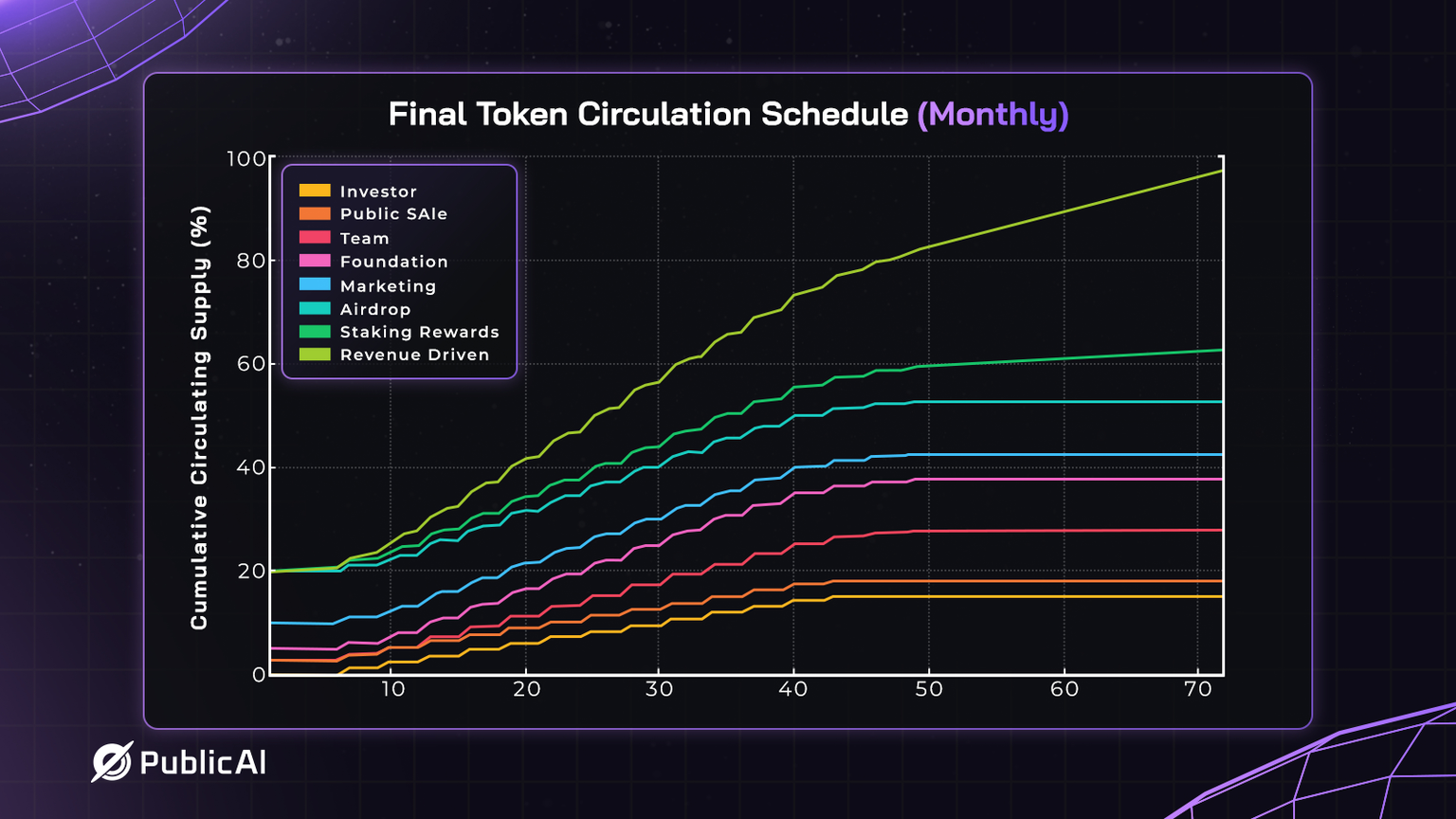
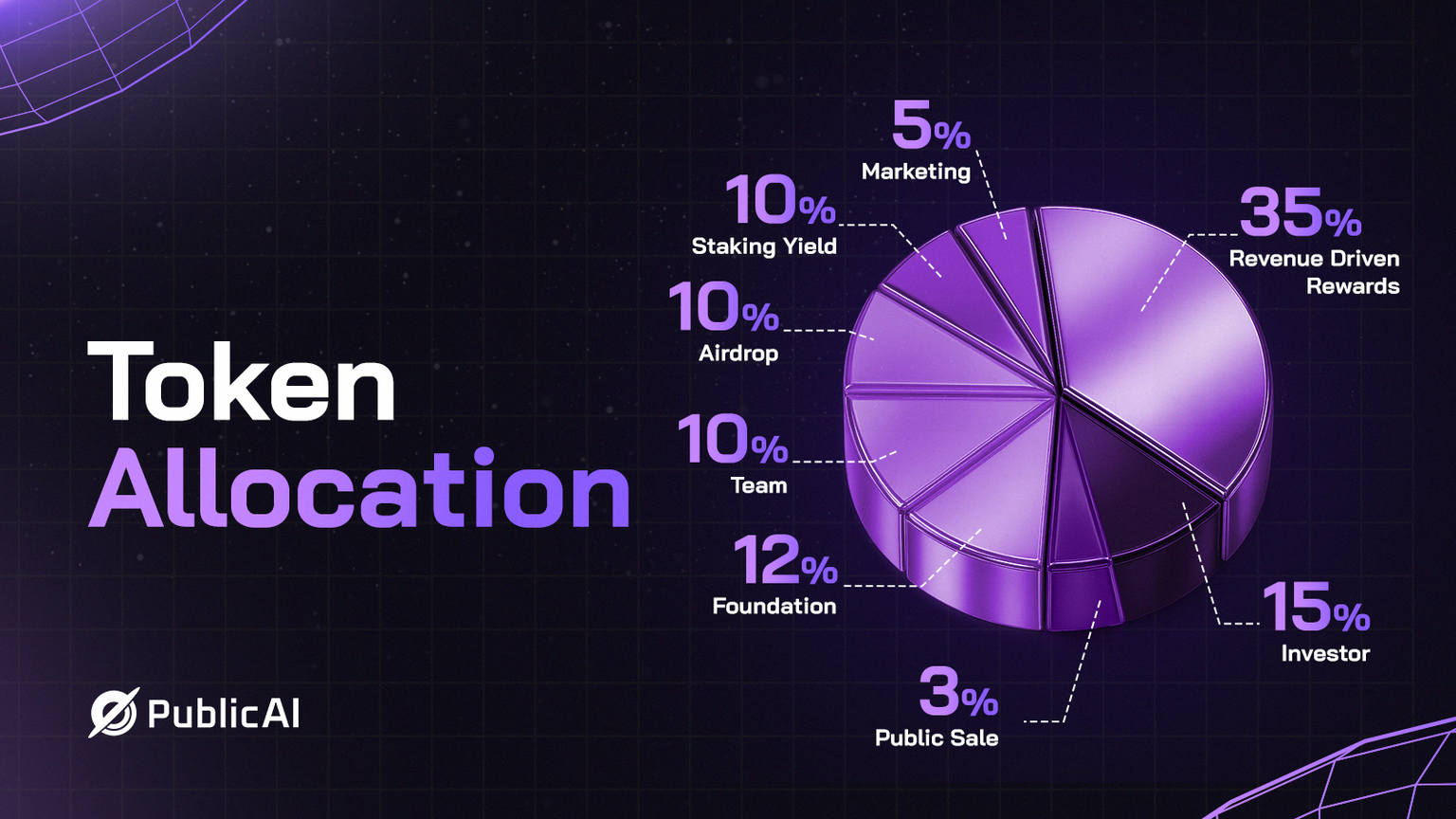
Total supply: 1 billion $PUBLIC
Distribution is as follows:
- Community Rewards – 35% (350M) Rewards linked to real revenue.
- Community Distribution – 20% (200M)
- Airdrop
- Staking incentives
- Investors – 15% (150M) Investors who financed the project’s early development stages.
- Public Sale – 3% (30M) Reserved for global community participation.
- Foundation Treasury – 12% (120M) Research, grants, and operations.
- Core Operations – 15% (150M)
- Team (10%)
- Marketing (5%)
Circulating supply: 200,000,000 tokens.
BFT Data Consensus: PublicAI’s Quality Assurance
PublicAI has a two-stage verification system that guarantees data quality:
- AI Screening Data is first filtered by AI. This stage reduces the workload of human validators.
- Human Voting Then the data is reviewed by three roles:
- Scouts
- Guards
- Judges Consensus thresholds differ for each role. For example, for data to be accepted:
- 50 Scout votes or
- 5 Guard votes or
- 1 Judge approval is sufficient.
This structure ensures that only high-quality data is recorded on-chain.
Contribution Rollup: Converting Points to Tokens
Contributors earn points by completing tasks in campaigns. When a campaign ends, points are converted into $PUBLIC tokens.
The token amount per point is calculated based on:
- Campaign revenue (X)
- Total points issued (W)
- Token price (P)
This ensures everyone is rewarded according to the real economic value of the campaign.
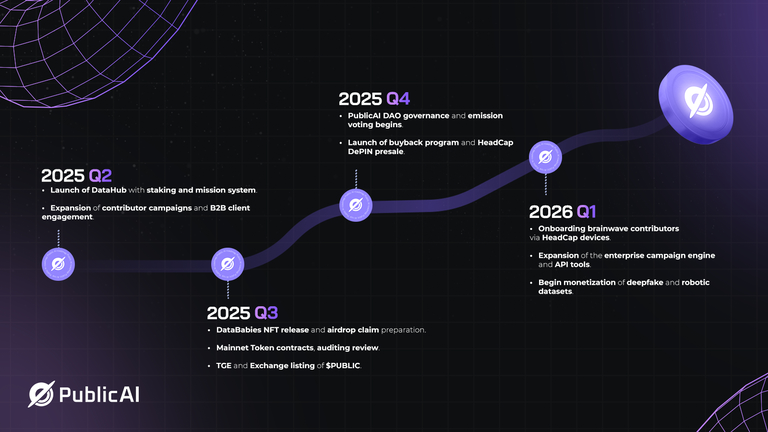
Roadmap (Last 1 Year)
Q1 2025
- Launch of DataHunter as a Web2 data capture tool
- Global scaling of the validator network
Q2 2025
- Opening of DataHub with staking and mission system
- Expansion of B2B client relationships
Q3 2025
- Release of DataBabies NFT collection
- Mainnet contract audits
- $PUBLIC TGE and exchange listings
Q4 2025
- Start of active governance period for PublicDAO
- Launch of buyback program
- HeadCap DePIN pre-sale
Q1 2026
- Onboarding of brainwave contributors via HeadCap devices
- Expansion of enterprise API tools
- Monetization of deepfake and robotics datasets
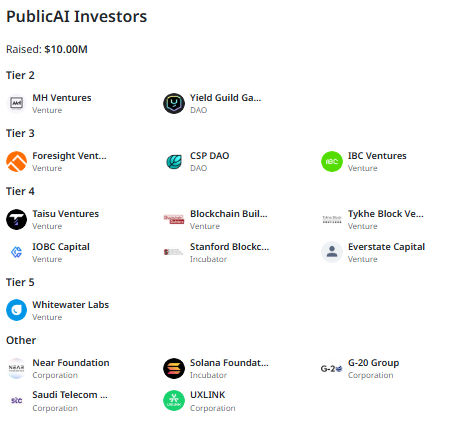
PublicAI (PUBLIC) Investors
The project has raised $10 million to date.
Notable backers:
- MH Ventures
- Yield Guild Games
- Foresight Ventures
- Stanford Blockchain Accelerator
- Solana Foundation
- Near Foundation
- Saudi Telecom Group
- G20 Group
This list shows that PublicAI has earned serious trust in both the Web3 and AI sectors.
PublicAI (PUBLIC) Team
Behind PublicAI is an experienced core team that knows both the artificial intelligence industry and Web3 infrastructure intimately. Since the project’s goal is not only high-quality data production but also creating a sustainable human-AI collaboration model on a global scale, a strong leadership structure is of critical importance.
The following team consists of the names turning this vision into reality:
- Steven Wong – Co-Founder
- Jordan Gray – Co-Founder
- Kenji Narushima – Co-Founder
- The Rare Vandal – Head of Growth

Official Links
You can also freely share your thoughts and comments about the topic in the comment section. Additionally, don’t forget to follow us on our Telegram, YouTube, and Twitter channels for the latest news and updates.