

 Emre Yumlu
Concerns have been circulating within the crypto community about whether Strategy (MSTR) might be compelled to sell part of its Bitcoin holdings due to the recent decline in its share price. According to Matt Hougan, Chief Investment Officer at Bitwise, these fears are misplaced. Hougan argues that the company’s financial position remains strong and that a lower market valuation does not translate into a necessity to liquidate Bitcoin.
No Immediate Pressure to Sell
Hougan notes that Strategy’s share price dropping below its net asset value (NAV) does not automatically create a scenario where Bitcoin must be offloaded. He points to Chairman Michael Saylor’s steadfast commitment to Bitcoin and the company’s long-term accumulation strategy as key reasons why a forced sale is not on the table.
He also highlights that Strategy currently holds around $1.4 billion in cash and has no debt maturing until 2027. With these factors in place, Hougan emphasizes that there is no financial obligation driving the company toward liquidation.
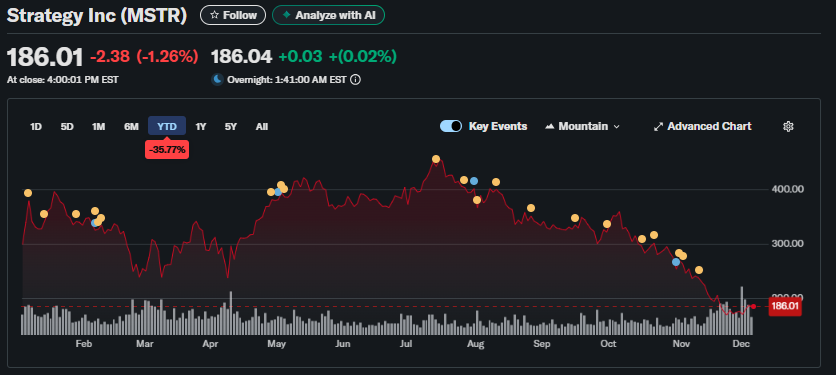
Debate Sparked by the CEO’s “Last Resort” Comment
The discussion intensified last week after CEO Phong Le suggested that, if the company’s market capitalization were to fall below the total value of its Bitcoin holdings and financing alternatives were exhausted, selling Bitcoin could become a “last resort.” The remark raised concerns among investors.
Hougan, however, stresses that such a scenario is not realistic at present. Bitcoin is trading near $92,000, which remains 24% above Strategy’s average purchase price of $74,436.
Financial Responsibilities Remain Manageable
Hougan further explains that the company faces roughly $800 million in annual interest payments but has enough cash reserves to cover these expenses without strain. As a result, he sees no short-term liquidity pressures that would push the firm toward selling its BTC.
Potential MSCI Removal Adds Market Noise
Recent weakness in the stock has also been linked to MSCI’s indication that companies with over half of their balance sheets tied to crypto assets may be removed from its index. Such an action could force index-tracking funds to sell.
Even so, Hougan points out that index-related flows often have less impact than expected. He cites Strategy’s entry into the Nasdaq-100 as an example, where approximately $2.1 billion in inflows did not trigger a significant price reaction.
You can also freely share your thoughts and comments about the topic in the comment section. Additionally, don’t forget to follow us on our Telegram, YouTube, and Twitter channels for the latest news and updates.