

 Emre Yumlu
Throughout 2025, the cryptocurrency industry appeared to have nearly all the ingredients required for a sustained bull market. Regulatory sentiment in the United States softened, spot crypto ETFs launched, institutional participation expanded, and even government-level initiatives entered the conversation. Under normal market conditions, such developments would be expected to fuel strong upside momentum.
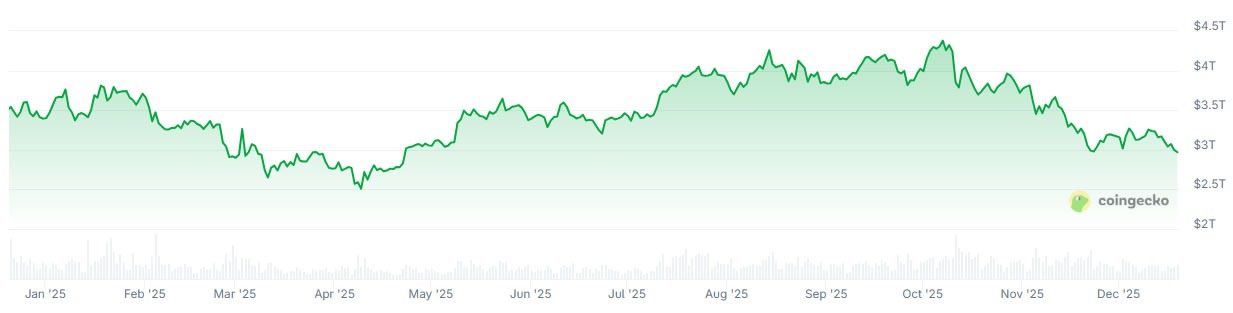
Instead, crypto markets are heading toward year-end in negative territory. Total market capitalization has declined more than 32% from its peak of roughly $4.4 trillion reached in early October and remains nearly 13% below levels seen at the start of the year. This disconnect between fundamentals and price action has led analysts to question whether deeper structural issues are holding the market back.
Is Something Structurally Broken?
One of the most vocal critics of the current market behavior is Ran Neuner. According to Neuner, rising liquidity, a pro-crypto political backdrop, ETF approvals, and strong performance in traditional assets like equities and precious metals should have translated into higher crypto prices. The fact that they have not suggests that the market may be constrained by factors that are not immediately visible.
Neuner outlines two possible paths forward: either the market eventually identifies the true source of persistent selling pressure, or crypto experiences a sharp catch-up rally once that pressure is exhausted.
Leverage and Persistent Selling Pressure
Economist Adam Kobeissi points to another key factor: excessive leverage. He argues that the wave of near-daily liquidations seen over the past two months reflects a broader structural shift within crypto markets. High leverage has amplified downside volatility, preventing prices from stabilizing despite improving macro and regulatory conditions.
Analyst PlanB highlights a more behavioral explanation. In his view, selling pressure continues to come from long-term holders still influenced by the 2021 market collapse, technical traders reacting to momentum indicators, and investors who believe the traditional four-year cycle implies another prolonged downturn.
Has the Crypto Winter Already Arrived?
Some analysts believe the debate is already settled. Markus Thielen, CEO of 10x Research, argues that Bitcoin entered a bear market in late October 2025 by pricing in an economic slowdown ahead of other risk assets. He notes that retail participation failed to meaningfully return during this cycle, while value creation remained concentrated in Bitcoin rather than spreading across the broader market.
Weak Prices, Strong Foundations
Despite disappointing price performance, industry fundamentals remain robust. Pantera’s Erik Lowe emphasizes that 2025 delivered more structural progress than any prior year. Regulatory realignment, the emergence of strategic Bitcoin reserves, growing stablecoin supply, and the expansion of tokenized real-world assets all point to long-term growth rather than decline.
In the short term, crypto markets may continue to struggle. Over the long term, however, the groundwork being laid suggests that the question is not whether the next expansion will come, but when and under what conditions it will unfold.
You can also freely share your thoughts and comments about the topic in the comment section. Additionally, don’t forget to follow us on our Telegram, YouTube, and Twitter channels for the latest news and updates.