

 Emre Yumlu
As systemic risk discussions gain momentum in the Bitcoin ecosystem, one corporate name increasingly stands out: Strategy, formerly known as MicroStrategy. With 671,268 BTC on its balance sheet—representing roughly 3.2% of Bitcoin’s total circulating supply—the company occupies a uniquely influential position. This level of exposure turns Strategy into more than a large investor; it effectively acts as a structural pillar within the crypto market.
A Corporate Model Built Around Bitcoin
Strategy’s business model has evolved into an almost pure Bitcoin proxy. Over time, the company has spent more than $50 billion accumulating BTC, primarily financed through debt issuance and equity sales. In contrast, its legacy software business generates approximately $460 million in annual revenue, a figure that is minimal relative to its Bitcoin exposure.
By December 2025, Strategy’s market capitalization hovered near $45 billion, despite holding Bitcoin valued at approximately $59–60 billion. This valuation gap reflects investor skepticism surrounding dilution risk, leverage, and the long-term sustainability of the strategy. Notably, the company’s average BTC cost basis sits near $74,972, with a significant portion of purchases executed close to market highs in late 2025. Today, over 95% of Strategy’s valuation is directly tied to Bitcoin price movements.
Where the Black Swan Risk Emerges
To fund its Bitcoin accumulation, Strategy employed aggressive financial instruments. Its balance sheet includes over $8.2 billion in convertible debt and more than $7.5 billion in preferred equity, translating into roughly $779 million per year in interest and dividend obligations.
Analysts estimate that a Bitcoin price decline below $13,000 could push the company toward technical insolvency. While such a scenario appears unlikely in the near term, Bitcoin’s historical drawdowns—often exceeding 70–80%—cannot be ignored.
Unlike centralized exchanges, Strategy does not custody third-party funds. However, its failure could prove more disruptive than the FTX collapse in 2022, given its direct control over a massive share of Bitcoin supply. Forced liquidations or market panic could trigger a sharp price cascade across the entire crypto ecosystem.
Assessing the Probability of a 2026 Breakdown
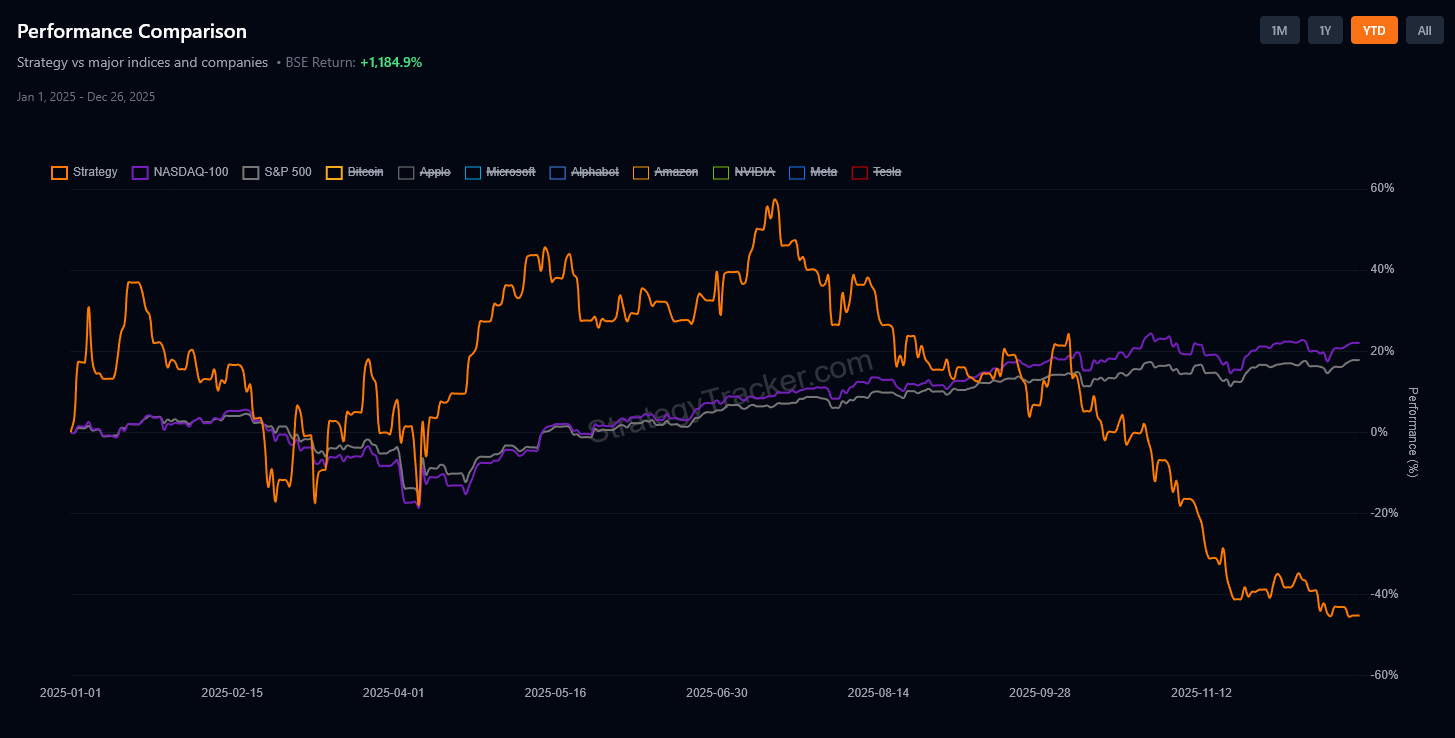
The risk profile is not binary, but it is increasing. Strategy’s stock has declined nearly 50% year-to-date, and its mNAV ratio has fallen below 0.8x. Meanwhile, institutional capital continues shifting toward Bitcoin ETFs, which offer simpler and cheaper exposure.
If Bitcoin remains below $50,000 for an extended period, Strategy’s market value could fall beneath its debt burden. Under such conditions, access to capital markets may tighten significantly, raising the likelihood of restructuring or asset sales.
While a full collapse in 2026 is not the base case, market participants increasingly acknowledge a 10–20% probability. Should that scenario materialize, the repercussions could mark one of the most consequential shock events in crypto history.
This content does not constitute investment advice.
Also, in the comment section, you can freely share your comments and opinions about the topic. Additionally, don’t forget to follow us on Telegram, YouTube and Twitter for the latest news and updates.