

 Yeliz Akmaca
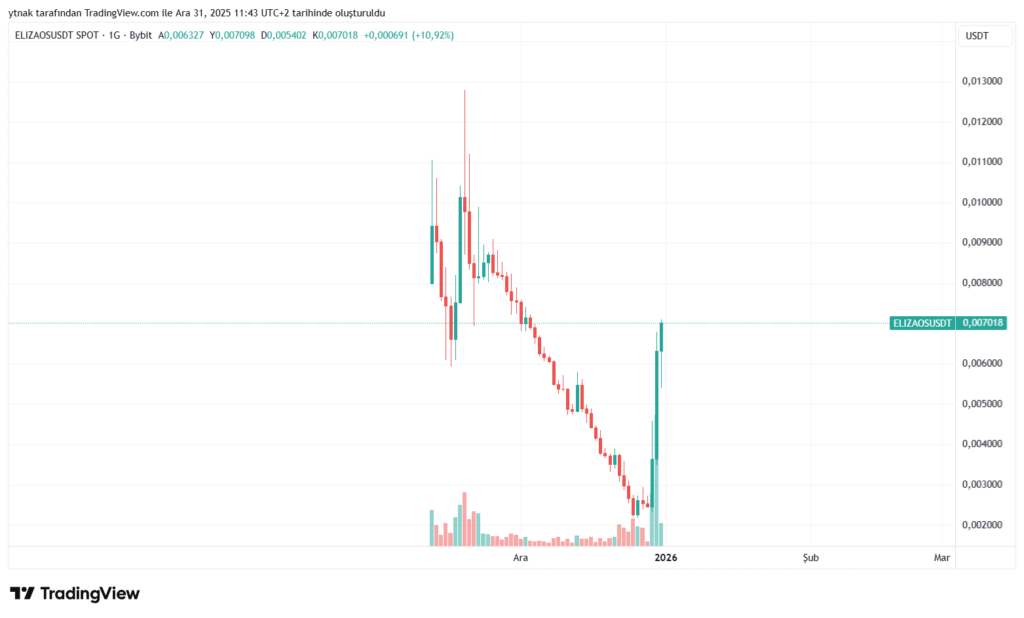
X’s decision to restore the accounts of ElizaOS and its founder Shaw Walters after a six-month suspension triggered an unexpected chain reaction across the crypto market. A project that had remained largely silent for months didn’t just return to the platform — it re-entered the market with force. The ElizaOS token surged more than 150% in the last 24 hours, leaving a sharp mark on the price chart.
This comeback did not arrive by chance. X’s reversal came at a moment when the narrative around AI agents was already regaining momentum. For ElizaOS, the restored visibility acted like a release valve, freeing attention that had been suppressed for months. Still, despite the aggressive price move, the broader picture remains cautious rather than euphoric.
Price Spikes, But Memory Remains
Following the news, ElizaOS’s market capitalization climbed to roughly $48 million. Even so, the token remains far below its November peak of around $0.039. At current levels near $0.0070, ElizaOS is still trading more than 80% below its all-time high.
The contrast matters. Markets appear to be treating the rally as a signal of renewed life, not a full reset. Momentum has returned, but past excesses have not been forgotten. Optimism is present, though it comes with visible restraint.
The Message After a Long Ban
The restoration of Shaw Walters’ account, known on X as @shawmakesmagic, was not interpreted as a routine reversal. In a public statement, Walters and his team described how difficult it had been to survive off-platform, openly admitting that the project was pushed close to invisibility during the ban.
That message reignited a broader discussion about the power social platforms hold over emerging technology projects. When a single account suspension can stall an entire ecosystem, the tension between centralized platforms and decentralized ambitions becomes harder to ignore.
What Is ElizaOS — And Why Is It Back in Focus?
ElizaOS is an open-source framework designed to build autonomous AI agents that operate on blockchains. Rather than limiting itself to single-purpose agents, the project aims to let developers and communities create, tokenize, and deploy their own AI agents within a shared infrastructure.
This vision places ElizaOS in the same narrative lane as early AI-agent platforms like Virtuals Protocol. While development remains in its early stages, markets have a habit of pricing narrative potential long before results fully materialize.
November’s Restructuring Changed the Equation
Another reason ElizaOS has resurfaced is the major restructuring completed in November 2025. The project migrated from the AI16Z token to a new token at a one-to-six ratio, expanding total supply from 6.6 billion to 11 billion tokens.
With circulating supply rising to approximately 7.4 billion, the token’s unit price was effectively divided by six. The move boosted liquidity and lowered the psychological entry barrier for new participants. Markets appear to have interpreted the shift not just as dilution, but as increased accessibility.
Tensions With X Run Deep
The conflict between ElizaOS and X did not begin with this suspension. In August, Eliza Labs and Shaw Walters filed a lawsuit in federal court in San Francisco, accusing X of launching competing AI products after being exposed to Eliza’s technical roadmap. The filing also claims that X subsequently removed Eliza from the platform.
According to the complaint, X demanded enterprise licensing fees of up to $50,000 per month for developers to remain active on the platform. Eliza Labs described those terms as excessive and stated it refused to comply.
While the restored accounts do not signal that the legal dispute has been resolved, the market interpreted X’s move as a meaningful shift in posture.
AI, Competition, and the Unanswered Questions
As X continues to promote its own AI platform, Grok, enforcement actions against third-party AI projects raise uncomfortable questions about fair competition. Some industry participants defend these moves as necessary for platform integrity, while others see them as barriers that could slow innovation.
The ElizaOS episode highlights an unresolved issue: at what point does a platform stop being a neutral host and become a direct competitor? There is no clear answer yet, but markets are already pricing in that uncertainty.
What is clear is this: ElizaOS has returned with momentum. Whether it can turn renewed visibility into lasting relevance remains the real test ahead.
You can also freely share your thoughts and comments about the topic in the comment section. Additionally, don’t forget to follow us on our Telegram, YouTube, and Twitter channels for the latest news and updates.