

 Haciyev Reşit
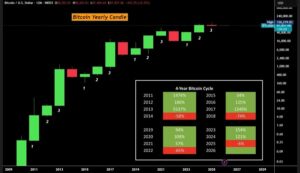
The world’s largest cryptocurrency, Bitcoin, closed 2025 with a red candle, failing to follow its famous four-year cycle for the first time in 14 years. BTC, which lost around 28% of its value in the fourth quarter, surprised investors and long-term holders. As 2026 begins, whale accumulation, tight price ranges, and shifting market dynamics are emerging as key factors that will shape Bitcoin’s direction.
Bitcoin Breaks the 4-Year Cycle
For more than a decade, Bitcoin had followed a typical four-year cycle tied to halving events. In this cycle, the halving year usually closed with a green candle, the following year saw strong price appreciation, then the market peaked and entered a deep correction. The 2013, 2017, and 2021 cycles clearly reflected this rhythm.
However, 2025 broke this pattern. While the 2024 halving year closed strongly, 2025 ended with a red candle. This marked the first time Bitcoin lost value in the year following a halving. Experts do not interpret this shift as a sign of weakness; rather, they see it as an indication of a maturing market. Growing institutional participation, spot ETFs, and deeper liquidity suggest that Bitcoin is now influenced less by halving hype and more by broader economic conditions.
Whales Begin Accumulating Again
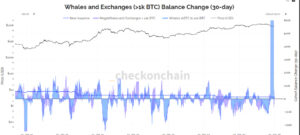
At the start of 2026, on-chain data shows that Bitcoin whales are becoming active again. Large wallets holding more than 1,000 BTC have begun to gradually increase their positions after weeks of declining activity. According to analysis by crypto data provider Crypto Rover, the 30-day trend for these wallets has turned upward, signaling renewed accumulation.
At the same time, the supply of Bitcoin held on exchanges continues to decline. Coins flowing out of exchanges indicate that holders prefer to store their assets rather than sell, reducing the available market supply. In past cycles, this pattern often appeared ahead of strong rallies.
Tight Price Range and Critical Levels
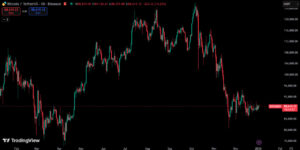
Over the past month, Bitcoin has been trading in a narrow range between resistance around $100,000 and strong support near $84,000. These two levels stand out as key decision points for the market.
- Resistance level: $100,000 is a critical zone as the lower boundary of Bitcoin’s all-time high range. A breakout above this level could signal renewed strength.
- Support level: $74,500 stands out as a key monthly support. If this level is broken, some analysts predict that Bitcoin could form a deeper bottom around $40,000 in 2026.
Bitcoin is currently trading around $88,600, with a market capitalization of approximately $1.75 trillion.
Assessment
By breaking its four-year cycle in 2025, Bitcoin has entered a new phase as it moves into 2026. Whale accumulation is gaining momentum again, while declining exchange balances indicate that investors are choosing to hold rather than sell. This trend limits the available supply in the market and creates conditions for potential price movements.
However, Bitcoin remains stuck in a tight price range. Resistance near $100,000 and support around $84,000 represent critical decision levels for investors. Whether these levels hold or break could be decisive for BTC’s direction in the period ahead. Taken together, these indicators suggest that Bitcoin’s movements in 2026 will be shaped not only by price charts, but also by whale behavior, exchange supply dynamics, and key technical levels, pointing to a more complex and multi-dimensional market environment.
You can also freely share your thoughts and comments about the topic in the comment section. Additionally, don’t forget to follow us on our Telegram, YouTube, and Twitter channels for the latest news and updates.