

 Emre Yumlu
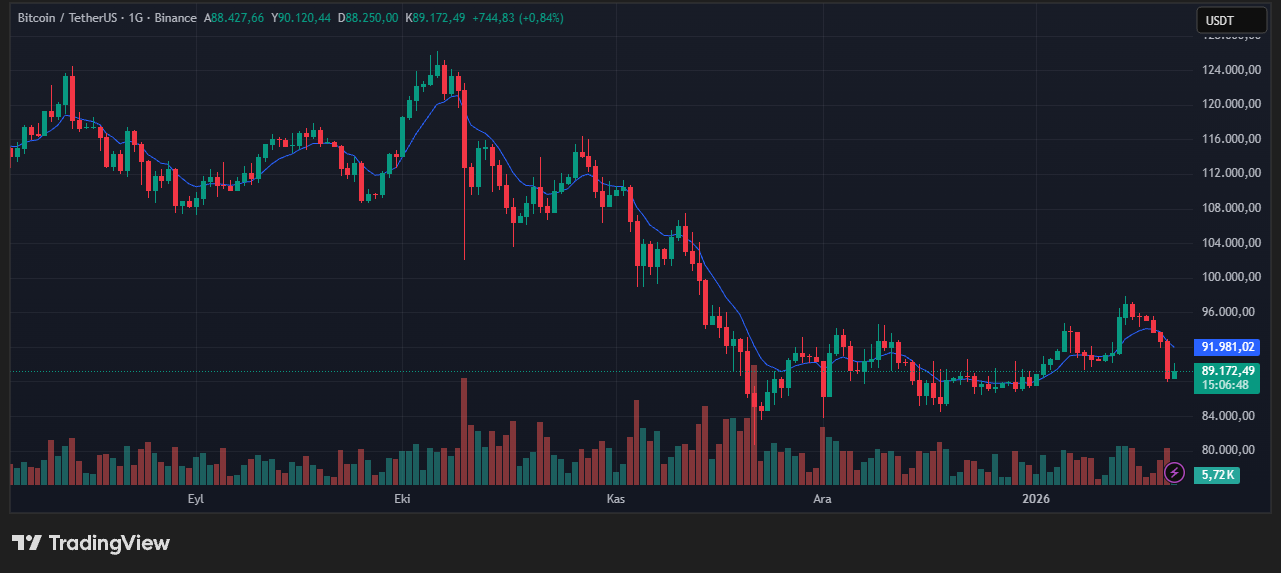
Crypto markets entered the week under heavy pressure as Bitcoin suffered a sharp sell-off, dropping below the $88,000 level and wiping out all gains recorded so far in 2026. The move triggered widespread liquidations, with more than $1.8 billion in leveraged positions cleared in just 48 hours.
The broader market followed suit. Total crypto market capitalization fell by approximately $225 billion, sliding to $3.08 trillion. This marked the steepest market-wide decline since mid-November, highlighting a renewed shift toward risk aversion across global assets.
Bitcoin Breaks Below Key Price Levels
Bitcoin extended its losses on Tuesday, falling nearly 4% on the day and briefly touching $87,790 on Coinbase. The price marked Bitcoin’s lowest level since late December, effectively resetting its year-to-date performance.
Liquidation data shows that roughly 93% of forced closures over the past two days came from long positions, underscoring how heavily positioned the market was on the bullish side. From a technical perspective, Bitcoin also slipped below its 50-day exponential moving average, a level that had previously acted as strong support during the recent rally.
The breakdown has shifted short-term market structure from consolidation to correction, increasing sensitivity to macro-driven headlines.
Is the “Sell America” Trade Re-Emerging?
One of the dominant narratives behind the sell-off has been the return of trade-related uncertainty. Renewed tariff threats from U.S. President Donald Trump have reignited concerns over global trade tensions, prompting investors to reassess exposure to U.S.-linked risk assets.
This dynamic mirrors the so-called “Sell America” trade that emerged earlier in the year, where capital rotated away from U.S. equities, bonds, and risk assets amid policy uncertainty. However, market participants increasingly agree that tariffs alone do not fully explain the scale and speed of the current drawdown.
Japanese Bond Market Turmoil Sends Shockwaves Globally
A major contributing factor has been extreme volatility in the Japanese government bond market. Yields on Japan’s 10-year bonds surged by nearly 19 basis points over two days, while 30-year yields recorded their largest single-day increase since 2003.
The move reflects rising concerns over fiscal expansion, increased government spending, and tightening liquidity conditions. As Japanese bonds play a central role in global funding markets, this sudden repricing has forced investors to unwind positions across multiple asset classes.
Analysts warn that such moves risk accelerating the unwinding of carry trades, a key source of global liquidity. As leverage is reduced, assets with higher sensitivity to liquidity—such as cryptocurrencies—tend to face disproportionate selling pressure.
Bitcoin Caught Between Hard Asset Narrative and Liquidity Reality
Despite often being compared to gold due to its fixed supply, Bitcoin continues to behave differently during periods of financial stress. While gold reached fresh all-time highs during this risk-off phase, Bitcoin struggled to attract defensive flows.
This divergence highlights Bitcoin’s current positioning: structurally aligned with hard assets, but tactically treated as a liquidity-sensitive risk asset. As capital shifts away from U.S. markets and geopolitical uncertainty intensifies, Bitcoin has been pulled into a broader deleveraging cycle rather than benefiting from safe-haven demand.
Some analysts suggest that if liquidity conditions stabilize, Bitcoin could follow gold’s trajectory with a delay. For now, however, macro forces remain the dominant driver.
Market Outlook: Volatility Likely to Persist
The past few days have reinforced a key reality for crypto markets: price action is increasingly dictated by global macroeconomic developments rather than purely crypto-native factors. Turmoil in Japanese bond markets, uncertainty around U.S. trade policy, and tightening liquidity conditions are all feeding into elevated volatility.
Until clarity emerges on these fronts, short-term stability remains unlikely. Bitcoin’s next directional move will depend not only on technical levels, but on whether global capital flows begin to normalize or continue retreating from risk.
For investors, the coming period may test conviction, as macro-driven shocks continue to override local market narratives.
Also, you can freely share your thoughts and comments about the topic in the comment section. Additionally, don’t forget to follow us on our Telegram, YouTube, and Twitter channels for the latest news and updates.