
 Yeliz Akmaca
Aztec Network is a privacy-focused Layer-2 (L2) blockchain platform built on Ethereum. Using zero-knowledge proofs (ZKPs), transactions, balances, and smart contract logic are visible only to the relevant parties. This approach enables configurable privacy while preserving Ethereum’s transparency guarantees. Rather than enforcing privacy by default, Aztec allows it to be programmed based on specific use cases. Through Ignition Chain, the network enables real-world assets to participate on-chain without compromising Ethereum’s security.
Why Privacy Matters
By design, most blockchains expose all transaction data publicly. While transparency is beneficial, it creates friction for institutions, asset issuers, and users who need confidentiality. Aztec addresses this structural limitation by making privacy a native, programmable component of the blockchain stack.
Founders and Core Team
Aztec was founded by a team with deep expertise in cryptography and blockchain engineering:
-
Zac Williamson (CEO): PhD in physics and co-creator of the PLONK zero-knowledge proof system.
-
Joe Andrews: Experienced founder focused on decentralized privacy solutions.
-
Tom Walton-Pocock: Leads strategy and protocol development.
Development is handled by Aztec Labs, while network support is coordinated through the Aztec Foundation. The team has been building Ethereum privacy infrastructure for over eight years, guided by cypherpunk principles.

Funding and Partnerships
Aztec has raised between $119 million and $170 million in funding. Key investors include a16z, Paradigm, Coinbase Ventures, Consensys, and Vitalik Buterin. Strategic partners include Uniswap Labs, P2P.org, Nethermind, and ZKV.
The network operates globally with over 185 operators and maintains deep integration with the Ethereum ecosystem, including privacy-focused collaborations such as ZKPassport.
Project Vision
Aztec aims to overcome the limitations imposed by full on-chain transparency. It enables end-to-end privacy for user data and transactions while giving developers granular control over privacy levels. The protocol unlocks new use cases across DeFi, NFTs, DAOs, and Web3 applications.
How the Mechanism Works
Aztec operates as a ZK-rollup on Ethereum using a PLONK-based verification system. Ignition Chain decentralizes block sequencing and proof generation. Sequencers stake AZTEC tokens to produce blocks, while provers generate zero-knowledge proofs. Block rewards are distributed 70% to sequencers and 30% to provers.
The Noir programming language simplifies the development of private applications. To date, the network has produced 75,000+ blocks with a verification rate exceeding 99%.
Transaction flow:
-
Users submit tokens or transactions.
-
A zero-knowledge proof is generated.
-
Ethereum mainnet verifies correctness without seeing transaction details.
Core Privacy Features
-
Hybrid State Model: Combines Ethereum’s account-based structure with a UTXO-like privacy model.
-
Client-Side Proving: ZK proofs are generated locally; sensitive data never leaves the device.
-
Noir Language: Enables private dApp development without deep cryptography expertise.
-
Call-Stack Obfuscation: Kernel circuits hide function calls and transaction counts.
How Governance Works on Aztec
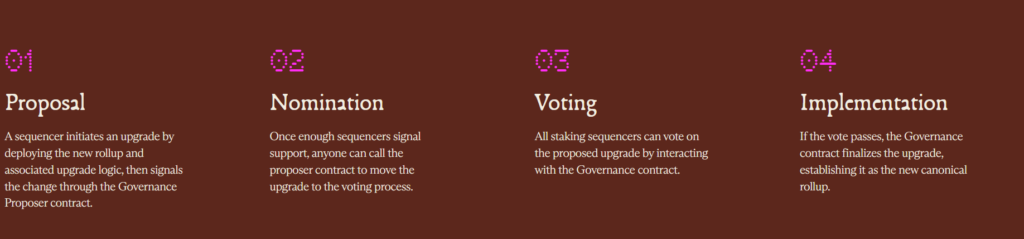
Network upgrades are executed through a multi-stage, on-chain governance process.
- Proposal Phase
A sequencer proposes a new rollup structure or technical upgrade. The update logic is uploaded on-chain and announced via the governance contract.
- Support Collection
Once sufficient support from other sequencers is gathered, any user may advance the proposal to a vote, preventing stagnation.
- Voting
Staked sequencers vote on the proposal through the governance contract. Decisions are made transparently on-chain.
- Execution
If approved, the update becomes the new canonical rollup and is automatically implemented.
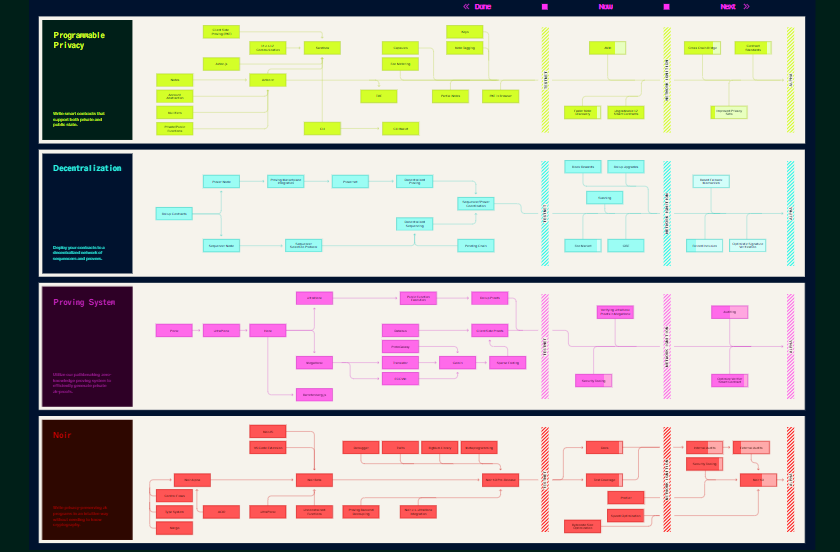
What’s in Development
Programmable Privacy
Private and public smart contracts can coexist within the same architecture. Current focus is on data availability, with future work targeting standardized contract frameworks.
Decentralized Network Structure
Sequencer and prover infrastructure is live. Staking mechanics, gas fees, and governance tooling remain under active development to eliminate central control points.
ZK Proving System
ZK proof libraries are production-ready. Ongoing efforts include security audits and proof delegation, optimized for long-term resilience.
Noir Programming Language
Noir’s core architecture is complete. Testing coverage is expanding, with plans for a Noir 1.0 release.
Roadmap
-
2018: Project founding and PLONK development
-
2022: $100M Series B funding
-
November 2025: Ignition Chain launch
-
December 2025: Token sale (~$60M)
-
January 2026: TGE approval
-
February 2026: Token trading begins; Uniswap V4 pool goes live
-
Future: Fractional staking, private smart contracts, expanded Ethereum compatibility
AZTEC Token Utility
-
Staking: Running or delegating to sequencers
-
Governance: Voting on protocol upgrades
-
Transaction Fees: Payment for network usage
-
Block Rewards: Distributed to sequencers and provers
-
Network Security: Supports decentralized PoS security
Token Information and Distribution
AZTEC is the native token of Aztec Network, a privacy-focused Ethereum Layer-2 solution.
-
Symbol: AZTEC
-
Total Supply: 10.35 billion
-
Launch: December 2025 via Uniswap CCA (~$350M FDV)
-
Vesting: Team and investors — 1-year cliff + 2-year vesting
Tokens are held in Aztec Token Position (ATP) contracts on Ethereum, enforcing lockups and release schedules on-chain. This structure enables locking, gradual unlocking, and temporary exclusion from staking or governance, ensuring strict, programmatic distribution discipline.
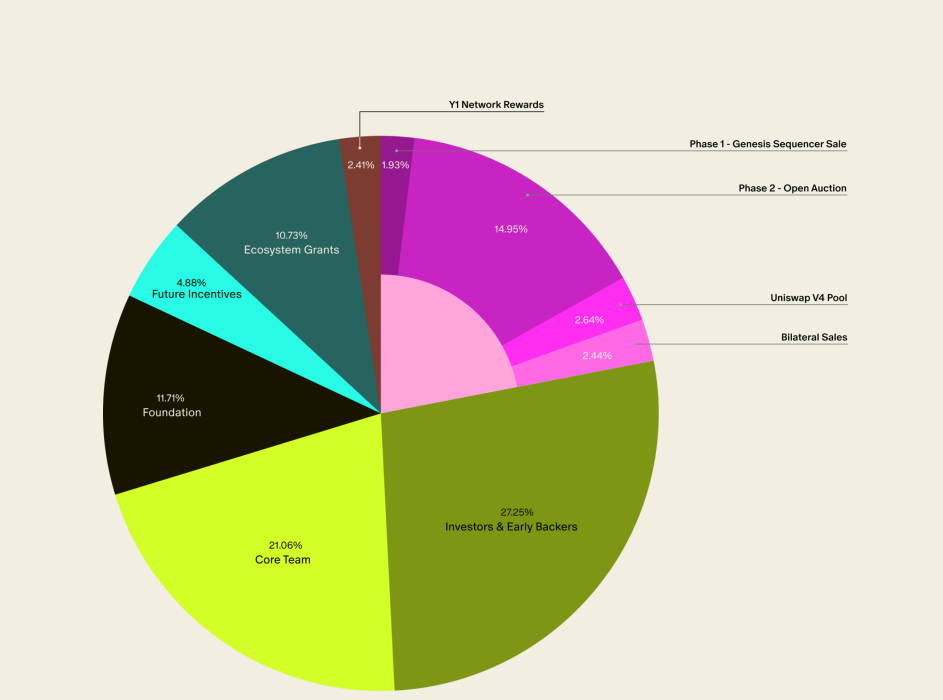
Allocation Breakdown
-
Investors & early backers: 27.26%
-
Core team: 21.06%
-
Foundation: 11.71%
-
Ecosystem grants: 10.73%
-
Future incentives: 4.89%
-
Year-1 network rewards: 2.41%
-
Liquidity & reserves: 21.96%
Ecosystem and Applications
-
Azguard Wallet: Browser wallet for private asset management
-
Nemi DEX: Privacy-preserving trading with transparent amounts
-
Nyx, Olla, Raven House: Private NFT ownership and marketplaces
-
ZKPassport: Selective disclosure of real-world identity on-chain
The network is supported by 3,400+ sequencers across five continents, with active testnets, grants, and ecosystem growth initiatives.
Key Features
-
Programmable privacy layers
-
Decentralized architecture from launch
-
99%+ verification rate with Ethereum compatibility
-
Simplified ZK development via Noir
-
Hybrid public/private execution model
-
Incentive-driven security through block rewards
Official Links
- Website: https://aztec.network
- Economic Whitepaper (Tokenomics): https://aztec.network/economic-whitepaper
- Blog: https://aztec.network/blog
- X (Twitter): https://x.com/aztecnetwork
You can also freely share your thoughts and comments about the topic in the comment section. Additionally, don’t forget to follow us on our Telegram, YouTube, and Twitter channels for the latest news and updates.