

 Emre Yumlu
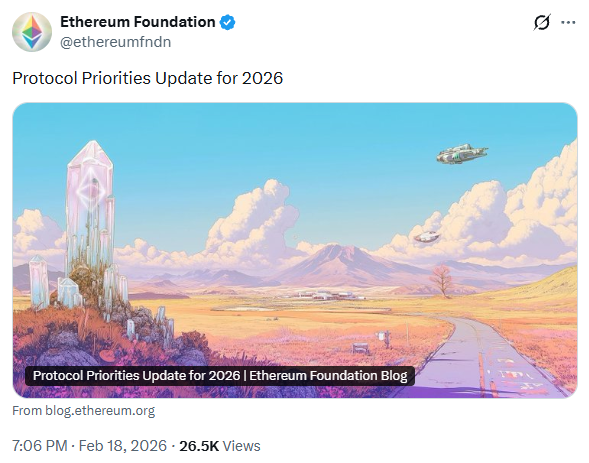
The Ethereum Foundation has outlined its protocol priorities for 2026, signaling a continued push toward scalability, improved user experience, stronger interoperability, and long-term quantum resistance. According to the foundation, 2025 marked one of the network’s most productive years, driven by two major upgrades and a significant increase in the gas limit.
Scaling Further: Gas Limit Beyond 100 Million
One of the most closely watched technical metrics within the Ethereum ecosystem has been the gas limit — the maximum computational workload allowed per block. Throughout 2025, the topic remained central to community discussions as the network pursued higher throughput without compromising decentralization.
Following the Pectra and Fusaka upgrades, the community doubled the gas limit from 30 million to 60 million, marking the first major increase since 2021. For 2026, the foundation aims to push the limit gradually beyond 100 million. Some Ethereum educators have suggested that projections of 180 million in 2026 may represent a baseline rather than an optimistic ceiling, highlighting growing confidence in the network’s scaling trajectory.
Preparing for the Post-Quantum Era
Beyond throughput improvements, Ethereum is taking a forward-looking stance on security. “Post-quantum readiness” has been identified as a strategic priority, reflecting concerns that future quantum computers could threaten existing cryptographic standards.
A key milestone will be the Glamsterdam network upgrade, expected in the first half of 2026. Earlier this year, Ethereum researcher Justin Drake announced the formation of a dedicated Post-Quantum (PQ) team within the foundation. The initiative represents a long-term effort to ensure the network remains secure in a future where quantum capabilities become commercially viable.
Smarter Wallets and Seamless Interoperability
User experience is also central to the 2026 agenda. Native account abstraction is expected to enhance smart wallet functionality, making Ethereum interactions more intuitive and flexible. At the infrastructure level, faster Layer 1 confirmations and shorter Layer 2 settlement times are being prioritized to enable smoother, trust-minimized cross-L2 interactions.
The broader goal is to create a more seamless multi-chain environment while preserving Ethereum’s security guarantees.
Ethereum and Artificial Intelligence
These developments follow recent comments from Ethereum co-founder Vitalik Buterin regarding the intersection of blockchain and artificial intelligence. Buterin has emphasized that AI should enhance human agency, improve financial safety, and support healthier markets rather than replace human decision-making. While near-term applications may remain practical and incremental, his long-term vision positions Ethereum as part of a broader technological evolution.
Overall, the 2026 roadmap reflects a balanced strategy: scaling the network’s capacity, upgrading its security architecture, and refining the user layer — all while preparing Ethereum for a more complex digital future.
You can also freely share your thoughts and comments about the topic in the comment section. Additionally, don’t forget to follow us on our Telegram, YouTube, and Twitter channels for the latest news and updates.