

 Emre Yumlu
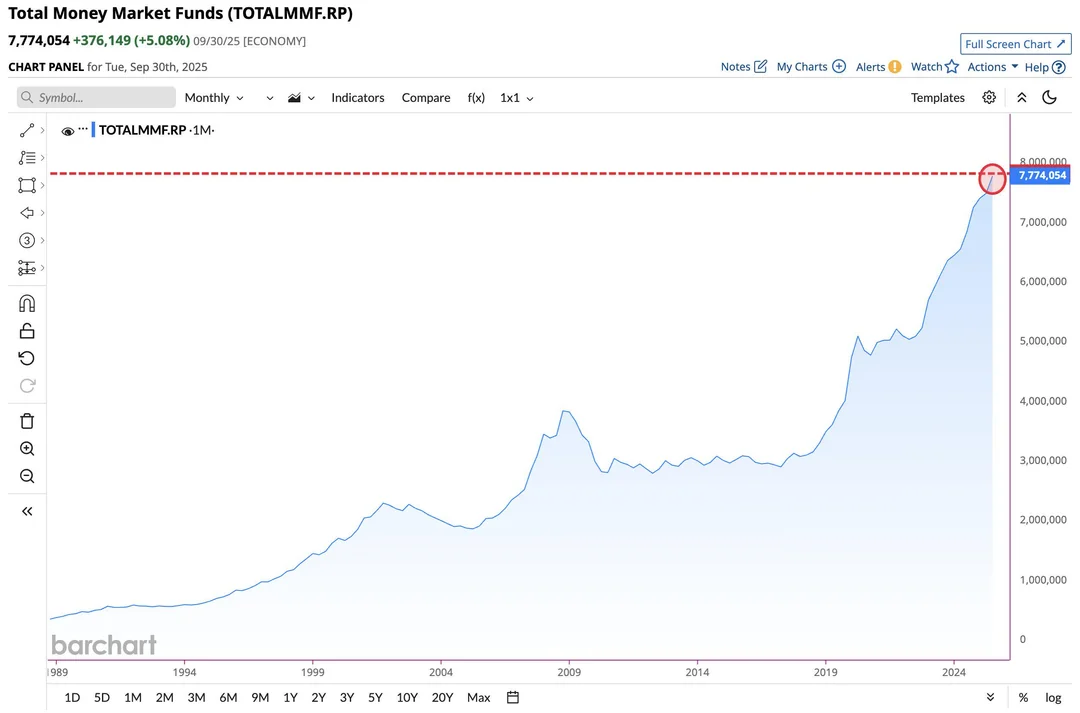
Roughly $7.8 trillion is currently parked in US money market funds, forming a massive pool of capital sitting on the sidelines. These funds primarily allocate to short-term, low-risk instruments, offering stability at the cost of gradually declining returns. The key question for markets is whether a portion of this capital could rotate into higher-risk assets such as Bitcoin and other cryptocurrencies.
The Federal Reserve began its rate-cutting cycle on September 18, 2024. It has now been 522 days since that first move. Historically, liquidity has tended to rotate into risk assets within a 500–1000 day window following the start of easing cycles. While the calendar may suggest a favorable setup, the decisive factor will be incentives.
Falling Yields, Shifting Incentives
As of January 2026, the effective federal funds rate stands at 3.64%, down from 4.22% in September 2025. Money market fund yields have followed suit, averaging around 3.58%. This compression in returns reduces the relative appeal of holding cash and forces investors to reconsider asset allocation decisions.
For the week ending February 18, 2026, total money market fund assets reached $7.791 trillion. Of this amount, $6.405 trillion is allocated to government funds, $1.242 trillion to prime funds, and $0.144 trillion to tax-exempt funds. Retail investors account for $3.082 trillion, while institutional investors hold $4.709 trillion. Institutional capital, often reserved for payroll, vendor payments, and credit facilities, typically moves more cautiously.
Even small reallocations carry significant implications. A 1% outflow equals approximately $78 billion, while a 5% shift would amount to roughly $390 billion. The scale alone underscores how meaningful changes in the rate environment could be.
Where Could the Money Go?
In most easing cycles, capital initially rotates toward bonds and investment-grade credit. However, if risk appetite strengthens, equities and digital assets may also attract flows. The stablecoin market currently stands at $308 billion, and US spot Bitcoin ETFs have recorded cumulative inflows of $61.3 billion, demonstrating that crypto infrastructure can absorb substantial capital. A mere 0.5% reallocation from money market funds would represent about $39 billion in potential inflows.
Three Possible Paths
A gradual and cautious easing cycle may result in limited outflows of 0–2%. A faster “soft landing” scenario could drive reallocations of 5–10%. In contrast, a recession-driven cutting cycle might initially boost money market balances by 3–8% as investors seek safety.
Ultimately, incentives matter more than timelines. As yields decline, the opportunity cost of holding cash rises. For Bitcoin, a marginal-demand-driven asset, the direction and speed of capital rotation from this enormous cash reserve may prove decisive.
You can also freely share your thoughts and comments about the topic in the comment section. Additionally, don’t forget to follow us on our Telegram, YouTube, and Twitter channels for the latest news and updates.