

 Emre Yumlu
Launched in June 2025, Katana Network (KAT) is positioned as a blockchain specifically designed with a focus on decentralized finance (DeFi). Katana’s core claim is to concentrate liquidity around specific core applications and assets rather than fragmenting it, thereby creating deeper market structure and sustainable yield generation. This approach aims to deliver a more efficient DeFi experience for both individual users and institutional actors.
What Does Katana Network (KAT) Provide?
Katana Network (KAT) is built on an architecture that aims to reduce the liquidity fragmentation commonly seen in classic DeFi ecosystems. Instead of liquidity being split across multiple lending protocols or DEXs, it prefers a structure where liquidity concentrates around designated core applications on-chain. This increases pricing efficiency, reduces slippage rates, and aims to improve capital utilization effectiveness.
Katana Network offers a hybrid DeFi architecture that deliberately centralizes liquidity while maintaining distributed governance oversight. Through Vault Bridge, Chain-Owned Liquidity, and multi-layered yield sources, it aims to create a sustainable incentive cycle.
Its security-focused governance model and combination of on-chain/off-chain revenue streams are among the key elements that distinguish Katana from classic DeFi chains. As of June 2025, this launched structure positions itself as an example of next-generation DeFi designs focused on liquidity depth and capital efficiency.
DeFi-Optimized Chain with Katana Network (KAT)
Katana is designed not as a general-purpose blockchain but as a chain specifically optimized for DeFi use cases. At the center of its architecture are two core applications:
- Spot DEX: Sushi
- Lending & Borrowing: Morpho
Concentrating liquidity around these two fundamental primitives creates stronger composability across the ecosystem. While hundreds of applications are built on top of this core infrastructure, liquidity deepens in the same pools without fragmentation.
This model enables the chain to operate with a cyclical yield mechanism defined as the “DeFi flywheel.” As liquidity increases, usage grows; as usage grows, revenue increases; and the generated revenue is redirected to liquidity incentives, strengthening the cycle.
Vault Bridge and Productive TVL Model
One of Katana’s most notable components is the Vault Bridge structure. This mechanism aims to generate productive total value locked (TVL) at the bridge level.
Users bridge specific assets into yield-generating “wrapper” structures to enter the Katana network. At the end of this process, users receive the following vbTokens:
- vbUSDC
- vbUSDS
- vbUSDT
- vbWBTC
- WETH (yield-generating version)
The yield generated from these assets is directed straight into the Katana ecosystem and used to incentivize liquidity pools. This way, incoming capital does not sit passively; it becomes productive.
WETH serves as the chain’s native ETH representation on Katana by implementing the WETH9 interface in a yield-generating version.

Chain-Owned Liquidity (CoL)
Katana adopts the “Chain-Owned Liquidity” (CoL) model so that liquidity is not solely dependent on user incentives. In this model, the chain directly owns liquidity around core assets.
This liquidity is funded from sequencer revenues and distributed to core applications. As a result:
- Liquidity flight during market fluctuations is limited
- Borrowing rates remain more stable
- Slippage rates decrease in DEX trades
CoL is designed as a shock-absorbing mechanism, especially during bear markets.
Katana Network (KAT) Ecosystem Components
The main asset types present in the Katana ecosystem are as follows:
- Native Stablecoin: AUSD
- Bridged Meta Assets: Vault Bridge (vbTokens)
- Asset Importer Protocol: Universal
- Native Bitcoin Wrapper: Lombard (LBTC)
AUSD brings off-chain yield flows backed by U.S. Treasury bills into the ecosystem. This incorporates not only on-chain revenues but also off-chain yields into the incentive mechanism.

Sustainable Yield Architecture
Katana’s yield model does not rely solely on inflationary token incentives. Multiple revenue sources are utilized:
- Yield generated at L1 level through Vault Bridge
- Off-chain yield from AUSD based on U.S. Treasury bills
- Net sequencer revenues
- Protocol fees collected from core applications
This diversified structure aims to provide revenue stability across different market cycles.
Security and Governance Structure
Katana was launched with a two-layer governance model:
Katana Admin (3/5 Multisig)
- Proposes all technical upgrades and system changes.
- Features a 10-day timelock mechanism.
- Initiates systemic decisions such as bridge contracts, validator upgrades, and $KAT token minting.
DeFi Security Council (10/13 Multisig)
- Can veto Admin decisions.
- Has direct intervention authority in emergency situations.
- Composed of infrastructure providers and DeFi integrators within the ecosystem.
This separation aims to strike a balance between fast iteration and security.
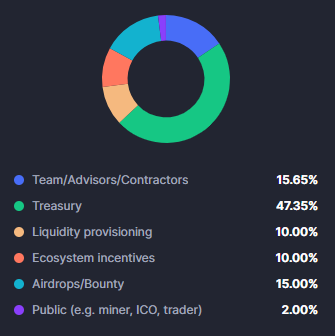
Katana Network (KAT) Tokenomics
Distribution
- Team / Advisors / Contractors: 15.65%
- Treasury: 47.35%
- Liquidity Provision: 10.00%
- Ecosystem Incentives: 10.00%
- Airdrop / Reward Programs: 15.00%
- Public Allocation (miners, ICO, traders, etc.): 2.00%
Allocating the largest share to the treasury signals long-term incentive and sustainability planning.
Katana Network (KAT) Team
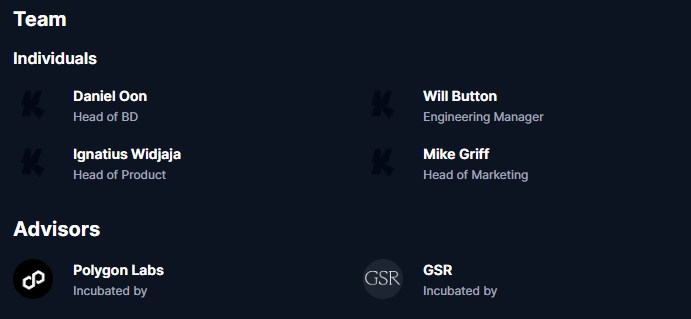
Katana is managed by professionals experienced in DeFi and infrastructure. The project has also received institutional-grade incubation support.
Individuals
- Daniel Oon – Head of BD
- Will Button – Engineering Manager
- Ignatius Widjaja – Head of Product
- Mike Griff – Head of Marketing
Incubators / Advisors
- Polygon Labs – Incubated by
- GSR – Incubated by
Official Links
Also, in the comment section, you can freely share your comments and opinions about the topic. Additionally, don’t forget to follow us on Telegram, YouTube and Twitter for the latest news and updates.