

 Yeliz Akmaca
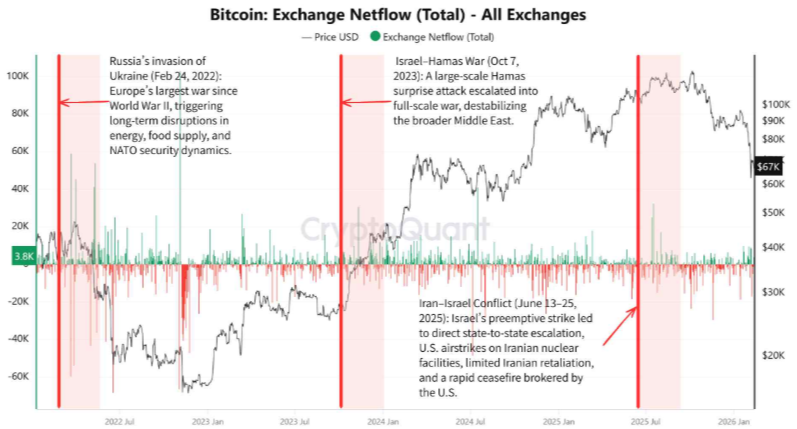
Why is Bitcoin so resilient to global events? CryptoQuant’s Exchange Netflow data from early 2022 to early 2026 helps answer this. Analysis shows sudden spikes in Bitcoin exchange inflows during three major geopolitical crises—but they are short-lived. And yes, the market quickly normalizes.
The first case began on February 24, 2022: Russia’s invasion of Ukraine. Europe witnessed one of its largest conflicts in decades, and Bitcoin flowed rapidly into exchanges. Netflow charts show a brief panic wave, but within weeks, levels returned to normal. During this period, exchange inflows rose by about 15%. Prices, however, continued without major deviation.
A similar scenario occurred during the Israel-Hamas conflict in October 2023. Bitcoin was trading around $20,000. Short-lived exchange movements suggested panic, but the annual upward trend remained intact. Notably, geopolitical crises did not create lasting downward pressure.
The Iran-Israel tensions in June 2025 and early 2026 reinforced this pattern. Rapid U.S. intervention, followed by a ceasefire… Bitcoin approached $100,000, and net inflows temporarily reached around 3,800 BTC. However, this spike was short-lived; prices slightly declined and flows returned to prior levels. Same rhythm. Same cycle.
Bitcoin’s Resilience
Analysts attribute this rapid normalization to Bitcoin’s structural characteristics. Supply is fixed, networks are continuous and independent. It is not tied to central banks or a single national economy. Military crises may disrupt supply chains, but they do not affect Bitcoin’s core mechanism.
Most netflow spikes stem from risk-aversion or short-term speculative moves: futures can trigger forced liquidations, whales may sell to manage positions. When uncertainty eases, market balance is quickly restored.
ETFs and institutional participation also make a difference. Shocks no longer fully impact spot markets; much is absorbed through derivatives. This keeps price movements brief and contained.
As of March 1, 2026, following U.S.-Israel strikes on Iran and reports of Ali Khamenei’s death, Bitcoin experienced short-term volatility. Netflow and price trends resembled prior geopolitical fluctuations.
Macro Factors and Regulatory Effects
Beyond military conflicts, Bitcoin’s mid- and long-term trajectory is shaped by macro factors: global liquidity, stablecoin supply, and interest rate expectations. These leave more lasting effects than wars. Regulatory initiatives like the U.S. Clarity Act may be more significant than geopolitical crises.
CryptoQuant observes that early 2026 U.S. operations resemble the June 2025 Iran-Israel escalation. Both involved rapid intervention and ceasefire. Relatively low netflow data indicate that market participants view these events as short-term volatility rather than structural shifts.
In short, geopolitical news causes temporary swings, but Bitcoin’s structural path remains unchanged. History shows: liquidity and regulation, not war, determine Bitcoin’s fate.
You can also freely share your thoughts and comments about the topic in the comment section. Additionally, don’t forget to follow us on our Telegram, YouTube, and Twitter channels for the latest news and updates.