

 Yeliz Akmaca
At a time when artificial intelligence tools are rapidly increasing, the inability of these tools to communicate with one another has become one of the biggest efficiency losses. This is exactly where Play AI enters the picture. With its vision of “Onchain AI Orchestration,” the platform introduces an intelligent layer designed to unify scattered AI models under a single system.
Play AI is a decentralized protocol that allows complex artificial intelligence tasks to be managed through a single command (prompt). The core idea behind the project is to create an “AI Playground” by connecting different blockchains, applications, and AI models. While users can earn income by sharing their data, developers can build far more accurate AI agents using that data.
The platform was founded in 2023 and has quickly grown to reach 2.25 million users. Its mainnet has already launched, and the project has raised a total of $6.3 million in funding. Users can perform AI operations using voice commands through the PlayHub interface and MadRims smart glasses.
Team and Founders
Although the official website does not include a dedicated “Team” page, the roots of the project trace back to well-known figures in the technology industry. Moreover the project is part of the PLAI Labs ecosystem.
The core team includes:
-
Chris DeWolfe: Co-founder of MySpace, one of the earliest social media platforms.
-
Aber Whitcomb: A veteran technology entrepreneur and co-founder.
-
Ramees PS: Co-founder responsible for overseeing the operational processes of the project.
This team brings experience from building multi-billion-dollar companies into the Web3 ecosystem.
Partners and Investors
PlayAI is supported by strategic partnerships and investors. Partnerships include Polygon Ventures, Solana, Ethereum multi-chain integrations, and the Kaito Launchpad. The project has raised $6.3 million in total funding.
-
Data integration through Hub.xyz and MadRims
-
Web3 venture funds and angel investors financing ecosystem expansion
-
Partnerships in the gaming and AI sectors supporting early adoption
Project Idea
Connecting different systems and AI agents forms the core concept behind PlayAI. Through a single interface, users can:
-
Start tasks
-
Share data between tools
-
Automate multi-step workflows
The main goal is to simplify everyday workflows and increase productivity.
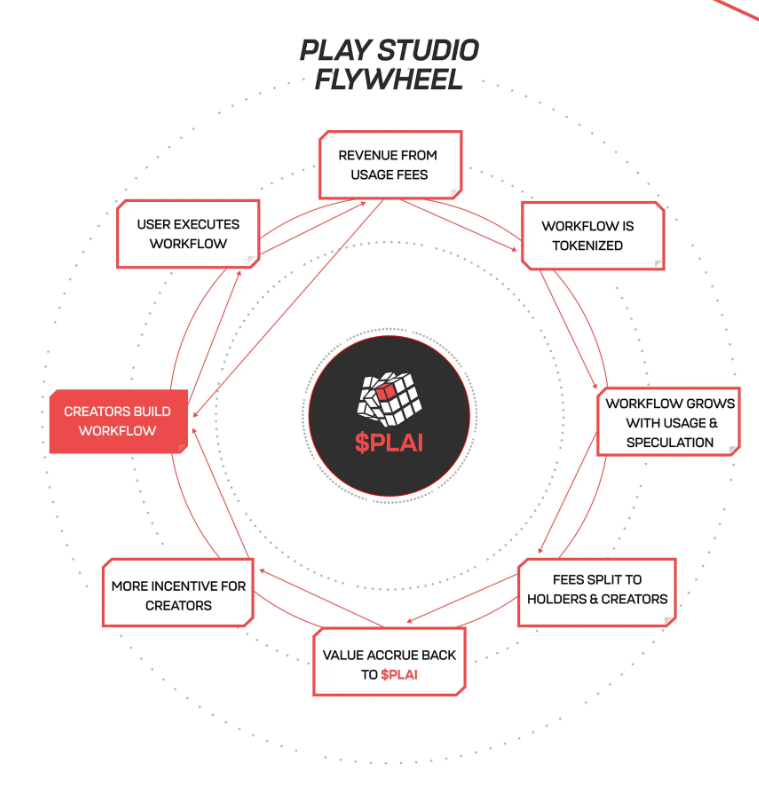
From a technical perspective, the system works like an orchestra. According to the shared workflow architecture, once a user task is initiated the system autonomously moves through Identify, Deploy, and Verify stages.
At this point, MCPS and AI agents become active. Working through Play Studio, they synchronize with data marketplaces and complete complex workflows within seconds.
Play AI How the Project Works
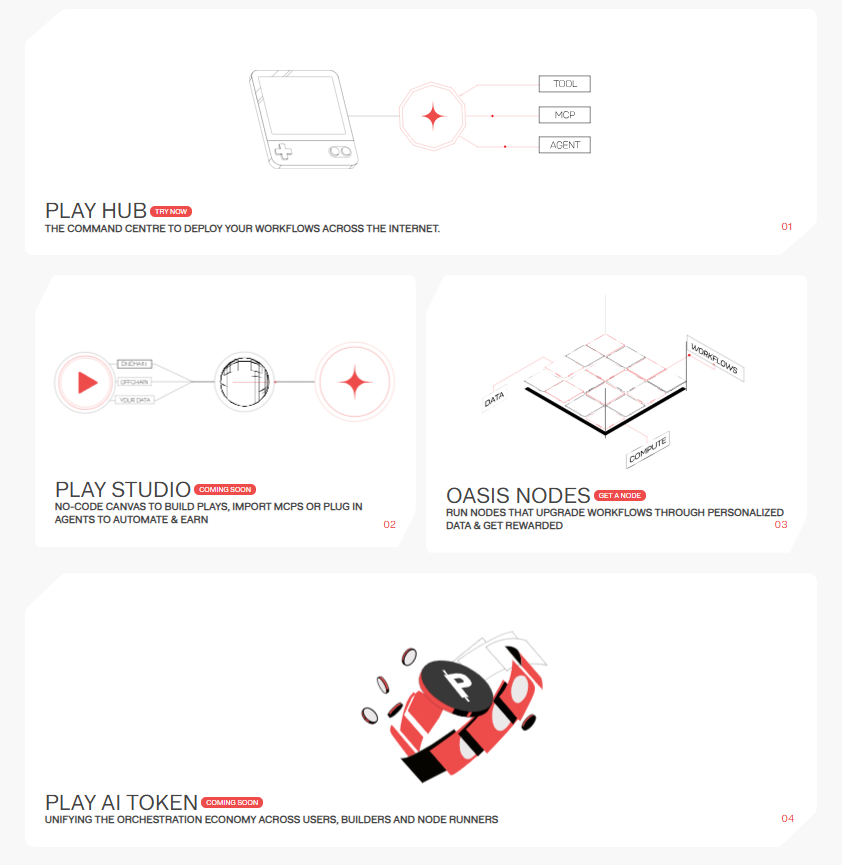
PlayAI’s infrastructure is built around several core components:
-
PlayHub: The central interface where users start tasks, select tools, and manage automated data flows.
-
PlayStudio: A development environment where users and developers can create AI workflows called “Plays,” publish them, and generate revenue.
-
Oasis Nodes: Responsible for off-chain computation, data processing, and model verification. These nodes optimize the performance of the network.
-
Data Mining & Marketplace: Users and developers can earn $PLAI tokens by contributing data and validating datasets.
Through MCP (Model Context Protocols), standardized communication between agents and tools is established, allowing complex workflows to operate smoothly.
Governance
$PLAI token holders can participate in key decisions such as network upgrades, economic parameters, and ecosystem governance.
Token ownership enables a decentralized and transparent governance model, allowing the community to influence the future direction of the project.
Roadmap
Although an official detailed roadmap has not yet been published, the platform’s known milestones include:
-
2023: Project foundation and early development
-
2024-2025: Testnet and mainnet launches, IDO, and community expansion
-
2026: MadRims improvements, collaborations with Kaito Studio, and stream-to-earn campaigns
Use Cases of the $PLAI Token in the Ecosystem
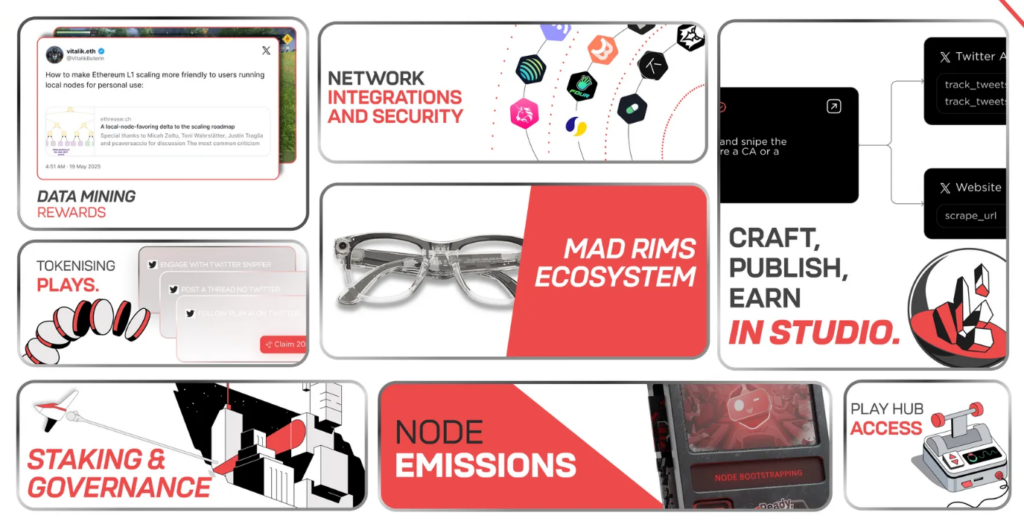
Within the ecosystem, the token serves several roles. The platform’s economic structure is shaped around the following mechanisms:
-
Users earning data mining rewards by sharing data or contributing to the network
-
Developers creating AI workflows in the Studio environment and earning revenue by publishing them
-
Tokenizing AI workflows so they can be bought and sold
-
Token holders staking their assets to earn rewards and participate in governance
-
Regular token emissions distributed to node operators
-
Access to the Play Hub interface and premium platform features
This structure shows that PlayAI aims to function not only as an AI tool but as a full economic ecosystem connecting developers, data providers, and users.
Why This Structure Matters
The architecture of PlayAI aims to distribute AI production beyond the control of a single company and instead spread it across a wider network of participants.
From data providers and node operators to developers and end users, multiple actors can participate in the same economic system.
For this reason, $PLAI is not only a payment token, but also a central mechanism supporting network security, content creation, and data flow across the ecosystem.
How the $PLAI Ecosystem Works
PlayAI is not just an AI platform. It combines data economy, developer tools, and physical hardware within a single ecosystem.
At the center of this system is the $PLAI token, which manages both network operations and economic incentives.
Users can earn data mining rewards by sharing data with the network or contributing to AI processes.
The technical security of the network and the data processing infrastructure are supported by Oasis Node operators, who receive regular token emissions as incentives.
One of the most notable aspects of PlayAI is that it is not limited to software. The project’s MadRims smart glasses demonstrate how artificial intelligence can be integrated with real-world hardware.
Token Information and Distribution
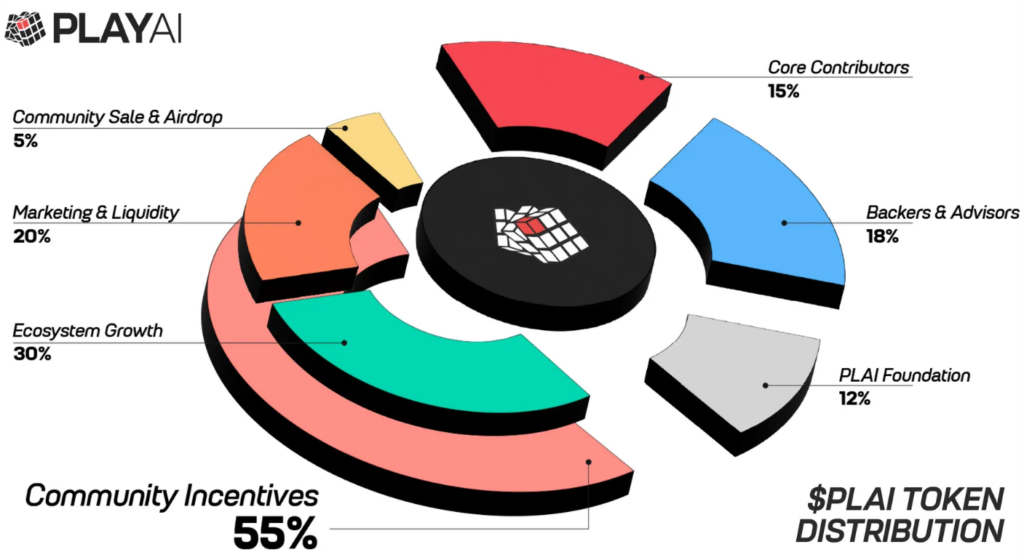
Total Supply: 1,000,000,000 $PLAI
-
Community Incentives: 55%
-
Core Team & Early Contributors: 15%
-
Backers & Advisors: 18%
-
PLAI Foundation: 12%
-
Airdrop & Community Sale: 5%
Vesting schedules and lock periods are designed to support long-term sustainability and commitment.
Ecosystem and Features
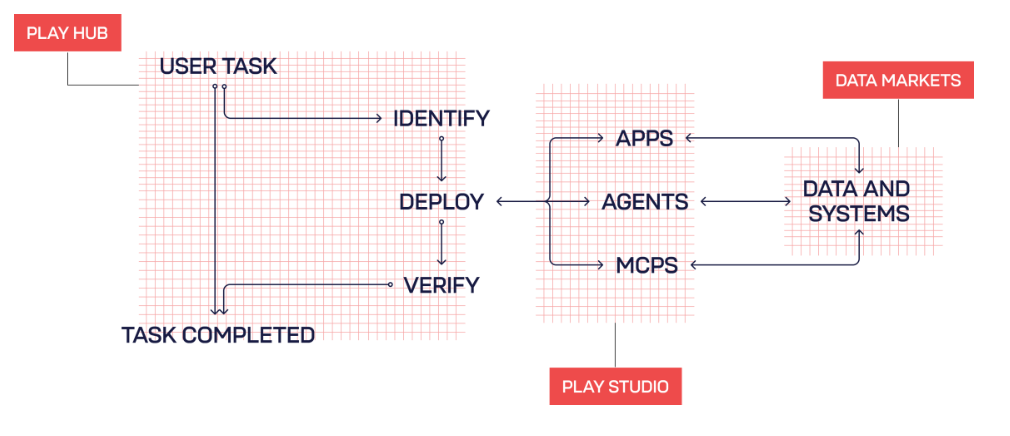
The Play Studio Flywheel model clarifies the structure of the ecosystem. Rather than simply providing a service, the system creates an autonomous economy that returns value to the $PLAI token with every interaction.
-
Autonomous agents and workflows deployable with a single prompt
-
Data mining supported by incentive mechanisms
-
Multi-chain infrastructure offering speed and security advantages
-
Hardware integration through MadRims for voice-based AI interaction
-
Community incentives including airdrops and campaigns
-
Security through fixed token supply and verification systems
-
Ease of use through automated data processing and trading examples