

 Yeliz Akmaca
Gold prices moved lower on Monday as the strengthening U.S. dollar weighed on dollar-denominated assets, while rising energy costs and persistent inflation concerns further reduced expectations for near-term interest-rate cuts.
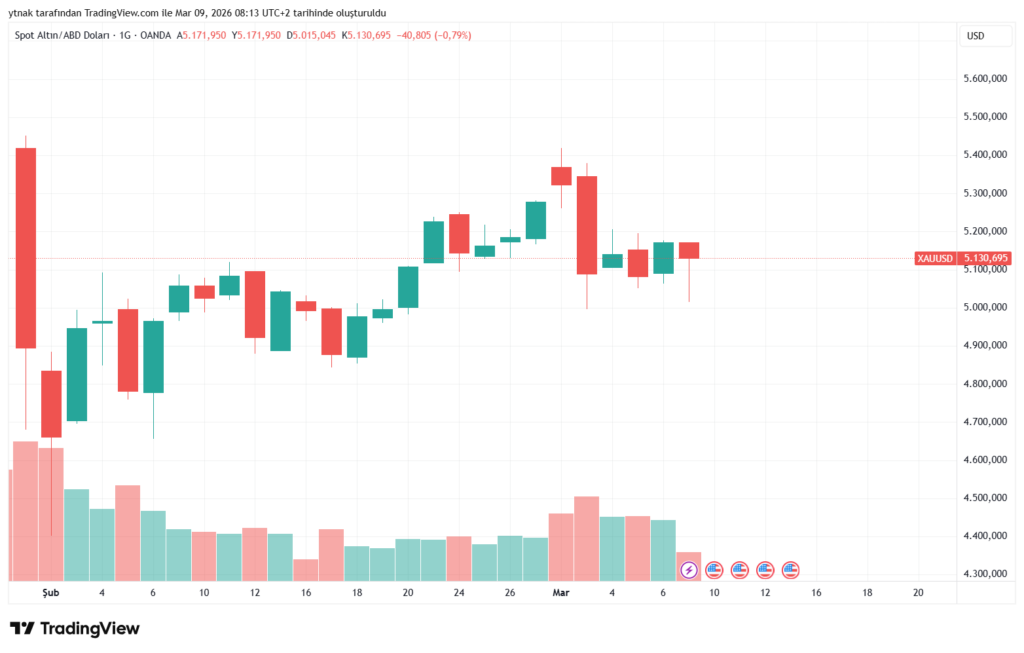
Spot gold fell after dropping more than 2% earlier in the session. As of 05:54 GMT+3, the metal was trading at $5,130.94 per ounce, down 0.8% on the day. U.S. gold futures for April delivery slipped 0.4% to $5,138.20.
The U.S. dollar climbed to its highest level in more than three months, making gold more expensive for holders of other currencies and limiting demand. At the same time, yields on U.S. 10-year Treasury bonds rose to their highest level in about a month, increasing the opportunity cost of holding non-yielding assets such as gold.
Stronger Dollar and Rising Yields Pressure Gold
The strengthening dollar has been one of the main drivers behind the latest move in gold prices. When the U.S. currency gains value, commodities priced in dollars tend to become more expensive for international investors, which can reduce buying interest.
At the same time, higher Treasury yields make interest-bearing assets more attractive relative to precious metals. Since gold does not provide yield, rising bond returns often lead investors to rebalance portfolios away from bullion.
Fed Rate Expectations Shift
Market expectations around U.S. monetary policy have also changed in recent days. According to CME Group’s FedWatch Tool, investors widely expect the Federal Reserve to keep interest rates unchanged at the conclusion of its two-day meeting on March 18.
Interest-rate market pricing shows a notable shift in sentiment. The probability that rates will remain unchanged in June has climbed to above 51%, compared with below 43% just a week earlier.
Because precious metals do not generate income, they generally perform better in low-interest-rate environments. As expectations for near-term rate cuts fade, pressure on gold prices can increase.
Oil Prices Surge on Middle East Tensions
Energy markets moved sharply higher as geopolitical tensions escalated in the Middle East. Concerns that the expanding conflict involving the United States, Israel and Iran could disrupt global energy supplies pushed crude prices significantly higher.
Fears of prolonged disruptions to shipping through the Strait of Hormuz, one of the world’s most critical oil transit routes, have also intensified. Some major Middle Eastern producers have reportedly begun reducing supply amid growing uncertainty.
Oil prices surged roughly 20%, climbing above $110 per barrel during the session. Brent crude futures rose to around $119.50 per barrel, while U.S. West Texas Intermediate (WTI) reached $119.48.
Analysts at ING noted in a research note that the situation appears to be worsening. According to the bank, production slowdowns have started and several producers are facing storage constraints. Countries such as Iraq, Kuwait and the United Arab Emirates have reportedly begun cutting output.
Iran Leadership Change Adds to Geopolitical Risk
Geopolitical tensions intensified further after Iran appointed Mojtaba Khamenei as the country’s new Supreme Leader, succeeding his father Ali Khamenei.
The leadership change is widely seen as a signal that hardline political control will remain in place. Analysts say the move could add to regional uncertainty at a time when global energy markets are already facing supply concerns.
Other Precious Metals See Volatility
Other precious metals also experienced volatility during the session.
Spot silver, after falling more than 5% earlier in the day, stabilized near $84.42 per ounce. Platinum slipped 0.1% to $2,133.95, while palladium declined 0.9% to around $1,610.
The broader picture across global commodity markets highlights diverging forces. While oil prices surged due to supply concerns and geopolitical risks, the combination of a stronger dollar and rising Treasury yields continued to create short-term pressure on precious metals.
Also, you can freely share your thoughts and comments about the topic in the comment section. Additionally, please follow us on our Telegram, YouTube and Twitter channels for the latest news and updates.