

 Yeliz Akmaca
Are the dynamics on the Ethereum front shifting? Investors withdrew $225 million from spot ETFs, while staking returns lagged behind stablecoin alternatives. Network activity is slowing, and derivatives markets are relatively quiet. Yet the interesting part is developers are still pushing plans to increase transaction speed and make wallet fees more flexible. Why isn’t Ethereum rising? Here are the details that help clarify the bigger picture.
Price and Market Dynamics
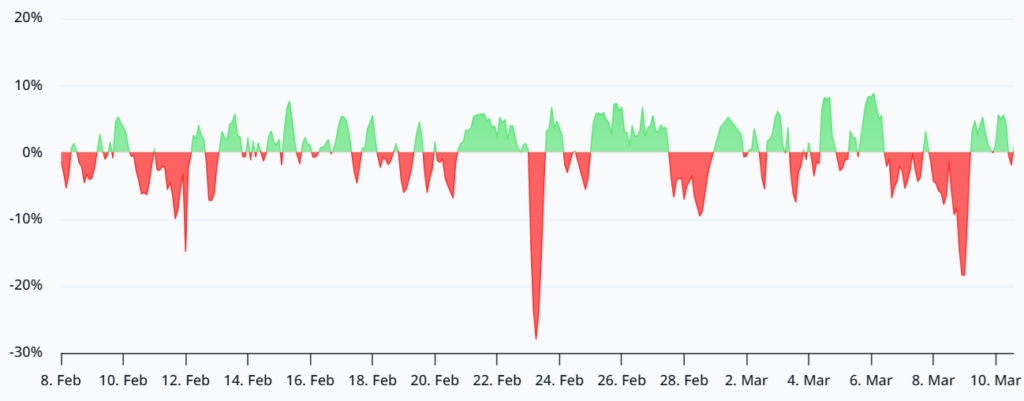
Over the past month, Ethereum has struggled to hold above $2,100. Investor confidence is gradually eroding. The 7% spike seen between Monday and Tuesday provided a short breath, but to put it in a slightly awkward way—it’s not exactly a lasting recovery. Perpetual futures dropped into negative territory, highlighting increased short (bear) positions. The curious part is that this metric has remained below the neutral range for a month; bears are active, but not fully dominant.
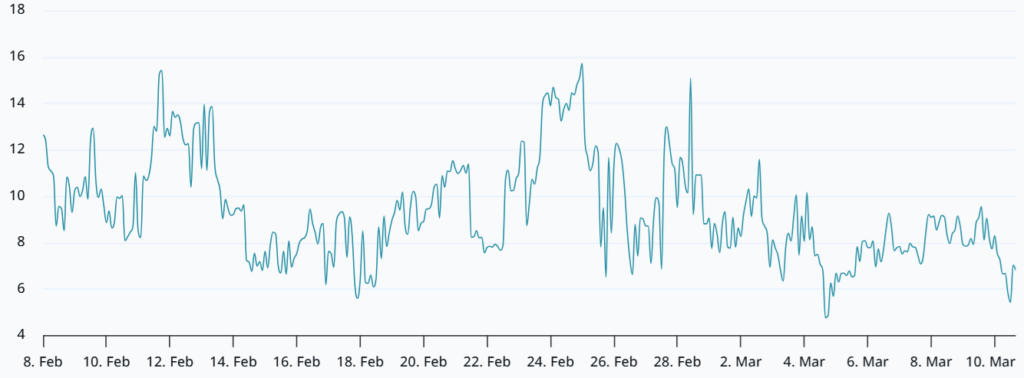
On-chain activity paints a similar picture. Weekly Ethereum network fees averaged $2.3 million over the past month—a significant drop from the $8 million peak in early February. Transaction counts stabilized near 14 million, yet Layer-2 rollup-focused developments have not sufficiently boosted native Ethereum demand. Fortunately, some long-term initiatives are in progress; let’s see when this picture changes.
Options and Risk Sentiment
The ETH options market shows slightly more balance. Put (sell) options traded at a 7% premium over call (buy) options, suggesting bulls are slowly regaining confidence. Additionally, Ethereum’s $56 billion total value locked (TVL) remains unmatched. So bears are present but not fully dominant—actually, this provides a bit of breathing room.
Why Did Institutional Appetite Fade?
Spot Ethereum ETFs saw a net outflow of $225 million between Thursday and Monday, reversing the $169 million inflow seen the previous Wednesday. The main reason for weak institutional demand is the 2.8% staking yield. By comparison, stablecoin yields are around 3.75%.
Even though ETF staking approval in the US came at the end of 2025, it has yet to translate into sustainable demand. Why? Because the market downturn starting in early October, after total capitalization neared $4 trillion, coincided with the launch. Ethereum has underperformed the broader crypto market since October and shows no signs of a reversal. Furthermore, Ethereum treasury firm Sharplink (SBET US) reported a net loss of $735 million in 2025, further shaking investor confidence.
Hegota Update and Vitalik’s New Plans
Ethereum’s native chain scaling pace affects price performance. Co-founder Vitalik Buterin expects account abstraction—equivalent to smart accounts—to launch “within a year.” This will allow transactions to reference each other’s data and enable quantum-resistant wallets.
The upcoming Ethereum Hegota fork will allow gas fees to be paid in tokens other than ETH and will remove public broadcasters on privacy-focused platforms while introducing a general-purpose public mempool. Buterin also plans to gradually reduce slot and finality times in the long term. Let’s see how these changes impact the market.
Overall, Ethereum derivatives and on-chain activity still do not show enough conviction for a strong bullish move above $2,200. But conditions aren’t dire; bears haven’t fully taken control. There is still room for movement, uncertainty remains high, and investors are cautious but not entirely pessimistic.
Also, you can freely share your thoughts and comments about the topic in the comment section. Additionally, please follow us on our Telegram, YouTube and Twitter channels for the latest news and updates.