

 Yeliz Akmaca
Gold prices started the week at a critical threshold. The ounce held above $5,000 as a weakening dollar and falling U.S. Treasury yields created a delicate market balance. Meanwhile, the conflict in the Middle East entered its third week, keeping oil prices above $100 and reigniting inflation concerns.
Global investors are now monitoring two key factors simultaneously: the Federal Reserve’s rate decision on Wednesday and growing energy risks around the Strait of Hormuz. At this point, market behavior is sitting on a particularly sensitive equilibrium.
Why Gold Prices Remain Stable
Gold has remained resilient despite waning expectations for rate cuts, supported by a weaker dollar and declining U.S. Treasury yields. These factors offset inflationary pressure from high energy prices, keeping gold above $5,000.
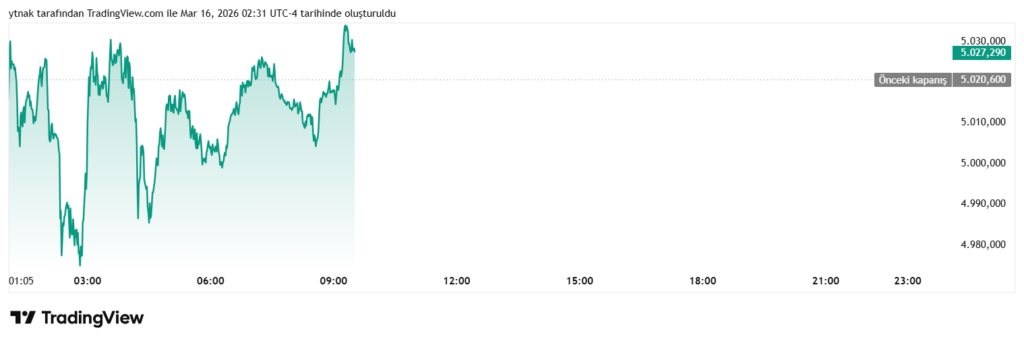
Earlier on Monday, gold experienced a roughly 1% drop. However, losses were quickly recovered as the dollar weakened. Spot gold rose 0.1% to $5,020 per ounce.
Meanwhile, April U.S. gold futures fell 0.7% to $5,024 per ounce, showing that the market is still searching for direction. The key driver here is actually a threefold balance: the dollar, Treasury yields, and energy prices.
When the dollar weakens, dollar-denominated commodities such as gold become cheaper for holders of other currencies, stimulating global demand.
Additionally, falling 10-year U.S. Treasury yields provide support for gold, as non-yielding assets like gold and silver become more attractive when yields decline.
Oil Remains Above $100
The Middle East conflict is directly affecting energy markets. As tensions between the U.S., Israel, and Iran enter the third week, oil remains above $100 per barrel.
This situation not only impacts energy markets but also affects global inflation expectations. High oil prices increase transportation and production costs, thereby strengthening inflationary pressure.
Gold is generally seen as a hedge against inflation. However, if inflation rises and central banks are forced to maintain high rates, real yields could increase, limiting gold’s upside.
According to OCBC strategist Christopher Wong, high energy prices may make the Fed more cautious about rate cuts. Essentially, the market is caught between two forces: geopolitical and inflation risks on one side, and the possibility of higher rates on the other.
Market Waiting Ahead of Fed Decision
The Federal Reserve’s two-day meeting concludes on Wednesday.
The market expects policy rates to remain unchanged, but investors are watching the Fed’s messaging closely.
If Fed officials signal that energy-driven inflation remains a concern, expectations for rate cuts could be further delayed.
Even if rates remain unchanged, changes in communication could swiftly shift market balance.
Meanwhile, the interplay of Treasury yields, the dollar index, and commodity prices is currently delicate. Small announcements can trigger significant price movements.
Strait of Hormuz Crisis and Energy Diplomacy
Geopolitical tensions remain high. Developments around the Strait of Hormuz are critical for global energy security.
U.S. President Donald Trump announced that his administration has held talks with seven countries to secure the Strait.
This move is not only military but also a signal of new energy diplomacy in the Gulf. Trump also threatened increased attacks on Iran’s main oil export terminal at Kharg Island, while stating that no peace agreement is currently on the table.
He emphasized that countries heavily reliant on Gulf oil bear responsibility for protecting the Strait.
This underscores that global energy supply is both an economic and security matter.
Other Precious Metals Gain
The cautious balance in gold has also extended to other precious metals.
Spot silver rose 0.1% to $80.62 per ounce. Platinum increased 1.8% to $2,060, while palladium climbed 1.6% to $1,576 per ounce.
Currently, the market is pricing three risk factors simultaneously: energy prices, geopolitical tensions, and Fed policy.
The coming days will reveal which direction this threefold equation pushes gold prices, as global market balance—risk premiums and real yields—is being recalculated in real time.
Also, you can freely share your thoughts and comments about the topic in the comment section. Additionally, please follow us on our Telegram, YouTube and Twitter channels for the latest news and updates.