
 Emre Yumlu
Decentralized finance (DeFi) protocol Aave has revealed a new security feature following a major trading incident that resulted in a user losing approximately $50 million. According to the protocol’s internal review, the loss was not primarily caused by slippage but by extremely low liquidity and several infrastructure-related issues during the transaction.
In response to the event, the Aave team announced plans to introduce a new protection mechanism called Aave Shield, designed to reduce the likelihood of similar incidents occurring in the future.
Aave Shield Aims to Prevent High-Risk Trades
The upcoming Aave Shield feature will add an additional layer of protection for users who perform token swaps through Aave’s interface. Under this system, transactions that would cause a price impact greater than 25% will automatically be blocked.
The goal is to prevent users from unintentionally executing trades that could result in severe losses due to extreme price deviations. However, Aave clarified that experienced users who intentionally want to proceed with such high-risk transactions will still have the option to manually disable the protection feature.
By introducing this safeguard, the protocol aims to improve the safety of trading within its interface while still maintaining flexibility for advanced traders.
How the $50 Million Swap Loss Happened
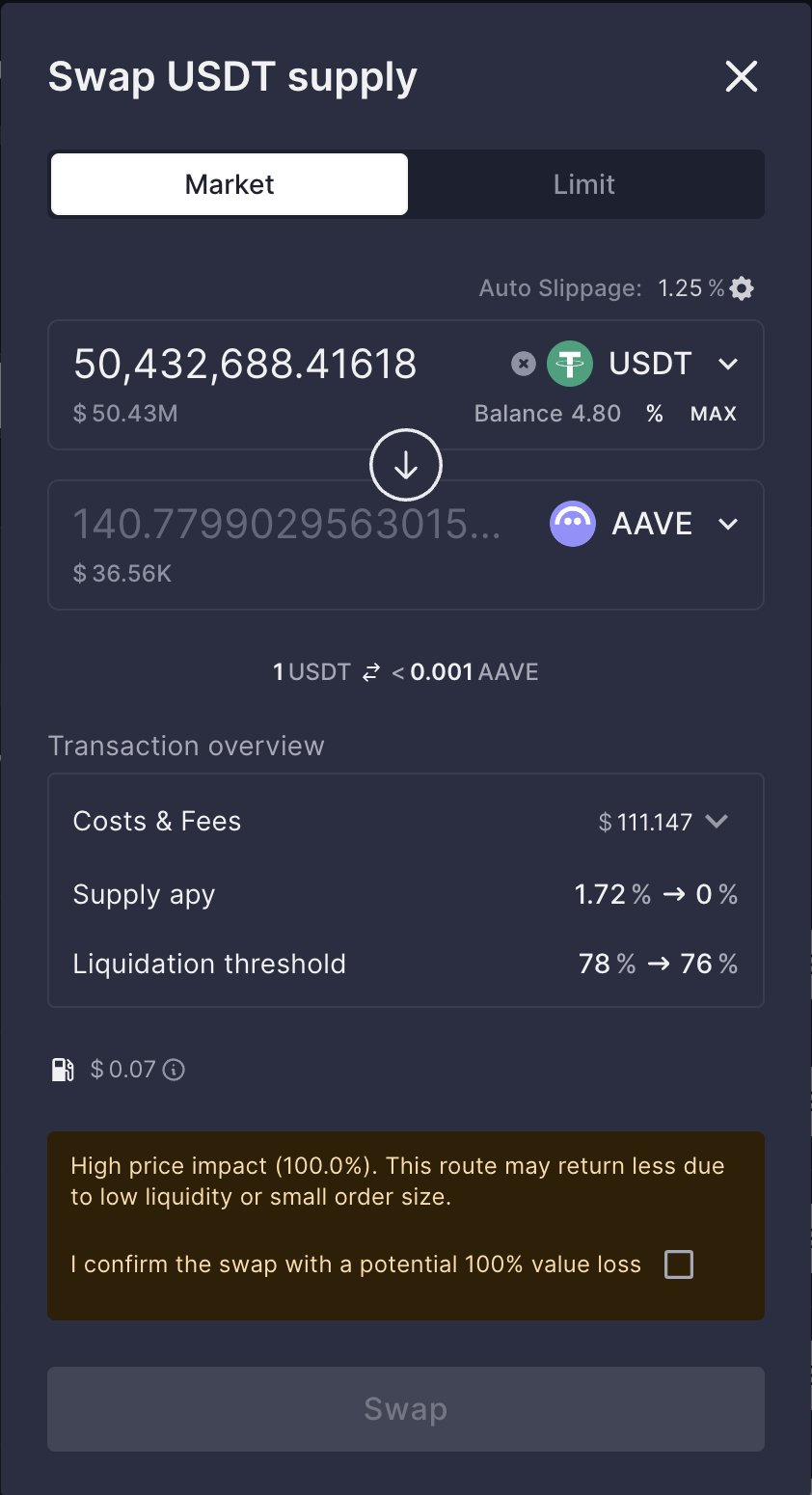
The incident occurred when a user attempted to convert approximately $50.4 million worth of USDT into AAVE tokens. The transaction was executed through CoW Swap, a decentralized exchange infrastructure used to route trades.
Due to insufficient liquidity in the selected trading route, the swap experienced an extremely high price impact. As a result, the user ultimately received only about $36,500 worth of AAVE tokens despite initiating a trade valued at more than $50 million.
The transaction led to a total loss exceeding $50 million.
Part of this loss was also attributed to a Maximal Extractable Value (MEV) bot that carried out a sandwich attack during the transaction. The bot reportedly captured nearly $10 million in profit from the event.
Platform Warnings Were Ignored
Aave’s post-incident explanation noted that several warnings had been displayed on the interface before the trade was finalized.
The platform reportedly alerted the user about the extremely high price impact and warned that low liquidity could significantly reduce the amount of tokens received. Additionally, the user confirmed a statement acknowledging that the transaction could potentially result in a complete loss of value.
Despite these alerts, the transaction was still approved and executed.
Technical Issues Also Played a Role
The team behind CoW Swap, known as CoW DAO, later stated that the incident was not solely the result of low liquidity. According to their explanation, certain infrastructure issues also contributed to the unfavorable outcome.
One of the systems responsible for identifying optimal trade routes—known as a solver—was affected by an outdated gas limit, preventing more favorable price quotes from being considered. Another solver that had produced a significantly better quote reportedly failed to submit the transaction on-chain when it had the opportunity.
CoW DAO also indicated that a potential mempool leak may have further influenced the extreme price movement observed during the trade.
DeFi Infrastructure Risks Back in Focus
The incident has once again highlighted the risks that can arise within decentralized finance systems, particularly when large transactions interact with markets that lack sufficient liquidity.
Both Aave and CoW DAO stated that investigations into the event are ongoing and that they are working transparently with the broader community to better understand what happened.
With the upcoming launch of Aave Shield, Aave hopes to strengthen user protections and reduce the chances of similar high-impact trading incidents occurring in the future.
You can also freely share your thoughts and comments about the topic in the comment section. Additionally, don’t forget to follow us on our Telegram, YouTube, and Twitter channels for the latest news and updates.