

 Emre Yumlu
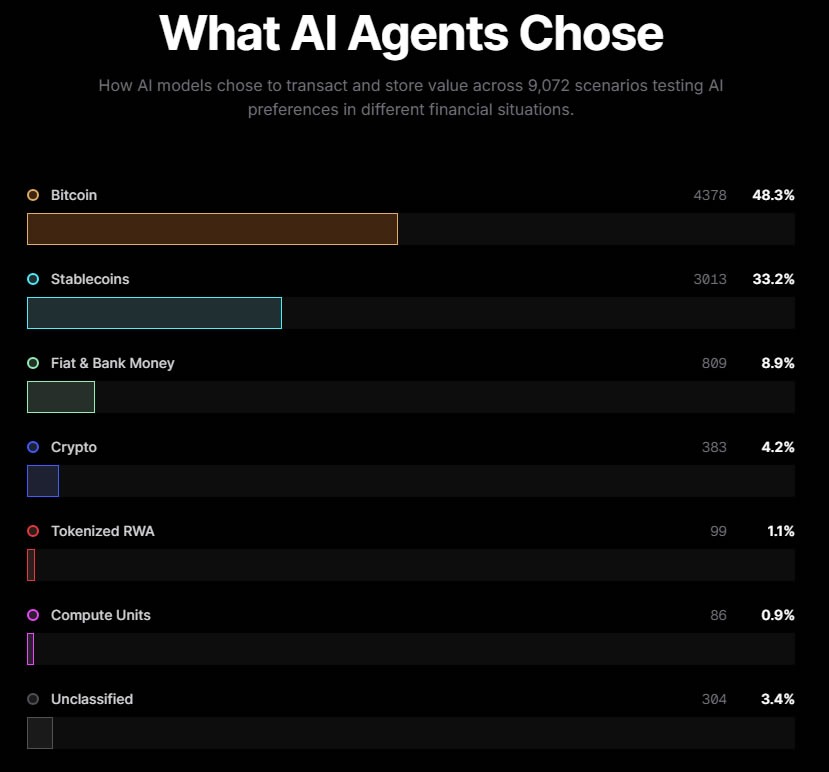
A recent research initiative examining how artificial intelligence systems approach monetary decision-making has produced striking results. In the study, 36 different AI models were tested across a range of financial scenarios, generating more than 9,000 responses in total. When asked to choose among various monetary instruments, Bitcoin emerged as the most frequently selected option overall.
According to the findings, Bitcoin accounted for 48.3% of total responses, making it the leading choice across all categories. The strongest result appeared in long-term purchasing power preservation scenarios. When models were asked which asset they would use to store value over multiple years, 79.1% selected Bitcoin—by far the most decisive outcome recorded in the research.
Stablecoins Lead in Payment Use Cases
Despite Bitcoin’s dominance in value storage scenarios, the results shift when the focus turns to transactional use. In cases involving everyday payments, services, micropayments, and cross-border transfers, stablecoins were favored more frequently. In these payment-oriented scenarios, 53.2% of responses chose stablecoins, compared to 36% for Bitcoin.
This divergence suggests that AI models conceptually separate store-of-value functions from medium-of-exchange functions. Stablecoins appear to benefit from price stability and operational efficiency in transactional contexts, whereas Bitcoin’s decentralized structure and resistance to censorship strengthen its appeal as a long-term savings vehicle.
Fiat Currency Largely Overlooked
One of the most notable findings was the minimal preference for traditional fiat currencies. None of the 36 models ranked fiat as their top overall monetary choice. Approximately 91% of all responses favored digitally native instruments, including Bitcoin, stablecoins, altcoins, tokenized real-world assets (RWAs), or other digital compute-based units.
This outcome points toward a strong bias in favor of digital monetary systems within the models’ decision frameworks.
Methodology and Limitations
The study was limited to 36 models across six providers, with plans to expand testing to additional systems in future iterations. Researchers also acknowledged that prompt framing may have influenced certain outcomes. For example, in a scenario involving earnings accumulated across multiple countries and a desire to avoid dependence on any single nation’s monetary policy or banking system, fiat currency would naturally be disadvantaged.
Importantly, these preferences do not necessarily reflect real-world adoption trends. Instead, they reveal patterns embedded in the training data used to develop the models. Provider-level results showed notable variation: Anthropic models averaged a 68% preference for Bitcoin, compared to 26% for OpenAI, 43% for Google, and 39% for xAI.
You can also freely share your thoughts and comments about the topic in the comment section. Additionally, don’t forget to follow us on our Telegram, YouTube, and Twitter channels for the latest news and updates.