
 Yeliz Akmaca
Allora is an open intelligence platform designed to make AI systems more adaptive, collaborative, and efficient. The network allows users and developers to access and contribute to a collective intelligence layer where multiple AI models are combined, compared, and optimized in real time.
The main goal of the project is to overcome traditional “siloed” AI solutions dominated by large industrial entities, which often limit transparency and accessibility. Allora maximizes connections between data, algorithms, and participants to solve this problem.
Team and Founders
Allora Network is a New York-based company founded in 2024.
-
Nick Emmons: Co-Founder & CEO
-
Kenny Peluso: Co-Founder
The development team includes engineers and researchers with experience in large-scale blockchain and AI infrastructure, including contributions to projects such as Chainlink, LayerZero, and Consensys. Technical paper contributors include J. M. Diederik Kruijssen, Nicholas Emmons, Kenneth Peluso, Faisal Ghaffar, Alexander Huang, Steven N. Longmore, and Tyler Kell.
Investors and Strategic Partners
Allora is supported by well-known and experienced investors:
-
Polychain Capital
-
Framework
-
CoinFund
-
Blockchain Capital

Project Concept
Allora aims to produce the best possible outcomes without relying on a single AI model. The platform continuously improves using data, model outputs, and insights contributed by participants.
How the Project Works
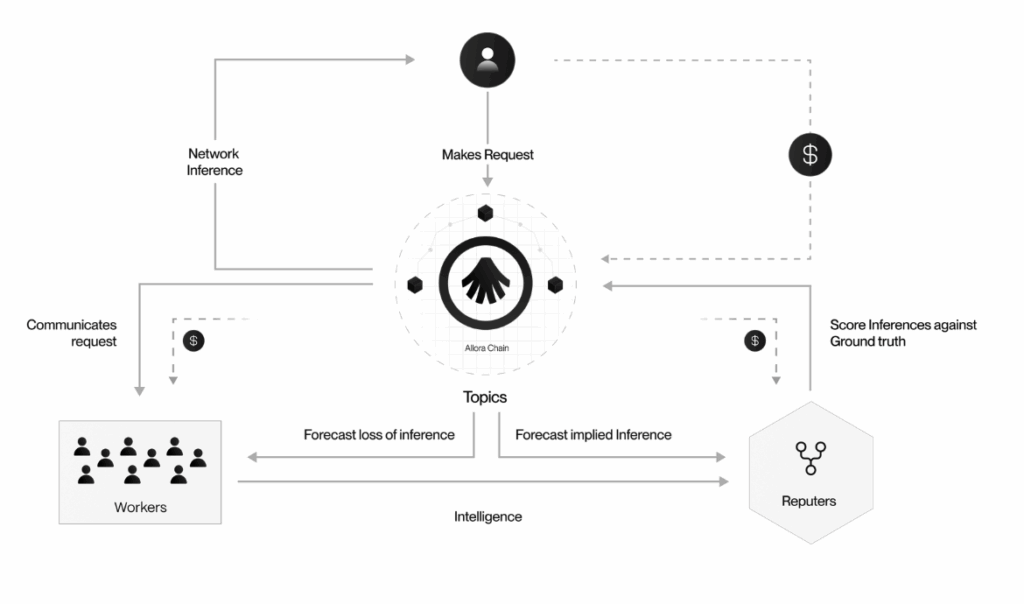
The Allora network generates and distributes AI predictions in a decentralized way, consisting of a Hub Chain (central coordination layer) and Topic subnets.
The network operates across three layers:
-
Inference Consumption Layer: Enables predictions to be consumed and used.
-
Forecasting & Synthesis Layer: Worker models generate predictions, estimate the accuracy of other models, and synthesize results into a single optimized output.
-
Consensus Layer: Manages participant rewards and ensures network security.
Participant Roles:
-
Workers: Generate predictions and estimate other models’ performance.
-
Reputers: Verify prediction accuracy and maintain network security.
-
Consumers: Request predictions from the network and pay with ALLO tokens.
-
Hub Chain: The central coordination layer organizing the network.
This structure allows Allora to combine multiple models to produce more accurate and reliable results.
Governance
The network features decentralized governance, allowing token holders and contributors to vote on proposals and platform policies.
Allora (ALLO) will be listed on the Binance Alpha platform on November 11, 2025. Users can track rewards and purchase opportunities via the Alpha Events page.
Roadmap
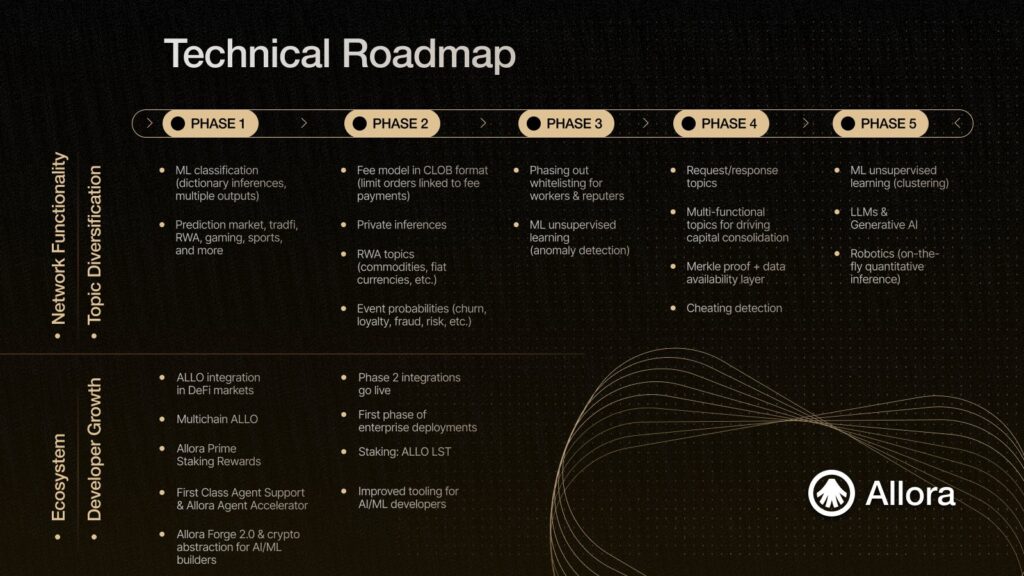
The 2024-2025 roadmap covers the transition from testnet to mainnet and network expansion:
-
Testnet Launch (2024): Workers, models, and topics tested; 692M+ inferences generated.
-
Tools & Integrations (2024-2025): Model Forge competitions, Builder Kit for quick worker deployment, and API/oracle integrations.
-
Mainnet Launch (Nov 11, 2025): First topics live; rewards and migration begin.
-
Expansion (2025+): New use cases (sentiment analysis, DAO governance), full on-chain governance, and additional partnerships.
ALLO Token Use Cases
ALLO tokens incentivize participation and reward contributors:
-
Rewarding model developers and data providers
-
Governance voting
-
Payment for services and access
-
Staking and network security
ALLO Token Supply
-
Total Supply: 1 billion ALLO
-
Max Supply: 1 billion ALLO
-
Circulating Supply: 200.5 million ALLO
ALLO Token Distribution
-
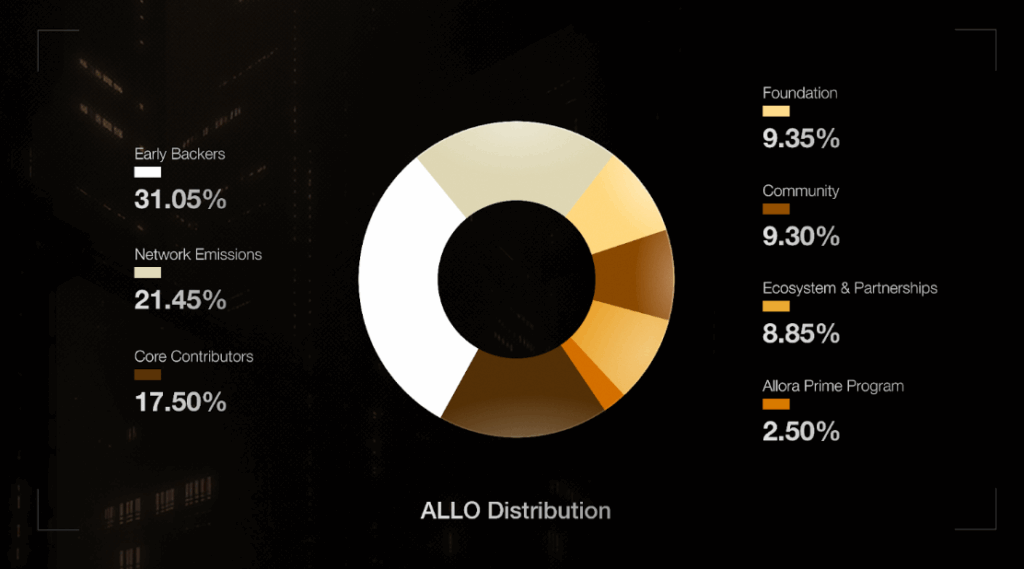
Early Backers: 31.05%
-
Network Emissions: 21.45%
-
Core Contributors: 17.50%
-
Foundation: 9.35%
-
Community Pool: 9.30%
-
Ecosystem & Partnerships: 8.85%
-
Allora Prime Staking Rewards: 2.50%
Ecosystem
Allora aims to democratize AI innovation across a global participant base. Key use cases include:
-
Finance & Trading: Real-time analysis using multiple models for better predictions and risk management.
-
Healthcare & Legal: AI applications that respect data privacy and security.
-
SMEs & Analytics: High-performance AI outputs without complex infrastructure.
-
Innovation & Collaboration: Peer-to-peer collaboration among researchers, developers, and small businesses.
Official Links
You can also freely share your thoughts and comments about the topic in the comment section. Additionally, don’t forget to follow us on our Telegram, YouTube, and Twitter channels for the latest news and updates.