

 Emre Yumlu
Bitcoin recent price action suggests that downside momentum is losing strength. However, analysts caution that this does not yet constitute a structural shift into a new bull cycle. While short-term indicators are beginning to stabilize, the broader market regime still reflects bear market conditions.
What Are Technical Indicators Signaling for Bitcoin?
Despite persistent risk-off headlines in global markets, Bitcoin has notably failed to accelerate to the downside. This deceleration in selling pressure is viewed by some analysts as an early sign that bearish momentum may be fading.
From a technical standpoint, Bitcoin recently retested its 20-day moving average near $68,500. At the same time, Bollinger Bands have narrowed significantly, indicating compressed volatility. Historically, such volatility contractions often precede expansion phases, where price breaks out decisively in either direction.
Earlier in the week, Bitcoin briefly traded above $70,000 on Coinbase before retreating toward the $68,400 area. On the downside, the $62,500 level has been tested three separate times and held firm, reinforcing its importance as a key support zone.
Momentum oscillators also reflect early signs of stabilization. Both the Relative Strength Index (RSI) and the stochastic indicator have displayed positive divergences, suggesting weakening bearish momentum. Still, these signals are developing within the context of a broader downtrend.
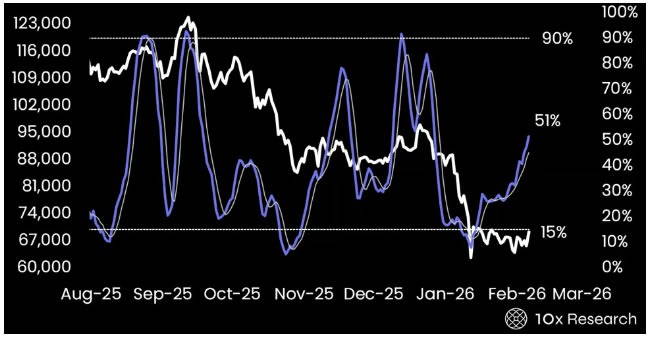
Tactical Improvement vs. Structural Reversal
Analysts emphasize the distinction between tactical recovery and structural trend reversal. While volatility compression, improving ETF inflows, and the disappearance of the Coinbase premium/discount gap suggest the market is not accelerating into a fresh leg lower, they do not yet confirm a full regime change.
Asset allocation models continue to classify Bitcoin within a bear market framework. As a result, upward price movements are currently interpreted as short-term tactical opportunities rather than the beginning of a sustained bullish phase.
Short Squeeze and Funding Dynamics
Derivatives market positioning has also played a significant role in recent price action. Deeply negative funding rates signaled crowded short positioning, meaning traders holding short contracts were paying longs. When Bitcoin rebounded sharply from around $63,000, it triggered a classic short squeeze, forcing liquidations and temporarily easing selling pressure.
Nevertheless, analysts underline that a durable trend reversal would require stronger structural capital inflows and meaningful macroeconomic catalysts. Until such drivers emerge, the prevailing downtrend from the all-time high remains technically intact, with fragile liquidity conditions and overhead resistance levels reinforcing a cautious market stance.
You can also freely share your thoughts and comments about the topic in the comment section. Additionally, don’t forget to follow us on our Telegram, YouTube, and Twitter channels for the latest news and updates.