

 Yeliz Akmaca
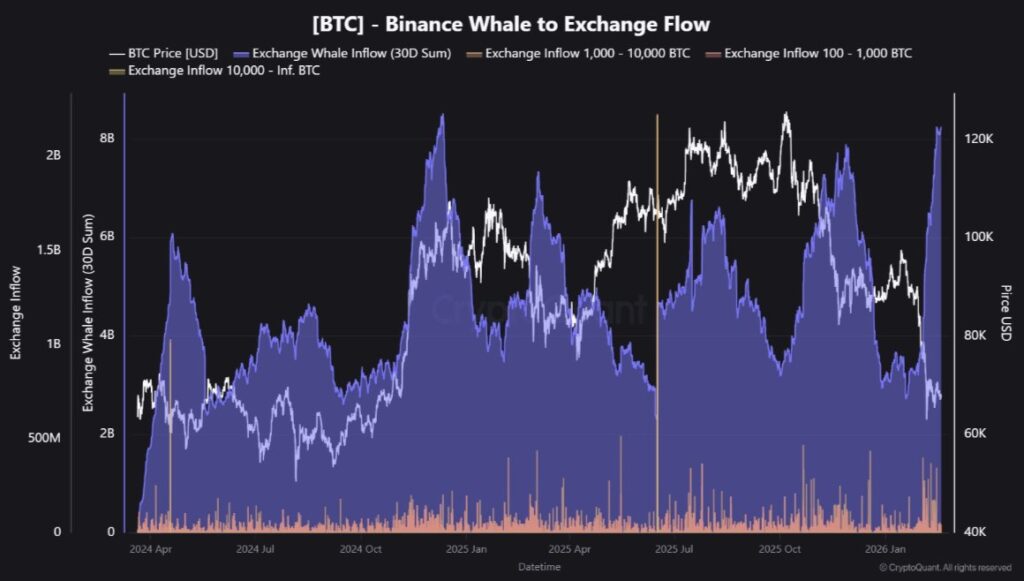
The amount of Bitcoin held in Binance wallets has started rising again. And this increase is not an ordinary recovery. Levels not seen since November 2024 have returned. Movements like this do not immediately appear obvious on price charts. But they often signal that something is changing behind the scenes.
Because Binance handles more Bitcoin trading volume than any other exchange, shifts in its wallet balances often reflect broader changes happening across the market.
According to CryptoQuant data, the total BTC held in wallets associated with Binance has reached 676,835 BTC. This is approximately 9.3% higher than the local bottom of 618,782 BTC recorded in November 2024. The timing is just as notable as the number itself. Because increases like this usually indicate that investors are moving their assets back to exchanges. And this often means coins that remained idle in private wallets for long periods are now becoming active again.
Simply put: when Bitcoin moves back onto exchanges, a decision phase may be approaching.
$760 Million Transfer: A Single Move Shifted the Balance
A single transfer over the weekend was enough to change the picture. Blockchain analytics platform Arkham detected that a large investor sent approximately $760 million worth of BTC to Binance. The identity behind the transfer is believed to be a whale associated with the Hyperliquid ecosystem, possibly Garret Jin.
The sharp pullback in price immediately after this transfer may not be a coincidence.
Bitcoin dropped quickly from $67,600 to $64,400 during the early Asian trading session. A partial recovery followed, yes. But the price remains in a fragile zone. Moves like this are not always driven by actual selling. Sometimes, expectations alone can move the market. The market often reacts before the selling even happens.
What’s more interesting is this: the same whale had transferred hundreds of millions of dollars worth of Ethereum to exchanges just days earlier. This may be portfolio rebalancing. Or something simpler — risk reduction.
Why Rising Exchange Balances Make the Market Uneasy
There is a well-known dynamic in crypto markets. When coins leave exchanges, investors usually intend to hold them. But when coins move back to exchanges, intentions may have changed.
This does not automatically mean selling. Sometimes it only means preparation. But even “ready-to-sell supply” creates psychological pressure. Because potential selling, even if it never happens, can weigh on price.
For this reason, rising exchange reserves are rarely interpreted as bullish signals in the short term. More often, they introduce caution into the market structure.
Macro Pressure and Fragile Balance
These movements are not driven solely by on-chain activity. Macro uncertainty has also increased. Proposed tariff policies by Trump and rising geopolitical tension between the U.S. and Iran have weakened overall risk appetite.
In this environment, Bitcoin’s drop toward $64,400 was not entirely unexpected.
More notable, however, is investor psychology. The market has remained in the “extreme fear” zone for seven consecutive days, with the Fear and Greed Index stuck at a reading of 6. This indicates deep hesitation among participants. Historically, extreme fear conditions have often appeared near major market bottoms. Not always. But often enough to matter.
The market right now is undecided. Not strong. Not broken either.
USDT Signal: Liquidity May Be Quietly Leaving
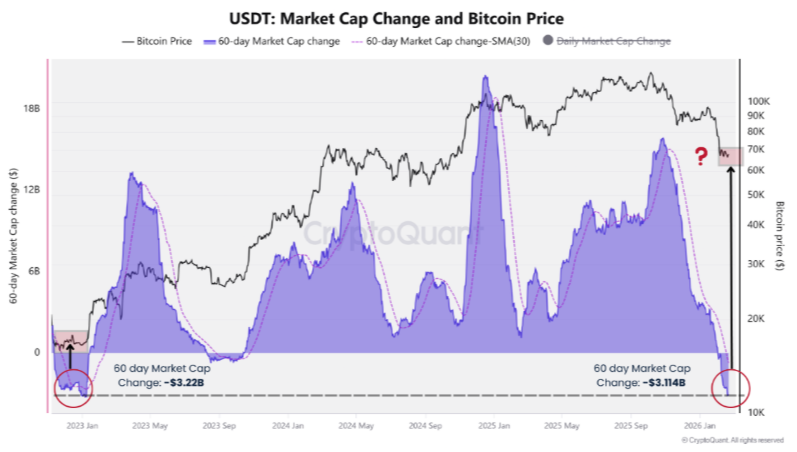
The stablecoin side shows a different signal. A contraction in USDT supply suggests capital may be leaving the system. Stablecoins function as ready liquidity inside the crypto ecosystem. When supply expands, buying power increases. When it contracts, risk appetite weakens.
Recent net outflows exceeding $1 billion in single-day sessions have occurred multiple times. This is not typical short-term fluctuation. It suggests larger players may be repositioning cautiously.
Periods like this sometimes mark the beginning of deeper declines. Other times, they appear near the exhaustion of selling pressure.
It is still unclear which scenario is unfolding now.
But one fact stands out: Bitcoin is moving again — not just on price charts, but inside exchange wallets. And movements like this often begin quietly. Their real impact tends to appear later.
You can also freely share your thoughts and comments about the topic in the comment section. Additionally, don’t forget to follow us on our Telegram, YouTube, and Twitter channels for the latest news and updates.