

 Emre Yumlu
Bitcoin has recently delivered a short-term rebound, providing some relief to investors after weeks of market pressure. However, many analysts caution that the latest price movement may not signal a lasting trend reversal. Both on-chain data and technical indicators suggest that broader bear market conditions could still be influencing the cryptocurrency market.
Brief Rally Pushes Bitcoin Above $74,000
Earlier in the week, Bitcoin climbed above the $74,000 level, marking its highest price in roughly a month. During this move, the asset briefly tested the 50-day exponential moving average (EMA), a technical level widely monitored by traders.
Despite the strong upward move, the rally quickly lost momentum. Bitcoin retraced more than $3,000 shortly afterward and slipped back below the $71,000 level during the following trading sessions. This pullback indicates that bullish momentum remains fragile and that sellers are still active in the market.
Indicators Continue to Signal Bearish Conditions for Bitcoin
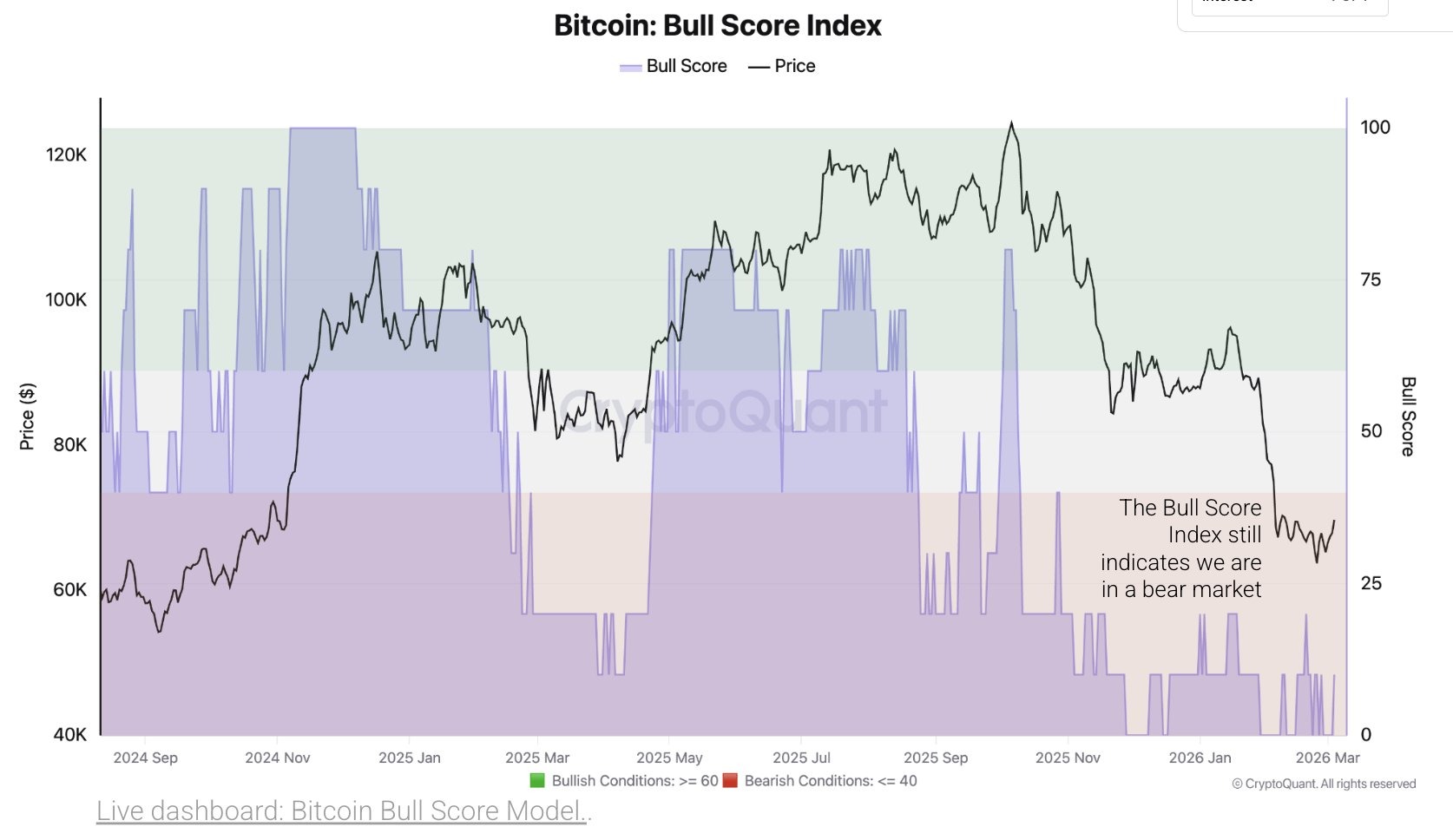
According to data from on-chain analytics platform CryptoQuant, the broader market environment still leans bearish. The firm tracks Bitcoin’s overall market health using its Bull Score Index, a composite metric that combines several fundamental and technical indicators.
Currently, the index sits at 10 out of 100, a level considered deeply bearish. Such a reading implies that the structural conditions typically associated with a sustained bull market are not yet present. Analysts therefore view the recent price increase as more of a relief rally rather than the beginning of a new bullish phase.
Macroeconomic Uncertainty Weighs on the Market
The recent upward movement in Bitcoin appears to have been supported by a temporary improvement in risk appetite and continued inflows into crypto investment products such as ETFs. Nevertheless, macroeconomic uncertainty continues to create headwinds for risk assets.
Upcoming U.S. economic data remains a key factor. In particular, expectations of a slowdown in February nonfarm payroll growth have led some investors to adopt a cautious stance. These macro signals could maintain pressure on cryptocurrencies, leaving Bitcoin vulnerable to further downside volatility.
Signs of Renewed Demand From U.S. Investors
While several indicators point to caution, some data suggests that demand may be returning. The Coinbase Premium, which reflects the difference between Bitcoin prices on Coinbase and other global exchanges, has recently turned positive.
Earlier in February, this metric was deeply negative, indicating weak demand from U.S. investors. The recent shift toward positive territory — reaching its strongest level since October — suggests that buying interest in the United States may be recovering.
Additionally, selling pressure from both short-term traders and long-term holders appears to be easing. Unrealized losses recently reached levels not seen since July 2022, after which selling activity began to decline.
A Possible Shift in Market Momentum
Some market observers believe that the current phase may represent a transition away from the most negative momentum seen in recent months. Historically, similar shifts have sometimes preceded larger structural changes in market trends.
Even so, analysts emphasize that caution remains essential. While Bitcoin’s recent rebound has provided temporary optimism, both technical signals and macroeconomic factors suggest that the market has not yet fully escaped bearish dynamics.
For now, the data points to a market in transition — one where volatility may persist until stronger evidence of a sustained bullish trend emerges.
This content is for informational purposes only and does not constitute investment advice.
You can also freely share your thoughts and comments about the topic in the comment section. Additionally, don’t forget to follow us on our Telegram, YouTube, and Twitter channels for the latest news and updates.