

 Yeliz Akmaca
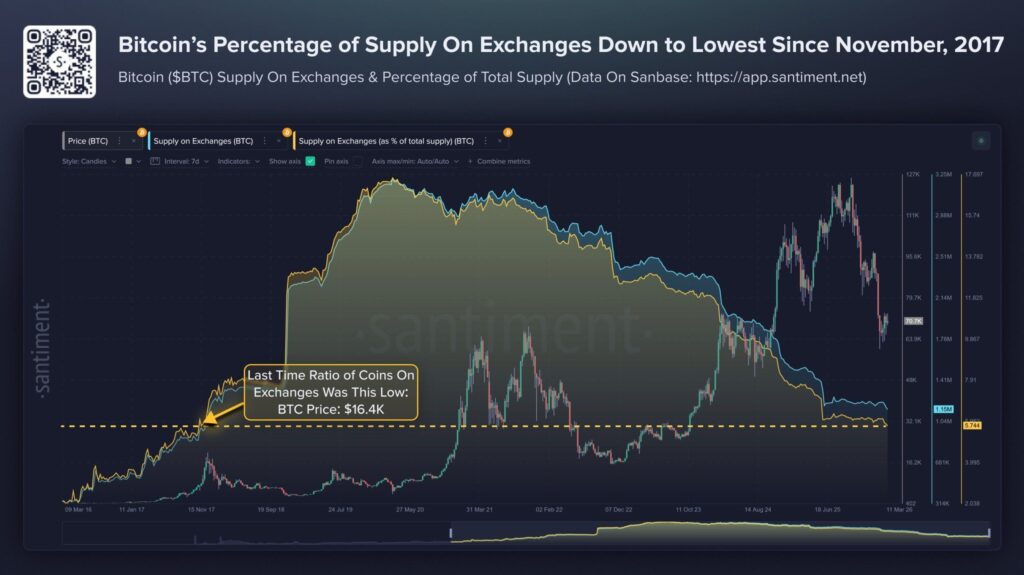
Actually, Bitcoin balances on exchanges have fallen to levels unseen since November 2017. Liquidity is shrinking. That means the market becomes more sensitive to demand fluctuations. Santiment reports that the percentage of Bitcoin held on centralized exchanges has reached the lowest point in eight years. This shift confirms investors are moving from short-term trading to long-term holding. Luckily, on-chain metrics clearly illustrate this trend.
Exchange supply metrics track the portion of circulating Bitcoin held in wallets associated with centralized exchanges. Currently, approximately 1.15 million BTC is held on exchanges, representing just 5.74% of the total supply. In comparison, past market cycles show that before similar declines, exchange balances had exceeded 3 million BTC. This highlights the potential for a supply shock.
Liquidity Shrinks, Price Movements Intensify
As exchange balances drop, the number of coins immediately available in the market decreases. Actually, when coins move to private wallets or cold storage, supply tightens and price movements can become sharper. Order book depth diminishes; even relatively small buy or sell orders can move the market more aggressively.
Cryptoquant data shows that exchange reserves decreased from over 3.2 million BTC in 2024 to around 2.73 million BTC by March 2026. The market price is roughly $70,500, providing a clear comparison between supply and market value over multiple cycles.
Key exchange balances and percentages:
-
Total BTC: ~21 million
-
BTC on exchanges: ~1.15 million
-
Exchange-held percentage: 5.74%
-
Early 2024 exchange reserves: 3.2 million BTC
-
March 2026 exchange reserves: 2.73 million BTC
Scarcity Dynamics and Long-Term Holding Trend
So, the drop in exchange reserves shows the long-term holding trend accelerating. Liquidity is decreasing, and the market is more sensitive. Even though over 20 million coins have been mined, the fact that less than 5% remain on exchanges strengthens scarcity dynamics. Supply tightens, and if demand rises, price impact grows larger.
Question: Why are Bitcoin exchange balances dropping and how does it affect prices?
Answer: As exchange reserves fall, fewer coins are immediately sellable. This makes price movements sharper during demand surges. Long-term holding strengthens, and scarcity increasingly impacts Bitcoin’s valuation.
Also, you can freely share your thoughts and comments about the topic in the comment section. Additionally, please follow us on our Telegram, YouTube and Twitter channels for the latest news and updates.