

 Haciyev Reşit
Ethereum co-founder Vitalik Buterin has released a comprehensive statement outlining the roadmap for 2026 and the goals for returning to Ethereum ecosystem’s core values. In his statement, Buterin focused especially on user autonomy, network decentralization, and trustless structures. The upcoming steps aim to enable users to participate in the network more independently, run their own nodes, and operate without reliance on centralized services. Buterin also emphasized reversing some negative trends in the ecosystem and strengthening Ethereum as a secure, user-focused network.
He Describes 2026 as the “Year of Reclaiming Decentralization”
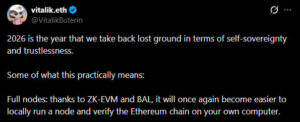
Buterin characterized 2026 as the year in which lost ground in self-sovereignty and trustless structures will be regained. According to him, Ethereum will transform into a structure where users can participate more directly and independently, run their own nodes, and verify transactions themselves. This approach will strengthen the network’s decentralization and increase user trust—a critical step forward.
Buterin acknowledged that this transformation cannot be completed with a single update or hard fork. However, he argued that the steps to be taken will make Ethereum not just a network that deserves its current position, but a much larger and more resilient ecosystem. He concluded his statement with words summarizing Ethereum’s philosophy:
“There is no central master in the world computer. No single point of failure. Only love exists.”
Full Node Experience Returns with ZK-EVM and BAL
Buterin noted that with ZK-EVM and BAL technologies, running a full node will become easier again. This will allow individual users to validate the Ethereum chain on their own computers and verify transactions directly. This development is considered a critical step in strengthening network decentralization and enabling users to participate independently in the Ethereum ecosystem. Consequently, reliance on centralized services will decrease, enhancing blockchain security and transparency.
The statement also mentioned that the era of unquestioned trust in RPC services is coming to an end. Technologies like Helios, ORAM, and PIR will allow users to verify the data they receive directly and hide which data they request from centralized services. This aims to prevent user behavior data from being sold to third parties.
Social Recovery and Timelock Mechanisms in Wallets
Buterin highlighted that social recovery and timelock mechanisms will become prominent on the wallet side. These structures will reduce the risk of losing seed phrases and prevent user funds from being indirectly controlled by centralized services. Privacy experience will also improve; private payments will be possible with the same user experience as regular payments.
Buterin acknowledged that over the past decade, some areas of the Ethereum ecosystem have regressed. Running full nodes has become more difficult, dApps have evolved into complex structures that leak data, and block production has come under the control of a small number of actors. By 2026, he stated, these trends will be reversed, and Ethereum will reclaim the value compromises made for mainstream adoption.
Also, you can freely share your thoughts and comments about the topic in the comment section. Additionally, please follow us on our Telegram, YouTube and Twitter channels for the latest news and updates.