

 Yeliz Akmaca
Elastos (ELA) aims to create a new version of the internet where digital assets can be owned and wealth can be generated. The project transforms the web from an “information network” into an “application network,” solving Ethereum’s speed, storage, cost, and flexibility issues to provide a better environment for decentralized applications (dApps).
Team and Founders
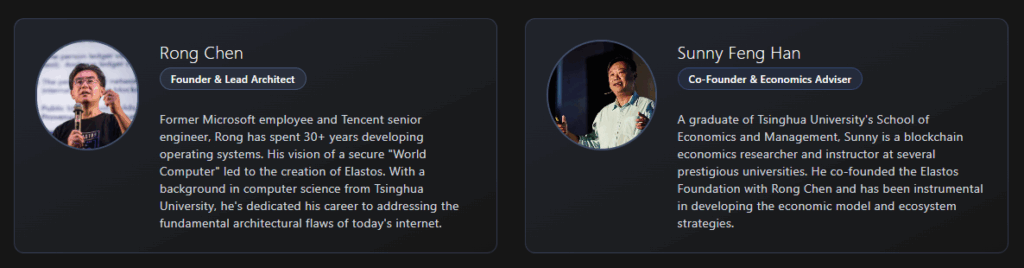
Rong Chen, founder and chief architect, is a former senior Microsoft software engineer with over 30 years of experience in operating systems. He created Elastos with a vision of a secure “World Computer.”
Sunny Feng Han, co-founder and economic advisor, graduated from Tsinghua University School of Economics and Management. He works alongside Chen on ecosystem strategies and the economic model of the project through the Elastos Foundation.
Investors and Key Partnerships
Elastos has received over 200 million RMB in funding from industry giants including Tsinghua Science Park, TD-SCDMA Industrial Alliance, and Foxconn Group.
Key partnerships include:
- ElacityLabs: Develops cDRM tech for P2P trading.
- Bitmain: Provides merged mining hardware support.
- OKMINER, f2pool & ViaBTC: Supply hashrate to secure the network.
- Tencent Cloud: Supports Chen’s operating system expertise.

Concept and How It Works
Elastos ensures digital assets are scarce, identifiable, and tradeable. Using blockchain, digital content receives verifiable identities, enabling creators to monetize their work.
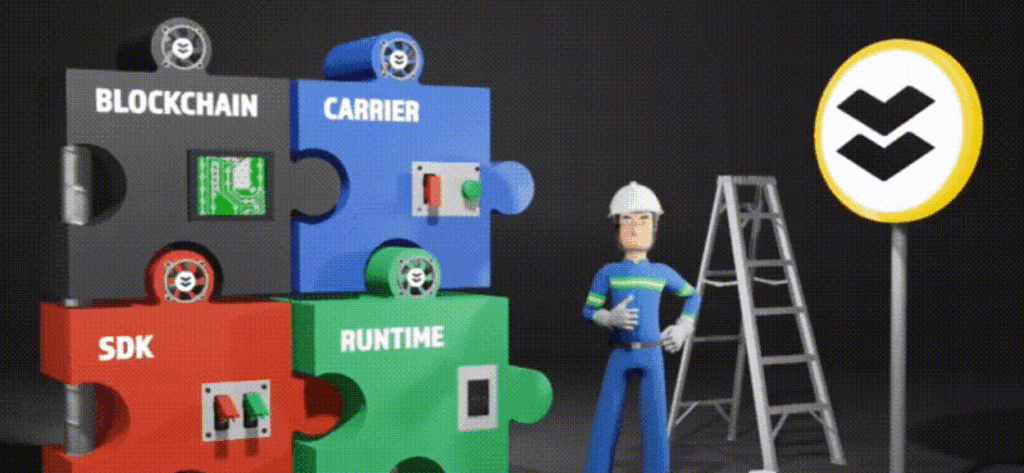
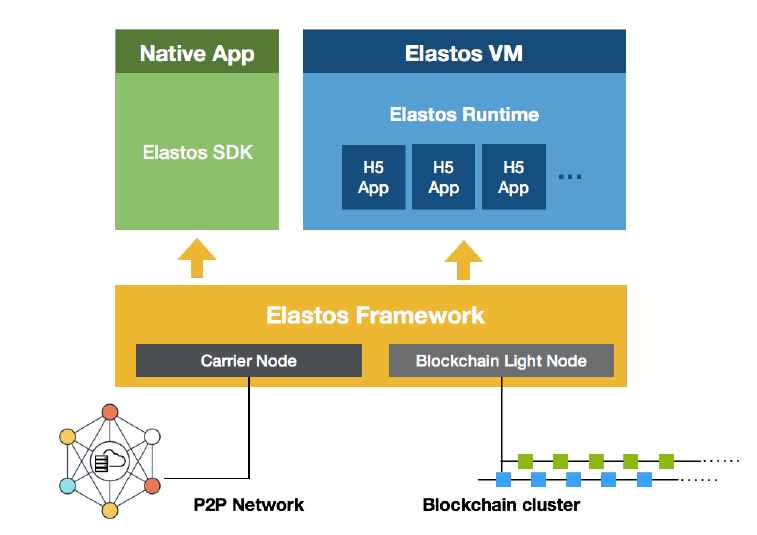
The Elastos Smart Network has four main components:
- Elastos Blockchain: Creates secure identities for every device, person, website, and digital asset. Uses main chain and sidechains to keep dApps separate from the main chain.
- Elastos Runtime: Lightweight OS that blocks direct internet access for apps, protecting user data from malware.
- Elastos Carrier: Fully decentralized P2P network that transmits app traffic.
- Elastos SDK: Provides tools for apps to access Elastos Smart Network identities and Carrier services.
- Elastos uses merged mining with Bitcoin to secure its network, leveraging existing computing resources while remaining environmentally efficient.
Governance
Elastos is governed by a global community including founders, angel investors, crowdfunding participants, and the Elastos Foundation (registered in Singapore). ELA holders collectively shape the network’s future through decentralized decision-making.
Roadmap
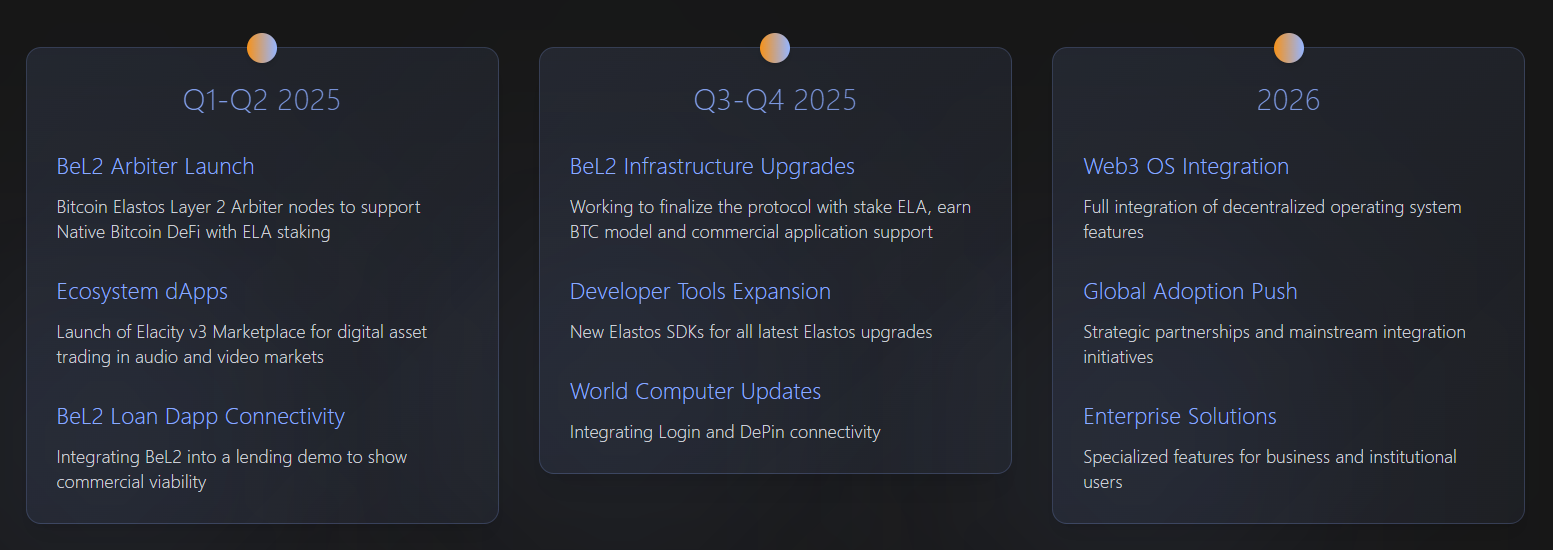
- H1 2025: Launch BeL2 Arbiter nodes for local Bitcoin DeFi, deploy Elacity v3 marketplace, integrate BeL2 lending dApp.
- H2 2025: Finalize BeL2 protocol with ELA staking, BTC model support, expand developer tools, update World Computer.
- 2026: Full integration of decentralized OS features, strategic partnerships, and global adoption initiatives.
Token Information and Use Cases
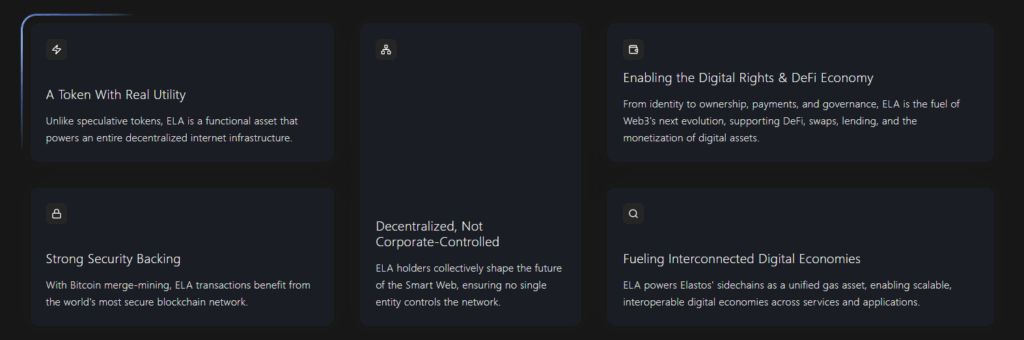
The Elastos token (ELA) powers the decentralized internet infrastructure:
- Governance: Voting in the Elastos DAO; 5,000 ELA required to be a council member.
- Digital Identity: Manage decentralized IDs (DIDs) on blockchain.
- Transactions & dApp Fuel: Gas token for smart contracts and dApps across sidechains.
- Digital Assets & DeFi: Payments, asset trading, staking, and DeFi transactions.
- Security: Bitcoin merged mining ensures high security.
Token Details
- Token Name: ELA
- Max Supply: 28,210,000 ELA
- Total Supply: 26,070,000 ELA
- Use: DAO governance, community incentives, ecosystem activities
Key Features
- Community-driven PoI governance
- BeL2 second-layer integration with Bitcoin
- High security and network reliability
- Open-source, decentralized infrastructure
- Bitcoin-backed security and reserve features
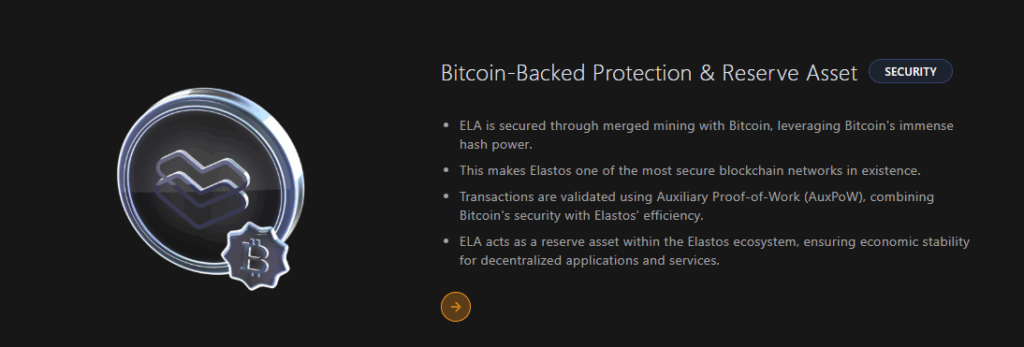
Security & Reserves
- Merged Mining: Uses Bitcoin’s hashpower to secure ELA.
- AuxPoW: Combines Bitcoin security with Elastos efficiency.
- Reserve Asset: ELA provides economic stability for dApps and services.
Official Links
You can also freely share your thoughts and comments about the topic in the comment section. Additionally, don’t forget to follow us on our Telegram, YouTube, and Twitter channels for the latest news and updates.