

 Haciyev Reşit
Ethereum co-founder Vitalik Buterin clearly outlined Ethereum’s long-term vision in a post shared on January 8. By comparing Ethereum to BitTorrent and Linux, Buterin explained why the network could become critical infrastructure not only for crypto users but also for individuals, institutions, and even governments on a global scale.
Why Is Ethereum Similar to BitTorrent?
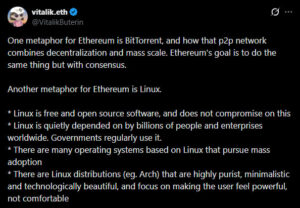
According to Buterin, one of the strongest metaphors for Ethereum is BitTorrent. BitTorrent is known as a system that can serve millions of users simultaneously without the need for a central server, thanks to its peer-to-peer (P2P) structure. This model proved years ago that decentralization does not have to conflict with scalability.
Highlighting this point, Vitalik Buterin stated:
“A metaphor for Ethereum is BitTorrent. This P2P network managed to combine decentralization with global scale. Ethereum’s goal is to achieve the same, but through the consensus layer.”
Buterin also reminded that BitTorrent has been used not only by individual users but, at times, even by governments for large-scale data distribution. This example demonstrates that decentralized systems can offer reliable and practical solutions.
The Linux Analogy and Institutional Adoption
Buterin’s second major comparison was with Linux. Despite being a fully open-source and free operating system, Linux today forms the backbone of billions of users, major corporations, and public institutions worldwide.
According to Buterin, the primary reason for this adoption is not ideology but risk management:
“What we call trustlessness is viewed by institutions as minimizing counterparty risk.”
In other words, institutions prioritize infrastructure that operates independently of centralized authorities and is transparent and auditable. At this point, Ethereum aims to offer a secure foundation regardless of crypto ideology.
The Role of Ethereum Layer 1
Vitalik Buterin emphasizes that Ethereum Layer 1 should serve as a shared “home base” for finance, identity, social systems, and governance—for both individuals and institutions. This approach reduces reliance on intermediaries while enabling direct, permissionless, and censorship-resistant access to the network.
This vision shows that Ethereum is not limited to popular use cases like DeFi or NFTs, but is positioning itself as a strong and reliable foundation for real-world applications such as digital identity solutions, enterprise use cases, and public infrastructure.
Ethereum’s Long-Term Roadmap
The picture drawn by Vitalik Buterin is quite clear: Ethereum aims to become decentralized yet scalable like BitTorrent, and open, neutral, and reliable like Linux. If this vision is realized, Ethereum is expected to see broader adoption not only within the crypto ecosystem but also across global finance, public services, and digital identity sectors.
You can also freely share your thoughts and comments about the topic in the comment section. Additionally, don’t forget to follow us on our Telegram, YouTube, and Twitter channels for the latest news and updates.