

 Emre Yumlu
Gold prices started the week on a firm footing, supported by a softer U.S. dollar and declining Treasury yields. As global investors reassess expectations around Federal Reserve policy, attention has shifted toward upcoming U.S. employment data, which is seen as a critical input for the Fed’s next moves. Against this backdrop, gold has once again benefited from its role as a defensive asset amid lingering macroeconomic uncertainty.
One of the Strongest Annual Performances in Years
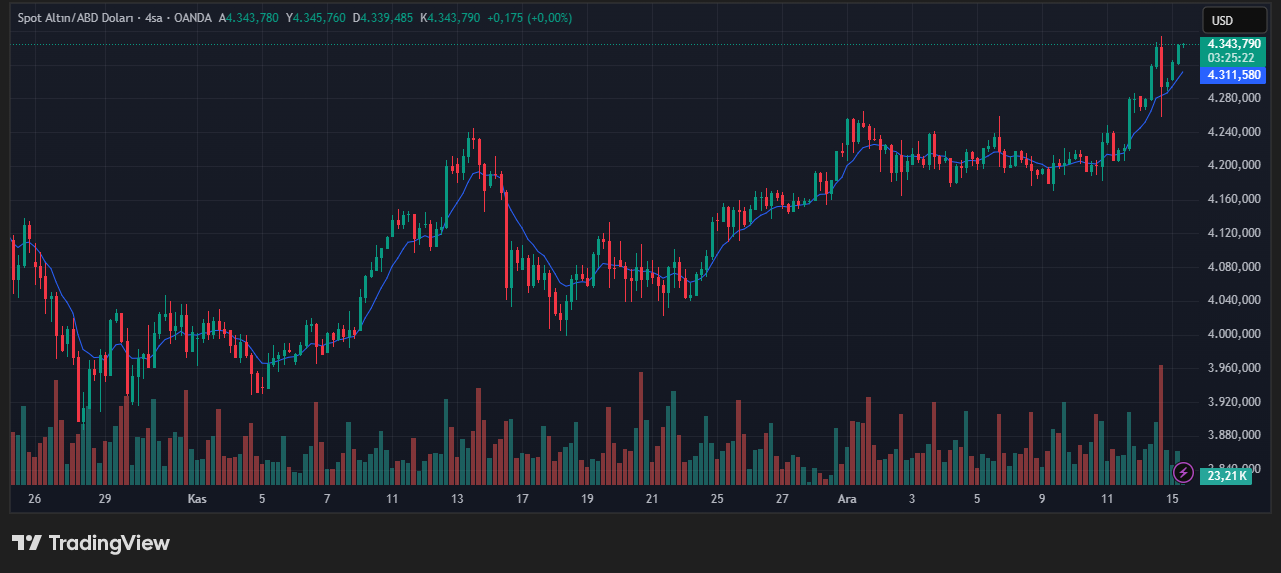
Spot gold climbed by around 0.5% in early-week trading, moving above the $4,340 per ounce level. With this advance, gold has posted an impressive gain of roughly 64% since the start of the year, marking one of its strongest annual performances in recent history. Heightened geopolitical risks, concerns over economic growth, and questions surrounding monetary policy have encouraged investors to increase their exposure to precious metals as a hedge against volatility.
Weaker Dollar and Lower Yields Provide Tailwinds
A key driver behind gold’s recent momentum has been weakness in the U.S. dollar. The dollar index has hovered near its lowest levels in nearly two months, making dollar-denominated gold more attractive to international buyers. At the same time, yields on benchmark 10-year U.S. Treasury bonds have moved lower, reducing the opportunity cost of holding non-yielding assets such as gold. This combination has created a supportive environment for further price appreciation.
Fed Policy Outlook Remains Uncertain
Uncertainty surrounding the Federal Reserve’s policy path continues to shape market sentiment. Last week’s decision to cut interest rates by 25 basis points was notable for being reached through a rare split vote, highlighting internal divisions within the central bank. Persistent inflationary pressures and mixed signals from the labor market have fueled expectations that the Fed may adopt a more cautious stance in the coming months.
While some policymakers argue that inflation remains too elevated to justify aggressive easing, financial markets are still pricing in the possibility of two additional rate cuts next year. In this context, the upcoming U.S. jobs report is widely viewed as a pivotal data point that could influence both short-term market direction and longer-term policy expectations.
Silver Seeks Stability After Sharp Swings
In the broader precious metals complex, silver has shown a more subdued performance compared to gold. Spot silver rose by approximately 0.8% to trade near $62.5 per ounce. After reaching an all-time high of $64.65 last week, prices experienced a sharp pullback, followed by a period of consolidation.
Although some analysts caution about near-term downside risks, silver has still delivered a remarkable gain of around 115% year to date. Declining inventories, strong industrial demand, and its classification as a strategically important mineral continue to underpin its longer-term outlook.
As investors look ahead, gold and silver markets are likely to remain sensitive to macroeconomic data releases and signals from central banks, with U.S. employment figures standing out as the next major catalyst.
You can also freely share your thoughts and comments about the topic in the comment section. Additionally, don’t forget to follow us on our Telegram, YouTube, and Twitter channels for the latest news and updates.