

 Haciyev Reşit
The long-accepted four-year cycle theory in the Bitcoin market has recently come under serious scrutiny. Especially since most of the supply has already been mined and Bitcoin’s price movements increasingly reflect macroeconomic factors, the validity of this classic narrative is now debatable. For crypto investors, the traditional “buy the halving, sell in the bull” approach no longer provides as clear signals.
Why Was the Four-Year Cycle So Strong?
Bitcoin’s four-year cycle is directly linked to the halving mechanism. Every four years, the block reward given to miners is halved, reducing the new BTC supply. In Bitcoin’s early years, this mechanism was extremely effective: when new supply decreased significantly and demand remained constant or increased, strong upward price pressure occurred. Historically, this model worked consistently. After each halving, strong bull markets emerged, followed by sharp corrections, reinforcing the perception that the four-year cycle was almost “inevitable.”
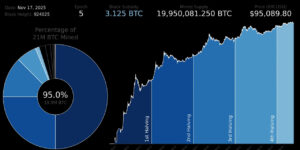
However, the current situation has changed significantly. According to recent data, over 95% of all mineable Bitcoin is already in circulation. The remaining supply will enter the market very slowly over the coming decades. Today, Bitcoin’s annual supply growth is about 1%, even lower than many investors’ perception of scarcity in gold. This raises the critical question: can halving such a limited remaining supply still have the same price impact as before?
What Really Drives Bitcoin’s Price?
Looking at recent major price movements, Bitcoin’s rises and falls are not solely driven by halvings but also by global liquidity conditions and macroeconomic cycles:
- 2017: Global economic expansion and abundant liquidity
- 2020–2021: Large-scale post-pandemic money printing and stimulus
- 2024: Institutional capital inflows due to the launch of spot Bitcoin ETFs
In particular, Bitcoin reaching an all-time high in 2024 before the halving occurred clearly breaks the historical cycle narrative. This indicates that Bitcoin is now a more mature asset class.
Liquidity, ETFs, and Changing Dynamics
Bitcoin’s price is increasingly tied to global money supply and financial liquidity. During periods of rising liquidity, BTC tends to perform strongly, while tightening phases put downward pressure on it. Spot Bitcoin ETFs add a new dimension to this, influencing price movements independently of the halving cycle.
Another notable point is that recent peaks came with lower market euphoria compared to past bull cycles. This doesn’t mean the cycles have completely disappeared, but that they have become weaker, more complex, and less predictable.
Where Does Bitcoin Stand Now?
In the short term, Bitcoin continues to show a cautious technical outlook. Its price remains below key moving averages, and trading volume is weakening, suggesting reduced investor risk appetite. Some capital has shifted to faster-return assets like AI, robotics, and tech stocks.
However, on the macroeconomic front, conditions are slowly improving. Central banks may approach interest rate cuts, and global liquidity could gradually increase. This could recreate the supportive conditions for Bitcoin seen in past cycles. Increased liquidity and renewed interest in risky assets may provide a more favorable medium- to long-term environment for BTC. Therefore, while the short-term outlook may not promise a strong rally, it is too early to declare the Bitcoin narrative over.
Conclusion
Bitcoin’s four-year cycle may not have disappeared entirely, but it is no longer the main factor driving price alone. Today, understanding BTC requires considering the halving alongside global liquidity, ETF flows, and macroeconomic developments. As Bitcoin matures, its cycles are evolving into a more complex and multi-variable structure.
You can also freely share your thoughts and comments about the topic in the comment section. Additionally, don’t forget to follow us on our Telegram, YouTube, and Twitter channels for the latest news and updates.