

 Emre Yumlu
BitMEX co-founder Arthur Hayes argues that escalating military tensions between the United States and Iran could have meaningful implications for monetary policy. According to Hayes, if President Donald Trump commits to a prolonged and costly engagement in Iran, the likelihood increases that the Federal Reserve (Fed) will pivot toward a more accommodative stance.
Hayes frames the issue through a macro-historical lens, suggesting that large-scale US military operations have often coincided with looser monetary conditions. In his view, extended geopolitical commitments tend to place fiscal pressure on Washington, creating an environment where expanding liquidity becomes a practical policy response.
Historical Examples: Wars and Fed Money Printing
Looking back at post-1985 conflicts in the Middle East, Hayes highlights several episodes where military involvement was followed by rate cuts or monetary easing. The 1990 Gulf War, the global war on terror after the September 11 attacks in 2001, and the 2009 troop surge in Afghanistan all occurred alongside periods of Federal Reserve accommodation.
His argument is that financing large-scale geopolitical strategies frequently requires supportive monetary conditions. If the US were to embark on a long-term and expensive political restructuring effort in Iran, similar dynamics could re-emerge. In such a scenario, lower interest rates and increased money supply would not only ease fiscal strain but also inject additional liquidity into global markets.
For digital assets, that liquidity expansion could serve as a tailwind. Historically, risk assets—including cryptocurrencies—have responded positively to periods of monetary easing.
A Wait-and-See Approach
Despite outlining a potentially bullish framework for crypto markets, Hayes advises caution. The scale and duration of US involvement in Iran remain uncertain, as does the political tolerance for sustained financial and geopolitical costs. For now, he suggests monitoring developments rather than front-running policy shifts.
In his assessment, the optimal entry point for Bitcoin and higher-quality altcoins would materialize only after the Fed explicitly signals rate cuts or balance sheet expansion.
Markets Remain Measured
Although weekend airstrikes by the US and Israel on Iranian targets triggered heightened rhetoric on social media, broader financial markets have not displayed signs of systemic panic. US stock futures opened with only modest declines, oil prices retraced roughly half of their initial surge, and the S&P 500 fell by less than 1%.
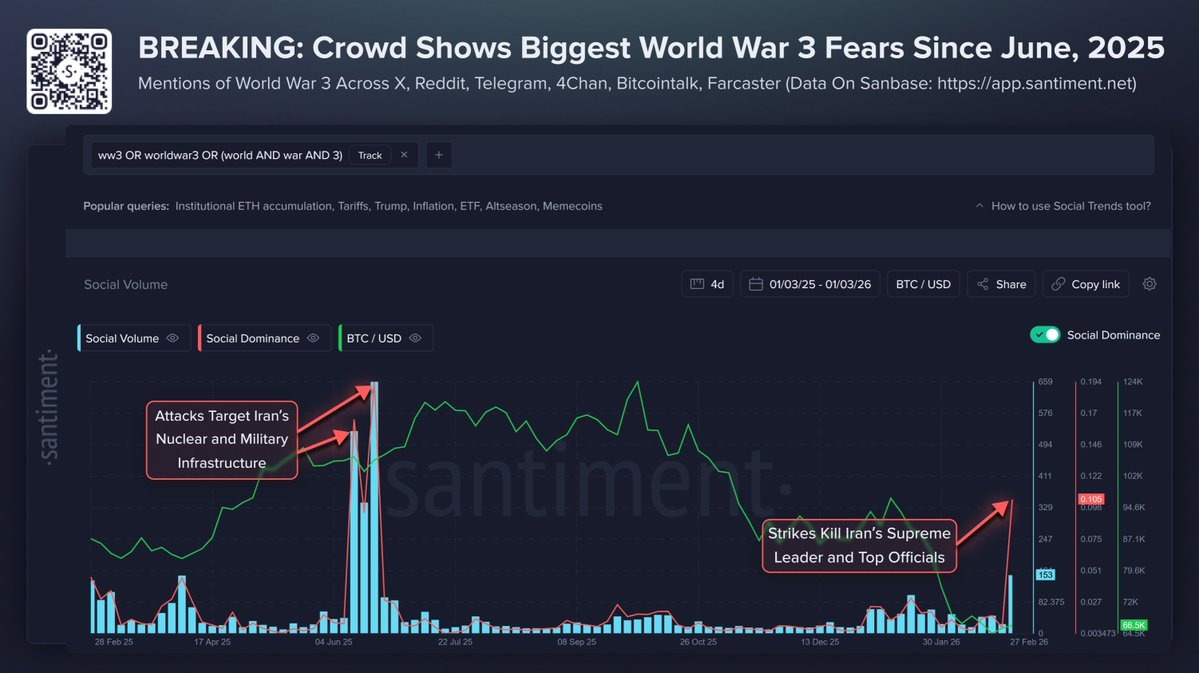
This muted reaction suggests that, at least for now, markets are not pricing in a full-scale global crisis. The key variable moving forward will be whether geopolitical escalation translates into a decisive shift in Federal Reserve policy.
This content is not investment advice.
Also, in the comment section, you can freely share your comments and opinions about the topic. Additionally, don’t forget to follow us on Telegram, YouTube and Twitter for the latest news and updates.