

 Haciyev Reşit
Rising geopolitical tensions in global markets have begun to directly impact the cryptocurrency sector. James Butterfill, Head of Research at CoinShares, stated that Iran-related developments and risks surrounding the Strait of Hormuz represent a significant test for Bitcoin’s “safe-haven” narrative. According to Butterfill, recent events may prompt investors to reassess the role of Bitcoin and other digital assets within the global financial system. Over the weekend, escalating geopolitical tensions and market-moving actions by U.S. President Donald Trump increased global risk perception. Developments such as the United Kingdom withdrawing some diplomatic personnel from the region also signaled growing uncertainty. These events have led investors to monitor global market risks more closely.
Why Is the Strait of Hormuz Critical for the Global Economy?
At the center of the crisis lies the Strait of Hormuz, a crucial chokepoint for global energy supply. Approximately 21% of daily global oil trade passes through this narrow waterway. Any disruption in the region has the potential to create serious consequences not only regionally but also for the global economy. Sudden fluctuations in energy markets could impact global inflation and economic stability through rising oil prices. According to Butterfill, the withdrawal of maritime insurance coverage and increased tanker activity indicate that the crisis is moving beyond political rhetoric and that markets have begun pricing in real risks. Additionally, the reemergence of actors such as Hezbollah and the Houthis has heightened concerns that tensions could spread into a broader conflict. This situation raises global risk perception and may lead investors to take more cautious positions.

Oil and Gold Moved, Bitcoin Reacted Differently
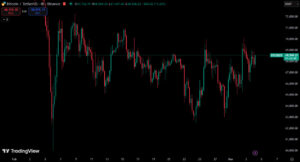
As geopolitical risks increased, oil prices rose by approximately 13%, while gold prices declined by 1.8%. However, according to Butterfill, the most notable move occurred in Bitcoin. Since Bitcoin is one of the few major liquid assets that can be traded on weekends, it is considered an important indicator for understanding market behavior during crises. In past geopolitical events, Bitcoin typically behaved like a risk asset, absorbing selling pressure during investor flight-to-safety phases. This time, however, a different picture emerged. As global uncertainty increased, Bitcoin’s price moved higher. This suggests that instead of panic-selling, some investors redirected capital into digital assets. Butterfill argues that this indicates a growing perception among certain investors that Bitcoin may serve as an alternative store of value. Especially during periods of rising uncertainty in traditional markets, Bitcoin’s reaction has reignited debates about the role of digital assets in the global financial system.
Technical Indicators and Market Positioning
According to the analysis, Bitcoin’s current resilience may also be linked to market positioning ahead of the crisis. Over the past five months, large investors are estimated to have sold approximately $30 billion worth of Bitcoin, significantly reducing supply pressure in the market.
During the same period, several key technical indicators approached bottom levels:
- The MVRV ratio fell roughly one standard deviation below realized value.
- The RSI dropped to 16, entering deep oversold territory.
- The leverage ratio declined from 33% in October 2025 to 25%, returning to its long-term average.
Butterfill suggests these figures indicate that the Bitcoin market had already largely completed its correction phase before the geopolitical shock occurred.
ETF Flows Show Growing Preference for Bitcoin
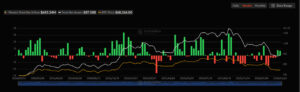
One of the most important indicators supporting market behavior has been ETF flows. Bitcoin ETFs had experienced cumulative outflows of $4.3 billion over five consecutive weeks. However, last week the trend reversed, with approximately $683 million in net inflows. According to Butterfill, these figures suggest that instead of exiting the market amid uncertainty, investors have begun reallocating capital into Bitcoin. Meanwhile, U.S. Producer Price Index (PPI) data came in above expectations, rising 0.5% monthly, while the core figure measured 0.8%. Continued increases in energy prices due to tensions involving Iran signal mounting global inflationary pressure. This development also affects interest rate expectations. Futures markets show that the probability of a rate cut in June has fallen below 50%. Butterfill notes that a high-interest-rate environment may create short-term pressure on non-yielding assets like Bitcoin. However, as tensions between energy-driven inflation and confidence in central banks intensify, Bitcoin’s attractiveness could increase.
Evaluation
Geopolitical tensions surrounding the Strait of Hormuz pose significant risks to the global financial system. A surge in energy prices, supply chain disruptions, and broader economic strain could drive investors toward alternative assets. According to CoinShares, short-term consolidation and limited downside risk may persist for Bitcoin. However, the normalization of leverage ratios, reduced selling pressure from large investors, and million-dollar ETF inflows during rising geopolitical risk suggest that Bitcoin is increasingly behaving like a maturing “safe-haven” asset.
Butterfill summarizes the situation as follows:
“The Iran crisis did not establish Bitcoin’s safe-haven thesis, but it has provided the strongest real-world test of this cycle so far.”
According to the analyst, market movements over the past 72 hours indicate that Bitcoin has, for now, passed that test successfully.
You can also freely share your thoughts and comments about the topic in the comment section. Additionally, don’t forget to follow us on our Telegram, YouTube, and Twitter channels for the latest news and updates.