

 Emre Yumlu
The rapid increase in investments directed toward artificial intelligence data centers has brought a new debate about Bitcoin mining. Some market commentators argue that Bitcoin miners shifting toward the increasingly profitable artificial intelligence infrastructure could have negative effects on network security. Other experts believe that Bitcoin’s protocol design will automatically adapt to such changes.
At the center of the discussion lies the competition for electricity usage among miners and its potential impact on the hash power of the Bitcoin network.
Electricity Competition Between Artificial Intelligence and Bitcoin Mining
According to crypto trader Ran Neuner, the artificial intelligence sector has become one of the biggest competitors facing Bitcoin mining. Neuner points out that both sectors consume large amounts of electricity, but artificial intelligence data centers can generate significantly higher revenue from the same energy.
According to Neuner’s assessment, revenue per megawatt in Bitcoin mining ranges from approximately $57 to $129, while in artificial intelligence data centers this figure can reach $200 to $500 levels. It is stated that this difference is causing some miners to shift their operations toward the artificial intelligence side.
Some developments signaling this transition are also noteworthy. It is reported that Core Scientific has secured up to $1 billion in credit for artificial intelligence hosting services, MARA Holdings has filed an application indicating plans to sell a portion of its Bitcoin holdings as part of its artificial intelligence strategy, and Hut 8 has signed a $7 billion artificial intelligence infrastructure agreement with Google.
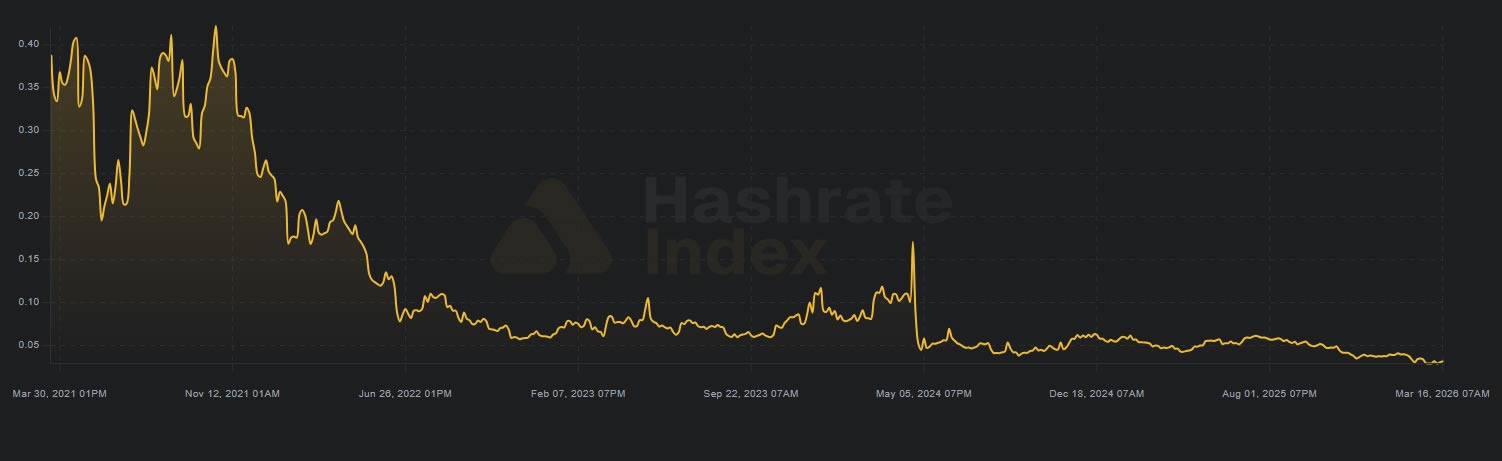
Network Security Debate
Neuner argues that miners leaving the network could lead to a decline in hash rate, which in theory could increase the risk of a 51% attack. Indeed, the total hash power of the Bitcoin network has declined by approximately 14.5% from its peak level reached in October.
However, there are also those who disagree with this view. According to Adam Back, one of Bitcoin’s early developers and a cryptographer, Bitcoin’s difficulty adjustment mechanism is designed precisely for such situations. Since mining difficulty adjusts automatically, while inefficient miners exit the system, the profitability of the remaining miners can increase.
Similarly, investor Fred Krueger states that in the event of rising electricity prices, some miners may temporarily halt operations, but mining can become profitable again following the difficulty adjustment.
Energy Usage and Alternative Views
Bitcoin ESG expert Daniel Batten approaches the discussion from a different perspective. According to Batten, data shows that the growth of the artificial intelligence sector is actually dependent on Bitcoin mining in some cases.
Batten argues that Bitcoin mining can utilize unused energy sources, act as a flexible load balancer in energy grids, and operate with cheaper energy sources.
Bitcoin Price Could Be Decisive
According to Ran Neuner, one of the most important factors determining whether miners will shift toward artificial intelligence will be the trajectory of Bitcoin’s price. In his view, a strong price rally could keep miners in the network.
Bitcoin’s price has recently gone through a challenging period, recording five consecutive months of declines. This situation was last seen during the bear market in 2018. Nevertheless, March has so far shown a positive picture, with Bitcoin’s price rising approximately 8% since the beginning of the month.
You can also freely share your thoughts and comments about the topic in the comment section. Additionally, don’t forget to follow us on our Telegram, YouTube, and Twitter channels for the latest news and updates.