

 Emre Yumlu
The recent pullback in Bitcoin price has reignited a familiar debate across the crypto market: has Bitcoin entered a new bear cycle, or is this simply a correction within a maturing asset class? Anthony Pompliano, a prominent financial commentator and long-time Bitcoin advocate, recently addressed this question by examining both historical data and structural changes in the market.
Understanding the 40% Price Decline
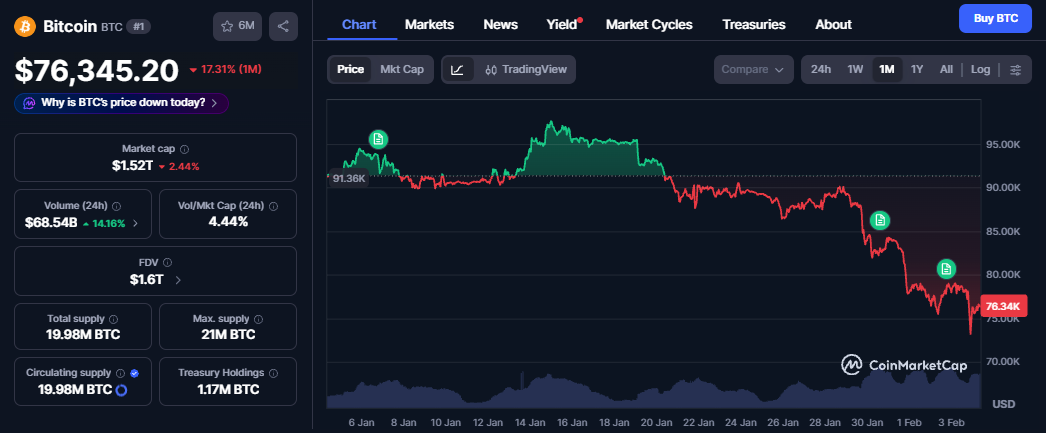
Bitcoin’s drop from its peak near $126,000 to the $75,000 range represents a decline of roughly 40%. While such a move appears severe at first glance, Pompliano argues that context is critical. In previous market cycles, Bitcoin regularly experienced drawdowns of 70% to 80% during full-fledged bear markets. From this perspective, today’s correction may not fit the traditional definition of a bear phase.
A More Mature Asset With Lower Volatility
A key pillar of Pompliano’s thesis is that Bitcoin has fundamentally evolved. According to his assessment, Bitcoin’s volatility has been reduced by approximately 50% compared to earlier cycles. As volatility declines, so does the magnitude of price swings. This implies that a 40% correction in today’s market environment could be comparable to the deep bear market bottoms of earlier years when volatility was significantly higher.
Institutional Participation Changes the Market Structure
Pompliano emphasizes that Bitcoin is no longer dominated solely by retail investors. Wall Street now plays an active role through spot ETFs, derivatives, and options markets. These instruments allow institutional participants to hedge exposure and implement complex trading strategies, which in turn dampens extreme price movements. As a result, Bitcoin’s behavior increasingly resembles that of a structured financial asset rather than a purely speculative instrument.
From Inflation Fear to Deflation Anxiety
Beyond market mechanics, Pompliano highlights a shift in macroeconomic sentiment. He suggests that the recent decline is less about technical weakness and more about changing expectations. While Bitcoin’s rally toward $126,000 coincided with fears of inflation driven by tariffs and policy uncertainty under a Trump administration narrative, current market pricing reflects reduced inflation concerns and growing deflationary anxiety. As expectations of high inflation fade, demand for Bitcoin as an inflation hedge can temporarily weaken.
Hash Rate Declines and Gold’s Divergence
Addressing concerns around falling Bitcoin hash rate, Pompliano explains that recent declines are largely operational rather than structural. Major North American mining firms reportedly shut down machines during extreme cold weather, selling electricity back to the grid for economic efficiency. He argues this has no lasting negative impact on Bitcoin’s fundamentals.
Meanwhile, gold reaching new highs is attributed to central bank behavior. Pompliano notes that central banks are accumulating gold not as an inflation hedge, but as a way to distance themselves from fiat currencies. Bitcoin, still not recognized as a reserve asset by central banks, has yet to benefit from this trend.
Taken together, Pompliano’s analysis suggests that Bitcoin’s current drawdown may reflect a transition phase rather than the onset of a traditional bear market.
You can also freely share your thoughts and comments about the topic in the comment section. Additionally, don’t forget to follow us on our Telegram, YouTube, and Twitter channels for the latest news and updates.