

 Emre Yumlu
Recent movements in financial markets have sparked renewed debate about the relationship between Bitcoin and technology stocks. As Bitcoin’s price climbed alongside U.S. software equities in recent weeks, some observers suggested that the cryptocurrency is increasingly behaving like a proxy for the tech sector. However, a closer examination of market dynamics indicates that this conclusion may be overstated.
While the parallel price action between Bitcoin and certain technology stocks appears striking at first glance, the underlying reasons may have more to do with broader macroeconomic conditions than with any structural connection between the two markets.
Shared Sensitivity to Macroeconomic Conditions
One explanation for the recent synchronized movements lies in how both asset classes respond to the same macroeconomic environment. Assets that are sensitive to liquidity conditions and long-term growth expectations often react similarly when global financial conditions shift.
In periods when liquidity improves or risk appetite increases, investors tend to allocate capital toward higher-risk assets that promise potential long-term returns. Both technology equities and Bitcoin often fall into this category. As a result, their prices may rise or fall in tandem, not because they share the same economic drivers, but because they are responding to the same external financial forces.
This suggests that the apparent link between Bitcoin and software stocks may reflect temporary macro influences rather than a lasting convergence between the cryptocurrency market and the technology sector.
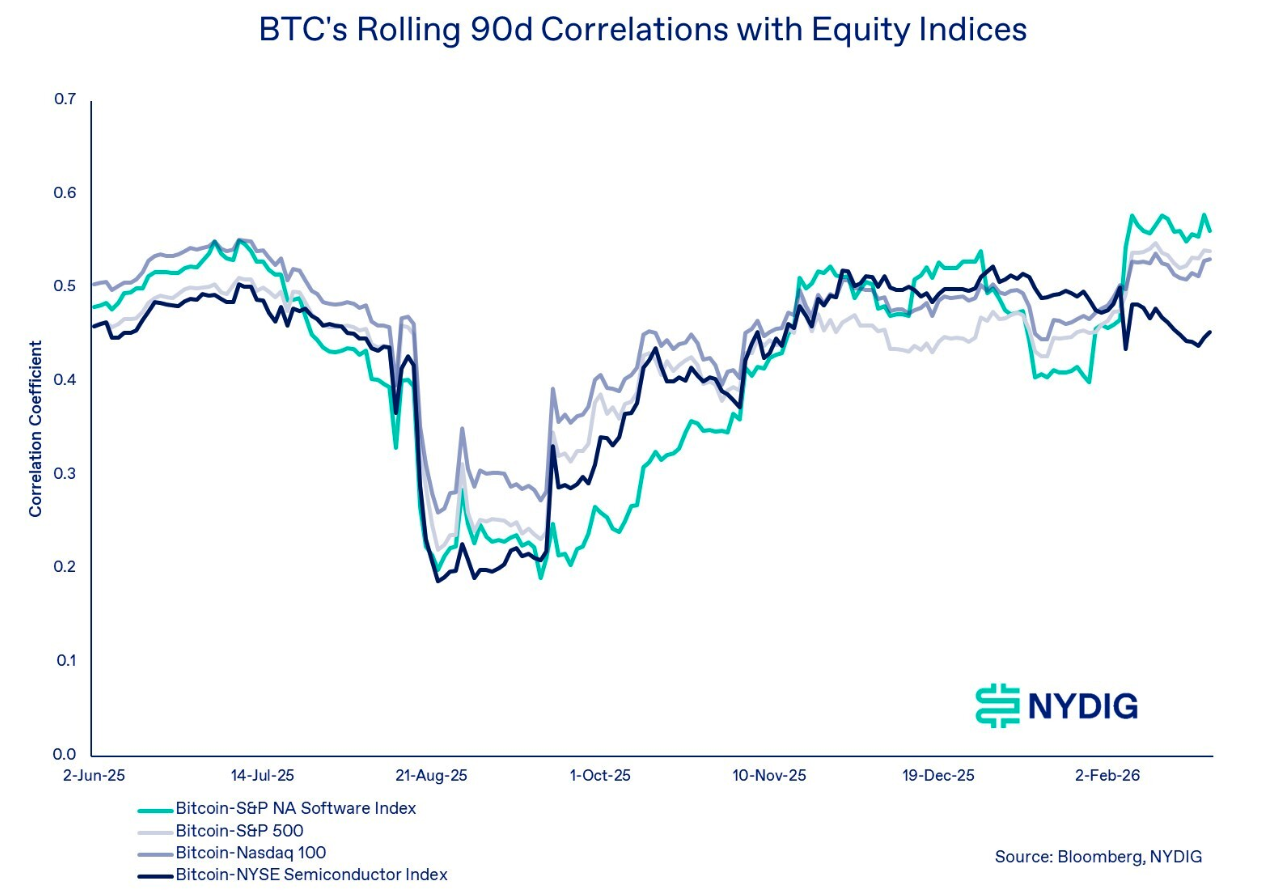
Most Bitcoin Price Movements Occur Independently
Data also indicates that Bitcoin’s price behavior cannot be fully explained by movements in the stock market. Although the correlation between Bitcoin and software stocks has increased in recent months—particularly after Bitcoin reached a new all-time high above $126,000 in early October—similar increases have also been observed with broader equity indices.
Both the S&P 500 and the Nasdaq have shown rising correlations with Bitcoin during this period. This pattern implies that the change is not unique to technology stocks but instead reflects broader market dynamics.
Despite these correlations, statistical analysis suggests that only about 25 percent of Bitcoin’s price movements can be linked to the stock market. In other words, roughly three quarters of Bitcoin’s volatility is driven by factors that lie outside traditional equity markets.
Why Bitcoin Doesn’t Always Behave Like Gold
Bitcoin is often described as “digital gold,” yet its market behavior does not always align with that narrative. One reason may be that many investors do not treat Bitcoin primarily as a hedge against macroeconomic uncertainty.
Instead, it is frequently positioned along a broader risk spectrum, where investors allocate capital based on risk tolerance rather than a specific monetary thesis. This approach can cause Bitcoin to behave more like a growth-oriented asset than a traditional safe-haven investment.
Unique Drivers Behind Bitcoin’s Market Structure
Despite occasional correlations with equities, Bitcoin still operates under a distinct set of economic and structural drivers. Factors such as network activity, user adoption, regulatory developments, and policy changes all play a meaningful role in shaping its price dynamics.
These characteristics distinguish Bitcoin from traditional financial assets and support its potential role as a portfolio diversifier. Even when cross-asset correlations temporarily rise, Bitcoin’s long-term performance remains influenced largely by its own ecosystem rather than by movements in conventional markets.
You can also freely share your thoughts and comments about the topic in the comment section. Additionally, don’t forget to follow us on our Telegram, YouTube, and Twitter channels for the latest news and updates.