

 Haciyev Reşit
The cryptocurrency market and global commodity markets have become active again due to geopolitical developments. While the price of Bitcoin has dropped to around $69,400, the price of Brent crude oil has risen above $100 per barrel. The surge in energy prices amid rising tensions in the Middle East is directly affecting investors’ approach to risk assets. According to analysts, market volatility could increase in the short term. In particular, Federal Reserve policy, war-driven monetary expansion, and the rising use of crypto in sanctioned countries are among the key factors that markets will closely monitor in the coming period.
Surge in Oil Prices Shakes Markets
Recent developments in energy markets have created a new wave of uncertainty in global markets. Brent crude oil prices rose more than 9%, reaching $101.59. The increase was largely driven by escalating geopolitical tensions in the Middle East. Two oil tankers were reportedly attacked off the coast of Iraq, while Baghdad halted operations at its oil port, rapidly impacting markets. At the same time, reports of attacks on fuel tanks in Bahrain and the evacuation of ships from the important export terminal Mina Al Fahal in Oman raised serious concerns about energy supply. All these developments occurred shortly after the International Energy Agency (IEA) announced a plan to release 400 million barrels of emergency oil reserves. Although the United States is expected to contribute 172 million barrels, markets did not consider the move sufficient.
SPI Asset Management analyst Stephen Innes commented:
“Releasing oil from emergency stockpiles is more of a symbolic gesture than a real solution.”
According to prediction market platform Polymarket, investors believe oil prices could continue rising. The market currently prices an 82% probability that oil will remain around $100 until the end of March, while the chance of exceeding $110 is estimated at over 60%. These expectations indicate that upward risks in the energy market remain strong.
Bitcoin Failed to Act as a Safe Haven
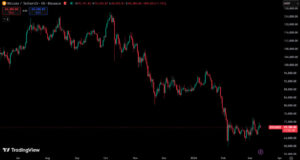
Despite rising geopolitical tensions, Bitcoin did not behave like traditional safe-haven assets. Since the Iran-centered conflict began on February 28, Bitcoin has moved more in line with risk assets rather than gold. Bitcoin was unable to maintain the $74,000 level reached during the first week of the conflict and subsequently moved downward. In addition, Bitcoin is currently down about 47% from its all-time high of $126,000 reached in October 2025. According to analysts, the main mechanism behind this situation is linked to energy prices. Rising oil prices increase inflation expectations, which in turn may force central banks to delay interest rate cuts. Delays in rate cuts can limit the liquidity that the crypto market typically relies on for growth.
Institutional Investors Continue Accumulating Bitcoin via ETFs
Despite Bitcoin’s weak price performance, institutional investors appear to be continuing accumulation through ETF products. According to data from SoSoValue, U.S. spot Bitcoin ETFs recorded net inflows for three consecutive days.
The data shows:
- March 9: $167 million inflow
- March 10: $250.92 million inflow
- March 11: $115.17 million inflow
In total, $533 million in net inflows occurred within just three days. This suggests that institutional investors resumed buying after large outflows in previous days. According to Bloomberg ETF analyst Eric Balchunas, spot Bitcoin ETFs currently hold around 1.28 million BTC, making them one of the largest Bitcoin holders in the world. Total net inflows into Bitcoin ETFs have reached approximately $56 billion.
Evaluation
One of the most critical upcoming developments for markets in the short term will be the core PCE inflation data. Expectations of a 0.4% monthly increase suggest that the Federal Reserve could maintain tight monetary policy for a longer period. At the same time, persistently high oil prices could further delay expectations of interest rate cuts. In the long term, however, geopolitical conflicts may affect the financial system differently. Historically, major wars involving the United States have often led to monetary expansion and looser central bank policies. If such a scenario occurs again, a new wave of liquidity could emerge for risk assets. Another important development is the growing use of crypto in sanctioned countries. According to Elliptic, Iran’s central bank reportedly held more than $500 million in USDT before the recent attacks. Additionally, the Russia-linked A7A5 stablecoin has exceeded $93 billion in circulation in less than a year. All these developments suggest that Bitcoin is currently behaving more like a liquidity-driven asset. However, whether wars and monetary expansion will reshape the long-term role of the crypto market remains one of the most important questions investors continue to watch closely.
Also, in the comment section, you can freely share your comments and opinions about the topic. Additionally, don’t forget to follow us on Telegram, YouTube and Twitter for the latest news and updates.