

 Emre Yumlu
Recent movements in the cryptocurrency market have sparked renewed debate about whether Bitcoin has already reached its bottom. While smaller investors have been increasing their exposure during the recent price decline, activity from large holders suggests the correction phase may still have further to go. On-chain data and sentiment indicators indicate that the current downturn could continue before a more stable recovery begins.
Whales Move to Take Profits
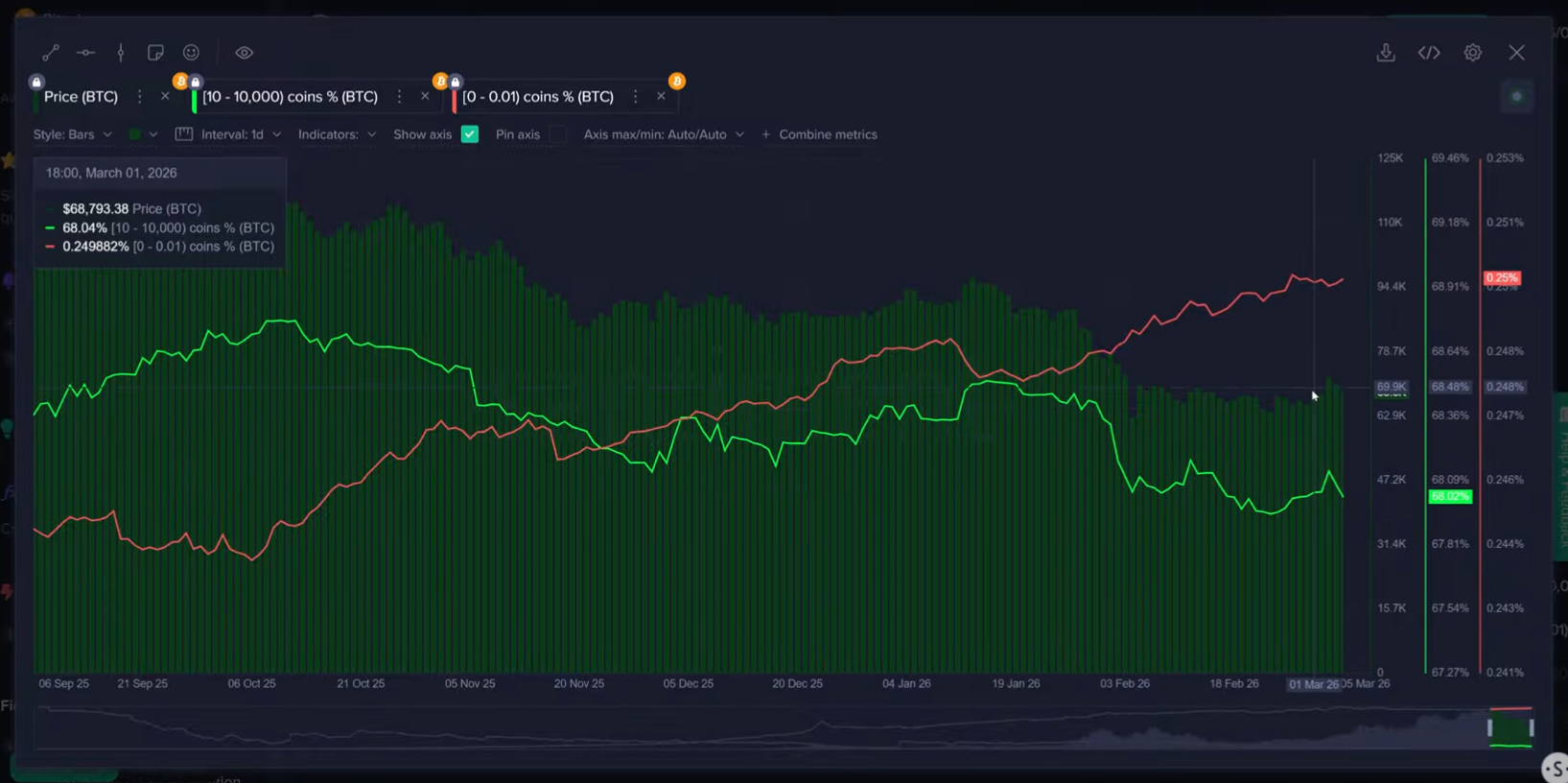
Large Bitcoin holders—often referred to as “whales”—have recently begun reducing their positions after a period of accumulation. This group, typically defined as wallets holding between 10 and 10,000 BTC, plays a significant role in shaping market trends due to the scale of their transactions.
Data shows that these investors accumulated substantial amounts of Bitcoin between February 23 and March 3, when prices were trading in the range of $62,900 to $69,600. However, when Bitcoin later climbed above $70,000 and briefly approached the $74,000 level, many of these large holders started locking in profits.
Since that point, whales have reportedly sold approximately 66% of the Bitcoin they had recently accumulated, suggesting a shift in market sentiment among major investors.
Retail Investors Increase Accumulation
While large holders were selling into the rally, smaller investors moved in the opposite direction. Retail participants—defined as wallets holding less than 0.01 BTC—have been steadily increasing their holdings as prices dipped below the $70,000 threshold.
This divergence between retail buying and whale selling has historically been viewed as a warning sign in cryptocurrency markets. When smaller investors accumulate during periods of large-scale profit-taking by whales, it often indicates that a broader market correction may still be underway.
Bitcoin Trades Near the $68,000 Level
At the time of writing, Bitcoin is trading around $67,984. The recent price decline has also affected overall market sentiment.
The Crypto Fear and Greed Index dropped by six points following the latest pullback, falling to a reading of 12. This level places the market firmly within the “Extreme Fear” zone, reflecting growing caution among investors.
Key Support Zone Around $67K–$68K
Some analysts have identified the $67,000 to $68,000 range as a crucial short-term support level for Bitcoin. If the price fails to hold within this zone, the market could revisit previous lows in search of liquidity before any meaningful recovery begins.
Temporary declines followed by rebounds are not uncommon during volatile market cycles, especially in periods of heightened uncertainty.
Significant Outflows From Spot Bitcoin ETFs
The price decline has also coincided with notable capital outflows from U.S.-based spot Bitcoin exchange-traded funds. Across 11 ETF products, net outflows reached approximately $348.9 million in a single day.
This marked the largest daily withdrawal from these investment vehicles in roughly three weeks, suggesting that institutional investors may also be adopting a more cautious stance toward the market.
$60,000 Could Act as a Strong Floor
Bitcoin previously dropped to around $60,000 on February 6 during the broader correction that followed its record high of $126,000 reached in October. After touching that level, the market managed to stage a modest rebound.
Some economists believe the $60,000 level could serve as a significant support zone for the time being. Certain valuation models that compare Bitcoin’s price to network value metrics suggest this area has historically aligned with market bottoms.
Although the long-term outlook remains uncertain, many market participants continue to monitor whale activity, investor sentiment, and institutional flows to determine whether the current correction has reached its final stage.
You can also freely share your thoughts and comments about the topic in the comment section. Additionally, don’t forget to follow us on our Telegram, YouTube, and Twitter channels for the latest news and updates.