

 Yeliz Akmaca
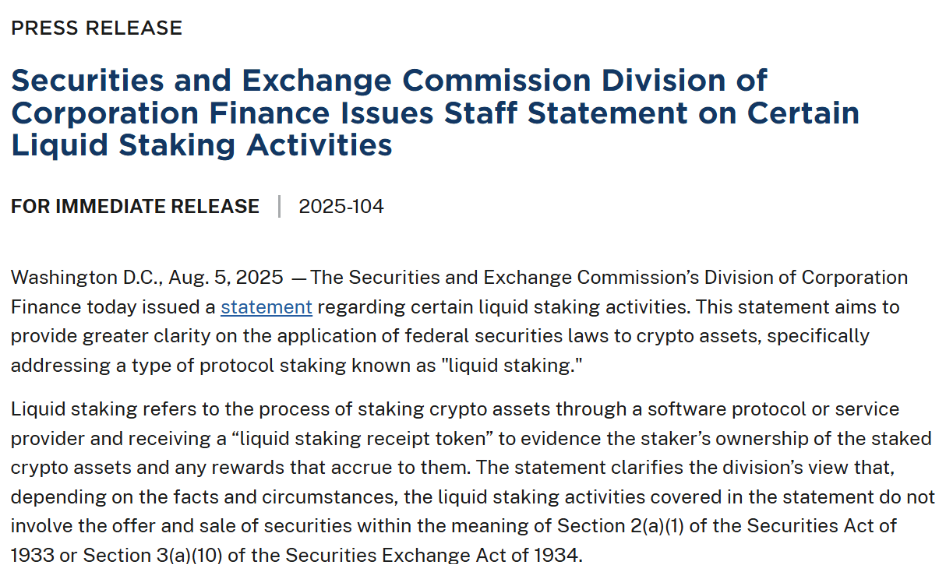
The U.S. Securities and Exchange Commission (SEC) has released a statement that marks a significant development for the crypto markets. The agency clarified that certain liquid staking practices are not considered securities. This clarification is seen as a critical step toward clearer regulation of digital assets.
In its staff statement, the SEC referenced the Securities Act of 1933 and the Exchange Act of 1934. The agency emphasized that some liquid staking practices mentioned in the statement do not constitute securities offerings under existing legal frameworks. This move aims to reduce legal uncertainty in the markets.
Liquid staking involves locking digital assets into a protocol in exchange for representative tokens. According to the SEC, this mechanism does not align with the definition of a security in some cases.
Atkins Sends Clear Message: Crypto-Friendly Approach Will Continue
SEC Chair Paul Atkins commented in support of the statement. He noted that the clarification on liquid staking is significant for crypto-related activities beyond the SEC’s core jurisdiction.
Interestingly, the SEC published this clarification as firms like Jito Labs, VanEck, and Bitwise seek approval for liquid staking ETF strategies. In this era of growing institutional interest, regulatory steps that provide legal clarity are broadly welcomed across the sector.
Meanwhile, the liquid staking sector is expanding rapidly. According to DeFiLlama data, the total value locked is approaching $67 billion, with Ethereum protocols accounting for $51 billion of that.
Crypto ETFs and Project Crypto Initiative
This move is considered part of the SEC’s broader transformation plan for crypto regulation. The agency recently launched an initiative called Project Crypto, based on recommendations from the White House Digital Assets Working Group.
Under the leadership of Paul Atkins, the new SEC administration is shifting away from the “enforcement-first” approach associated with former SEC Chair Gary Gensler, toward a more inclusive regulatory model. This change began with a clarification regarding proof-of-stake protocols issued in May.
Additionally, on July 29, the SEC approved an in-kind creation and redemption model for Bitcoin and Ether ETFs. This allows authorized participants to swap ETF shares directly with the underlying assets instead of using cash.
Ultimately, this approach aims to make digital assets more accessible. The House of Representatives is also expected to pass reform bills on market structure and CBDC opposition before the August recess. In short, the U.S. crypto industry is officially entering a new era of comprehensive regulatory reform.
Also, in the comment section, you can freely share your comments and opinions about the topic. Additionally, don’t forget to follow us on Telegram, YouTube and Twitter for the latest news and updates.