

 Emre Yumlu
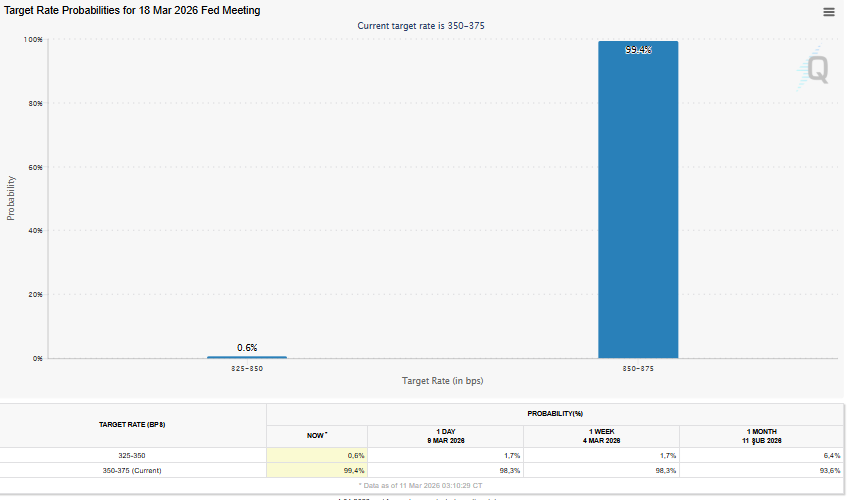
Global financial markets are heading into a crucial week as seven major central banks prepare to announce their latest interest rate decisions. Among them is the United States Federal Reserve (Fed), whose policy signals often influence liquidity conditions worldwide.
At the same time, rising oil prices driven by geopolitical tensions are raising new concerns about inflation. These developments are not only important for traditional markets but could also have a significant impact on Bitcoin and other risk assets.
A Busy Interest Rate Calendar Awaits Markets
The upcoming economic calendar is filled with key policy announcements that may shape the near-term outlook for global markets. The schedule is expected to unfold as follows:
-
March 17: Reserve Bank of Australia (RBA)
-
March 18: Bank of Canada (BOC) and the Federal Reserve (Fed)
-
March 19: Bank of Japan (BOJ), Swiss National Bank (SNB), and the European Central Bank (ECB)
With several major monetary authorities delivering decisions within just a few days, investors are preparing for potential volatility across global financial markets.
Rising Oil Prices Are Reviving Inflation Concerns
One of the main factors forcing investors to rethink their interest rate expectations is the recent surge in energy prices.
The conflict that began on February 28, following coordinated strikes by the United States and Israel on Iran, has expanded through retaliatory actions across the region. These developments have disrupted energy shipments in parts of the Middle East, pushing oil prices higher.
The increase in energy costs has raised fears that global inflation could accelerate again, complicating the policy outlook for central banks.
If energy prices remain elevated, policymakers may need to delay planned rate cuts or maintain a more cautious stance toward monetary easing.
Rate Cut Expectations Are Being Reconsidered
Until recently, many market participants expected central banks—led by the Federal Reserve—to begin gradually lowering interest rates throughout 2026.
This expectation was partly supported by the rapid rise of artificial intelligence technologies, which some analysts believe could increase productivity and exert disinflationary pressure on the economy. A lower-rate environment typically provides strong support for risk assets such as Bitcoin.
However, the recent spike in oil prices and escalating geopolitical tensions have introduced new uncertainty into that outlook. If rising energy costs push inflation higher, central banks could adopt a more hawkish policy stance.
Hawkish Signals Could Pressure Bitcoin
Any indication that policymakers may keep interest rates higher for longer could create turbulence in financial markets. Higher borrowing costs often reduce investor appetite for risk assets, which may lead to downward pressure on Bitcoin and other cryptocurrencies.
On the other hand, if central banks maintain a wait-and-see approach or signal that inflation risks remain manageable, risk assets could regain upward momentum.
How the Fed Typically Reacts to Oil Shocks
Economist and Fed watcher Ethan Harris notes that central banks tend to react cautiously when oil prices spike.
According to Harris, this hesitation stems from two key factors. First, oil shocks tend to slow economic growth while simultaneously increasing inflation, making it difficult for policymakers to determine which risk is more pressing.
Second, many oil price shocks prove to be temporary. As a result, central banks often avoid adjusting interest rates immediately to prevent the need for rapid policy reversals shortly afterward.
Fed and BOJ Decisions May Be Most Influential for Bitcoin
Historically, the Federal Reserve has had the strongest influence on Bitcoin’s price dynamics due to its impact on global liquidity conditions.
The Bank of Japan can also play an important role at times, particularly because of Japan’s position in global capital flows.
With rising energy costs already placing pressure on Japan’s economy, the upcoming BOJ policy decision could attract significant attention from both domestic investors and global markets, including the cryptocurrency sector.
Markets are Preparing For Interest Rate Decisions
The upcoming round of central bank announcements is expected to provide important insights into the direction of global monetary policy. The way policymakers respond to rising energy prices and inflation risks may shape financial market trends in the weeks ahead.
For this reason, investors are closely monitoring next week’s decisions, as signals from central banks could influence not only traditional assets but also the future trajectory of Bitcoin and the broader crypto market.
Also, you can freely share your thoughts and comments about the topic in the comment section. Additionally, please follow us on our Telegram, YouTube and Twitter channels for the latest news and updates.