

 Yeliz Akmaca
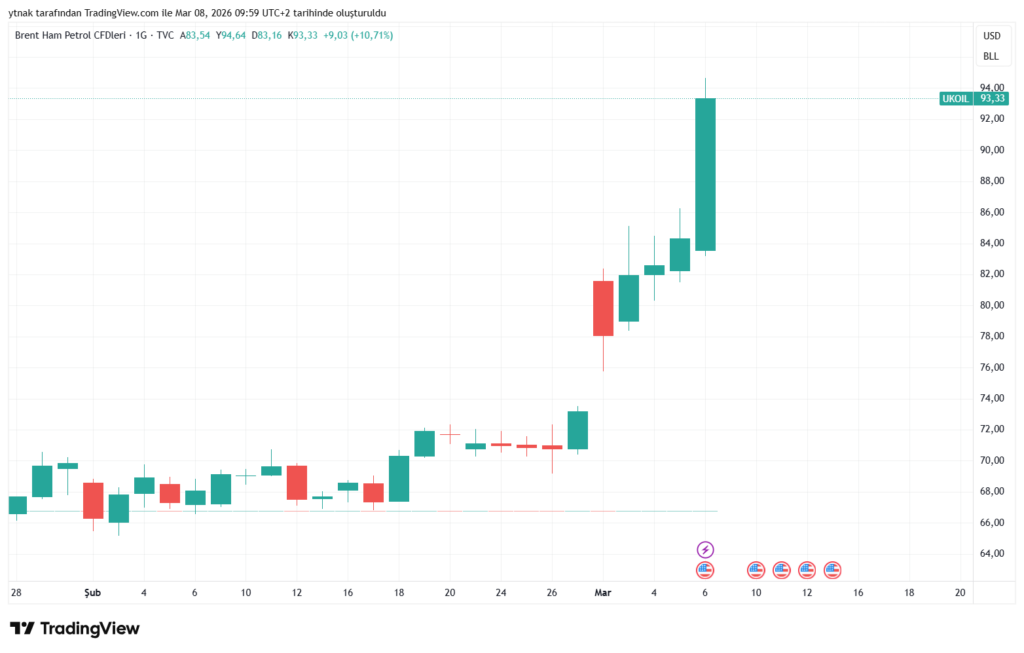
Tensions escalating rapidly in the Middle East have triggered a chain reaction in energy markets. Iran’s effective halt of tanker traffic in the Strait of Hormuz has heightened concerns over global oil supply. The first impact was seen in prices; Brent crude rose from around $70 pre-conflict to $93 per barrel, marking one of the sharpest weekly moves in recent years.
This development in the strategically critical Strait of Hormuz highlights that one of the world’s most sensitive energy arteries is at risk.
The Heart of Global Oil Supply: Strait of Hormuz
The Strait of Hormuz is not just a regional passage—it is a critical chokepoint for global oil trade.
Approximately 20 million barrels of oil per day pass through this narrow waterway, representing about 20% of global oil consumption. Major producers such as Saudi Arabia, Iraq, Kuwait, the UAE, and Qatar rely heavily on this route for exports.
Any tension in the strait, therefore, triggers rapid and aggressive movements in oil prices. Recent developments have confirmed this dynamic.
Oil Price War Rally
With the crisis, the risk premium in energy markets surged rapidly.
Brent crude rose by over $20 in just a few days, reaching $93 per barrel. U.S. West Texas Intermediate (WTI) crude also approached the $90 mark, experiencing one of the fastest recent price jumps.
Analysts point to three main reasons for this surge.
First, the possibility of disrupted tanker traffic created significant supply-side uncertainty.
Second, insurance and shipping costs rose sharply, pushing the actual trade price of oil higher.
Third, a geopolitical risk premium formed in the market, with energy traders pricing in a potential prolonged crisis scenario.
Could Oil Hit $100?
Market discussions are increasingly pointing toward a new price horizon.
If risks in the Strait of Hormuz persist, analysts believe oil prices could exceed $100 per barrel. The fact that a significant portion of global energy supply relies on this single chokepoint, with limited alternative routes, strengthens this scenario.
Asian countries—China, India, Japan, and South Korea—are highly dependent on Gulf oil, meaning developments in the region could impact global energy markets as a whole.
A New Era of Energy Risk
Energy markets are now pricing not only supply but also geopolitical risks. If tensions in the Strait of Hormuz are not resolved quickly, market volatility could rise further, and prices could test new highs.
The rise of oil to $93 a barrel is already being felt beyond markets. Fuel prices have surged over 10% this week, creating added pressure at gas stations for consumers already struggling with inflation.
Former U.S. President Donald Trump, in a Thursday interview, downplayed the issue. “If they go up, they go up,” he said, signaling that gasoline prices are not a priority on his agenda.
As a result, energy traders and global investors are monitoring developments in the Middle East more closely than ever.
You can also freely share your thoughts and comments about the topic in the comment section. Additionally, don’t forget to follow us on our Telegram, YouTube, and Twitter channels for the latest news and updates.