

 Haciyev Reşit
The DeFi protocol World Liberty Financial, backed by former U.S. President Donald Trump, has established a new trust company as part of its effort to obtain a U.S. banking license. This move not only aims to operate the protocol’s USD1 stablecoin within a regulated framework, but also to expand its use across institutional financial services. Once the license is secured, World Liberty will be able to use its stablecoin securely for cross-border payments as well as institutional-level settlement and treasury operations. This step brings the protocol’s financial activities into an official regulatory structure while strengthening trust in USD1 among investors and institutions.
A National Trust Bank Is Being Established
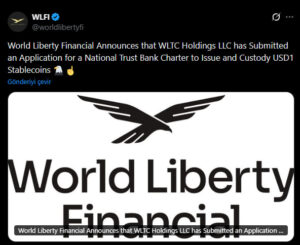
WLTC Holdings LLC has applied to the Office of the Comptroller of the Currency (OCC) to establish a national trust bank called World Liberty Trust Company, National Association (WLTC). The bank aims to handle the issuance, custody, and redemption of the USD1 stablecoin under a single, highly regulated entity.
World Liberty co-founder and proposed bank president Zach Witkoff stated:
“USD1 has grown faster in its first year than any other stablecoin in history. Institutions are already using USD1 for cross-border payments, settlements, and treasury operations. With a national trust charter, we will be able to bring all of these activities under a single, highly regulated structure.”
About the Stablecoin and the Protocol
World Liberty launched in October 2024, with President Donald Trump and his three sons—Donald Jr., Eric, and Barron—listed as co-founders. The protocol introduced the USD1 stablecoin in March 2025. USD1 is backed by U.S. dollars held in regulated depository institutions and short-term U.S. Treasury securities, a structure designed to ensure reliability and stability. According to statements, USD1 surpassed $3.3 billion in circulation within its first year, gaining rapid adoption in institutional transactions and cross-border payments.
Last year, Trump signed the Guiding and Establishing National Innovation for U.S. Stablecoins Act (GENIUS Act), marking the first major crypto regulatory framework added to U.S. law. The act enables stablecoins like USD1 to operate within an official and regulated environment, contributing to increased institutional confidence across the ecosystem.
Competition in the Regulatory Landscape
In December, the OCC granted conditional approvals to companies such as Circle, Ripple, BitGo, Fidelity Digital Assets, and Paxos. In addition, Coinbase and Crypto.com are among other firms that have applied for banking licenses. World Liberty’s move signals that regulated, institution-focused stablecoin services could gain further momentum in the U.S. With a license, USD1 could be used more securely and officially in both institutional and cross-border transactions—an important step toward the maturation of the stablecoin ecosystem.
You can also freely share your thoughts and comments about the topic in the comment section. Additionally, don’t forget to follow us on our Telegram, YouTube, and Twitter channels for the latest news and updates.