

 Haciyev Reşit
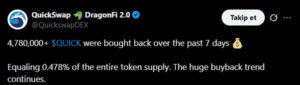
One of the most prominent decentralized exchanges (DEXs) in the Polygon ecosystem, QuickSwap, made a major economic move last week. The protocol announced that it had repurchased and burned 4.78 million QUICK tokens, equivalent to 0.478% of the total supply. This initiative is part of QuickSwap’s deflationary token model, aimed at reducing supply and protecting long-term investor value.
QuickSwap’s Strategy: Reducing Supply and Preserving Value
Through this buyback, QuickSwap once again demonstrated that its platform revenues can directly support the economic sustainability of its ecosystem. According to the team, the primary goal of the buyback is to reduce QUICK’s supply, increasing its scarcity and helping maintain long-term price stability.
Experts note that deflationary actions like these tend to create value for token holders both in the short and long term. Alongside buybacks, QuickSwap continues to grow its ecosystem through revenue sharing, staking incentives, and liquidity mining programs. Additionally, a portion of the platform’s revenue is allocated based on community governance votes, reinforcing the project’s decentralized decision-making framework.
The Deflationary Model in the Polygon Ecosystem
As one of the oldest and most active DEXs on Polygon (MATIC), QuickSwap has long followed a deflationary tokenomics model. Under this system, part of the platform’s revenue is used to either burn or repurchase QUICK tokens, gradually decreasing the total supply.
With Polygon’s growing user base and increasing transaction volume, this move by QuickSwap carries strategic importance for long-term market equilibrium. Analysts argue that supply-reduction mechanisms not only have a positive effect on price dynamics but also strengthen financial sustainability and investor confidence across the ecosystem.

Why It Matters for the Ecosystem and Investors
QuickSwap has evolved beyond being just a DEX it is now a self-sustaining financial protocol capable of managing its own token economy. The buyback program reinforces confidence in the project and encourages investors to take a long-term view.
Community members on social media described the move as a “confidence boost for the protocol,” noting that regular buybacks could enhance ecosystem stability. Furthermore, the QuickSwap team reportedly plans to expand staking pools and liquidity incentives in the near future, a step that would increase both platform revenue and user engagement.
Conclusion
By repurchasing 4.78 million QUICK tokens nearly half a percent of the total supply QuickSwap has reaffirmed its commitment to sustainable growth and community-driven economics. This buyback strengthens the protocol’s supply-demand dynamics and signals renewed confidence from both the team and investors.
Experts believe that if QuickSwap continues its regular buyback policy, QUICK could become a symbol of stability within the Polygon ecosystem. This move also sets an important precedent for the broader DeFi sector, highlighting the potential success of deflationary token models in maintaining long-term value.
You can also freely share your thoughts and comments about the topic in the comment section. Additionally, don’t forget to follow us on our Telegram, YouTube, and Twitter channels for the latest news and updates.