

 Ahmet Bedirhan Arvas
Son zamanlarda bir çok yatırımcının dikkatini üstüne çeken Bittensor (TAO) yapay zeka modellerinin birbirlerini sıralayarak ve değerlendirme yapan bir protokoldür. Aynı zamanda açık merkezsiz bir piyasa içinde bilgilerin hesaplanması ve üretilmesini de gerçekleştiriyor.
Ayrıca yatırımcılar bunun karşılığında TAO token ile ödüllendirilerek sürdürülebilirlik kazandırılıyor.

What is Bittensor?
Bittensor is a protocol designed as decentralized ML, also known as distributed artificial intelligence. Since it is open source and built on a blockchain, its use cases have significantly expanded.
We can explain the benefits of Bittensor’s open-source nature as follows:
By connecting different data, models, and compute resources around the world, it turns information production (model outputs) into a meta-market where participants query each other’s outputs, rank each other according to model performance, and distribute TAO tokens to those who produce value.
The protocol aims to create an ecosystem that economically links both the producers who contribute to models and the consumers who use the produced information. This objective is actually quite important.
You may also like: Two Critical Resistances for a Peak in Bitcoin: Watch These Levels!
How Does Bittensor Work?
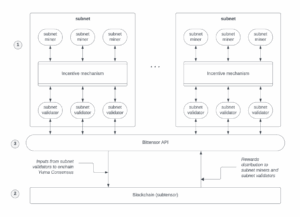
We can examine Bittensor’s operational stages under four different headings.
1) Peer-to-peer models and data flow
What we know as nodes are referred to here as peers. Each peer in the network holds its own model and dataset and performs operations accordingly.
2) Ranking and the Weight Matrix
Each peer measures the value of signals produced by other peers and maps this into a weight matrix. This matrix is accepted as a central indicator of who is producing valuable information.
3) Consensus Function and Collusion Resistance
Bittensor does not view this as just a voting process. The project uses a combination of weights and staking to produce a term called consensus (C). With this term, it measures whether a peer has achieved a network majority trust indicator and determines reward distribution accordingly.
4) Operation of Network Processes
There is a training loop operating within the network. There is a flow and the model of this flow is as follows:
dataset definition → batch broadcast → collection of peer outputs → local model update via backprop → weight update → on-chain update of weight/ bond / stake
The chain records these measurements and the token minting and distribution, thereby providing trust.
What is Bittensor’s Goal?
The aim is to democratize AI production and reduce dependence on larger centralized players. Enabling small teams or individuals to commercially monetize their models is also among the primary goals. In fact, creating a continuous open market makes a lot of sense for Bittensor. This way, a structure can be established that produces measurable outputs that can be priced as “intelligence as a commodity.”
Who Founded Bittensor?
Although there is no single definitive source, the co-founder who has been involved in the project for a long time and has a strong voice in many places appears to be Jacob Robert Steeves and Ala Shaabana.
Who Are Bittensor’s Investors?
The Bittensor ecosystem has clearly attracted the attention of many institutional and VC investors after the token was launched and the project grew. Major crypto investors such as Digital Currency Group, Polychain, and Pantera are also positioned here.
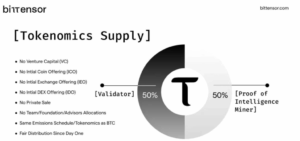
$TAO Tokenomics
The maximum supply of TAO token is limited to 21 million, similar to Bitcoin. Currently, a total of 10.39 million units are in circulation.
Official Sources
For the latest cryptocurrency news click here